SOLAR INVERTER BUYER GUIDE
Anti-Islanding in Solar Inverters: Why Grid Failure Can Stop Solar Power
Share on social media
Why a sunny rooftop can stop supplying a home during an outage, how safe backup differs from accidental islanding, and what Pakistani buyers should verify before accepting an installation.
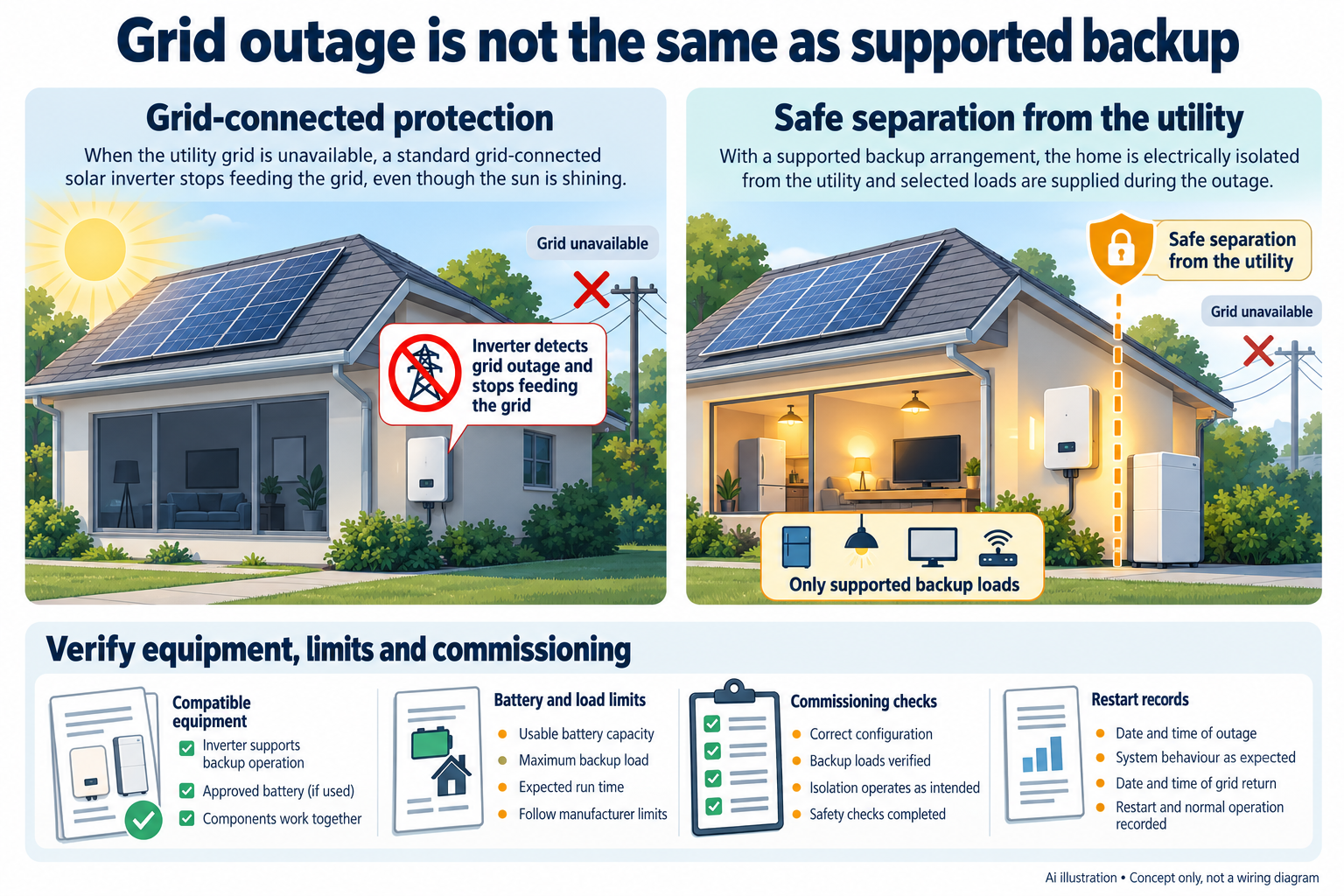
Original companion diagram
Sunlight is not a promise of backup power
A Pakistani household can have sunshine on its roof and still lose solar-powered appliances when the electricity supply fails. That does not automatically mean the panels or inverter are defective. A grid-connected inverter must distinguish normal operation from an unwanted electrical island: a section of network that remains energised after losing its normal grid supply. Anti-islanding protection is designed to detect that condition and disconnect the inverter from the utility network. [1]
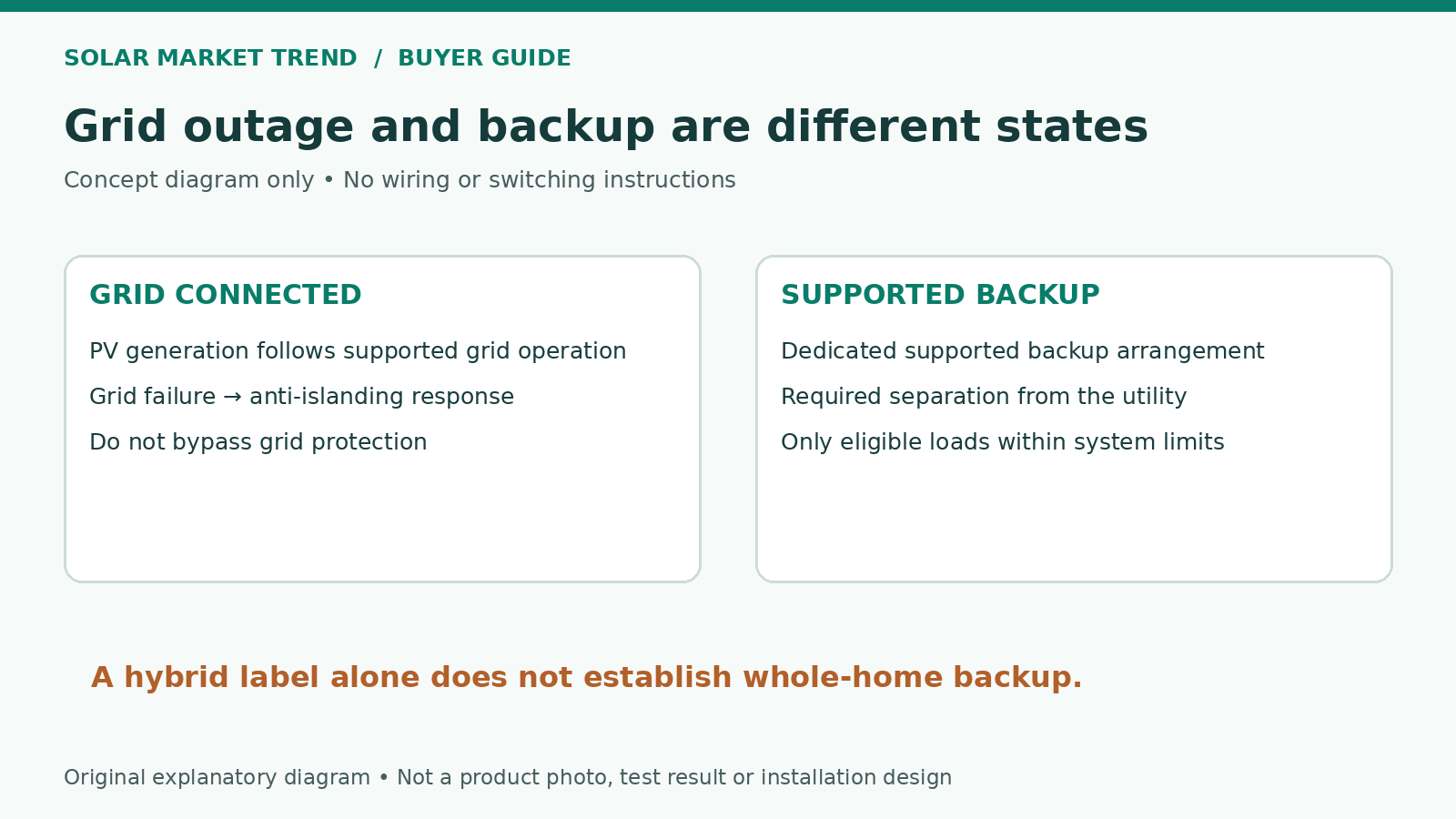
The useful question is therefore not simply, ‘Will this inverter work during load shedding?’ Ask which output supplies which appliances, and what equipment separates those appliances from the public grid. Backup capability belongs to the complete installation, not just the word ‘hybrid’ on a sales quotation. [3]
Why disconnection matters
Victron explains that loss-of-mains detection opens an inverter/charger’s back-feed relay so its AC input does not remain live from the inverter. This protects the separation between the local source and the disconnected supply wiring. It is not an optional energy-saving feature. Do not ask an installer to defeat grid protection merely to keep generation running. [2]
SMA describes a particularly important case: an unwanted island can form when generation and the disconnected network’s load are approximately matched. A neat-looking balance between solar production and household consumption is therefore not evidence that continued grid-connected operation is safe. Its documentation describes active checks of grid stability, rather than treating matching power figures as permission to continue. [1]
Safe backup creates a different electrical arrangement
A supported backup system can disconnect from the utility and supply a deliberately separated local circuit. Fronius distinguishes basic PV Point backup from Full Backup, which uses compatible equipment and a backup switching device. The purpose is not to eliminate anti-islanding but to supply loads on the safe side of the separation. [3]
Draw the boundary before buying. If the refrigerator, fans and router are on the backed-up circuit but the water pump is not, a successful outage transfer should not make the pump run. Conversely, calling an arrangement ‘whole-house backup’ does not remove its power limits. Ask for the circuit schedule and a single-line diagram showing the isolation arrangement, not just a photograph of the inverter. [3]
Battery-free backup exists, but it is not universal
The Fronius Primo GEN24 manual describes a dedicated PV Point output that can supply single-phase loads from available solar power or an optional battery. That is a specific supported function, not proof that every grid-tied inverter can operate without the grid. The same manual warns of transfer interruptions and inadequate available power; this output should not be treated as an uninterrupted supply for critical equipment. [4]
Adding a battery also does not automatically complete a backup installation. Fronius lists compatible storage, suitable cabling, metering and configuration among Full Backup prerequisites. Victron separately instructs designers to size backup inverter/chargers for expected loads and battery capacity for the required outage autonomy. Power capability and duration are separate questions. [4][5]
Compare documented outcomes, not brand labels
SMA, Fronius and Victron documentation illustrates different parts of the same decision: grid protection, backup architecture and storage sizing. These examples are not a Pakistan availability ranking or a claim that every model from those manufacturers has identical features. Obtain the exact model manual, firmware applicability and proposed wiring arrangement for whichever brand is quoted.
Ask the installer to record four acceptance outcomes: the named essential circuits remain usable during a supervised outage test; the intended starting loads are supported; the promised battery reserve and usable duration are explained; and reconnection follows the approved settings. These are practical procurement checks, not instructions to operate switchgear yourself.
A restart delay is not automatically a fault
Grid return and inverter return need not be simultaneous. For one Sunny Tripower model, SMA documents automatic or manual restart choices after several grid faults, including islanding detection. That model-specific example is a reason to inspect the event log and commissioning record before assuming a failed inverter, not a universal restart time for all products. [6]
If shutdowns repeat while the supply appears healthy, save the timestamps and displayed fault codes for a qualified technician. Do not change country profiles or protection settings to suppress the symptom. For a Pakistan installation, request confirmation of the applicable utility requirements separately; the international manuals cited here explain equipment behaviour, not local connection approval. The goal is useful backup with protection intact. [2]
Sources and references
- [1] SMA GRID GUARD 10.0: Technical Information, section 5.3 Islanding Detection
- [2] Victron Energy: VEConfigure grid codes and loss-of-mains detection
- [3] Fronius: Backup power function and backup variants
- [4] Fronius Primo GEN24 3–6 kW family: Operating instructions
- [5] Victron ESS design and installation manual: ESS system design
- [6] SMA Sunny Tripower 50-JP-40: Activating Manual Restart