BATTERY ENERGY STORAGE GUIDE
BESS in Pakistan Real Projects Uses and Buying Questions
Share on social media
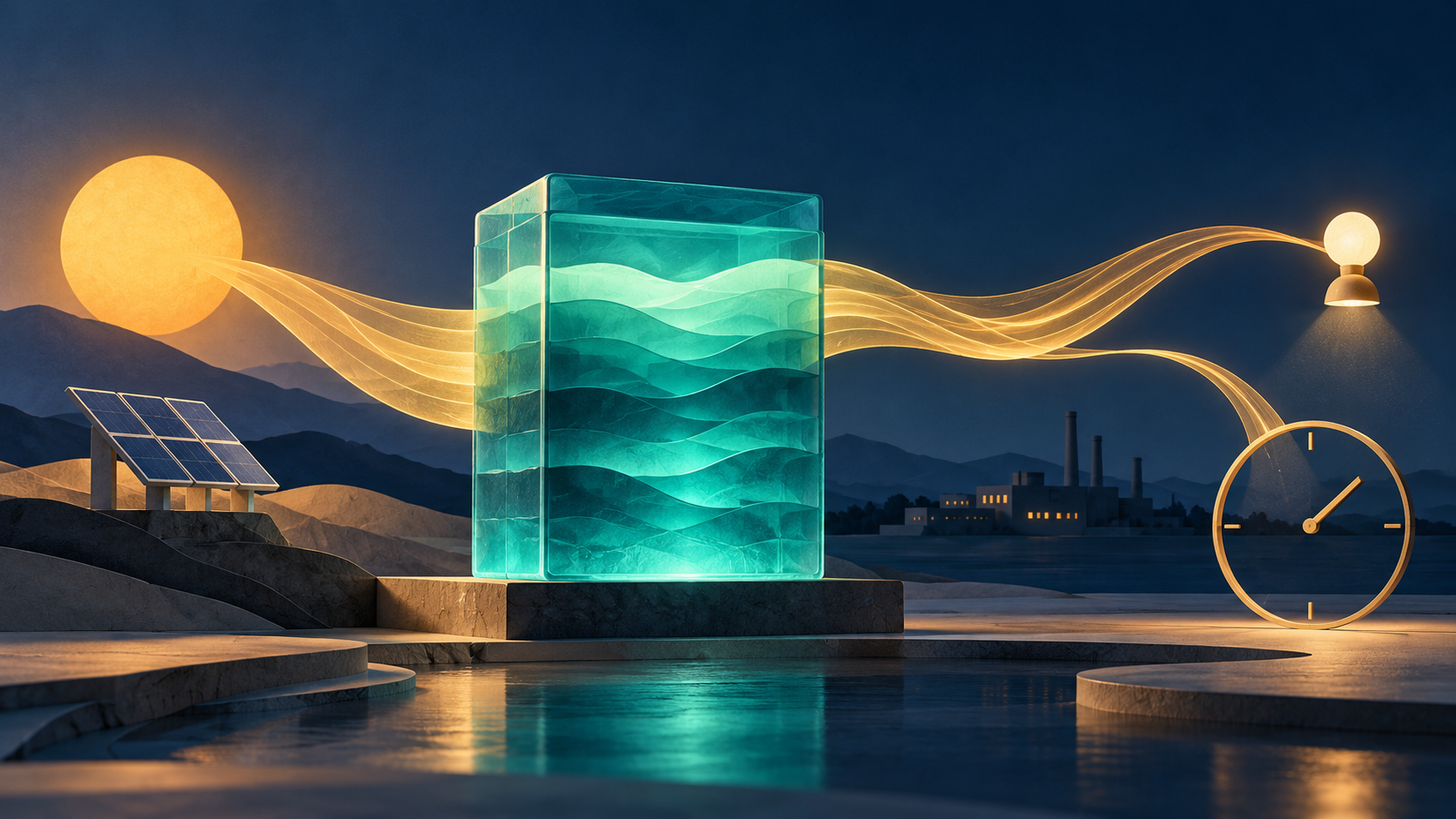
Pakistan has documented industrial battery projects and a much larger transmission-storage proposal. Understanding their status, power ratings and purpose is more useful than an unsupported market-size headline.
Battery energy storage systems are already part of Pakistan’s industrial energy story. Public announcements cover cement and textile facilities, while a substantially larger transmission-level proposal is under development. These are different applications at different stages, so a useful market assessment must separate delivered equipment, signed projects and preliminary plans. [1][2][3][4]
This guide uses public evidence checked on 17 October 2026. It does not estimate Pakistan’s total installed storage capacity or turn individual announcements into a national market forecast.
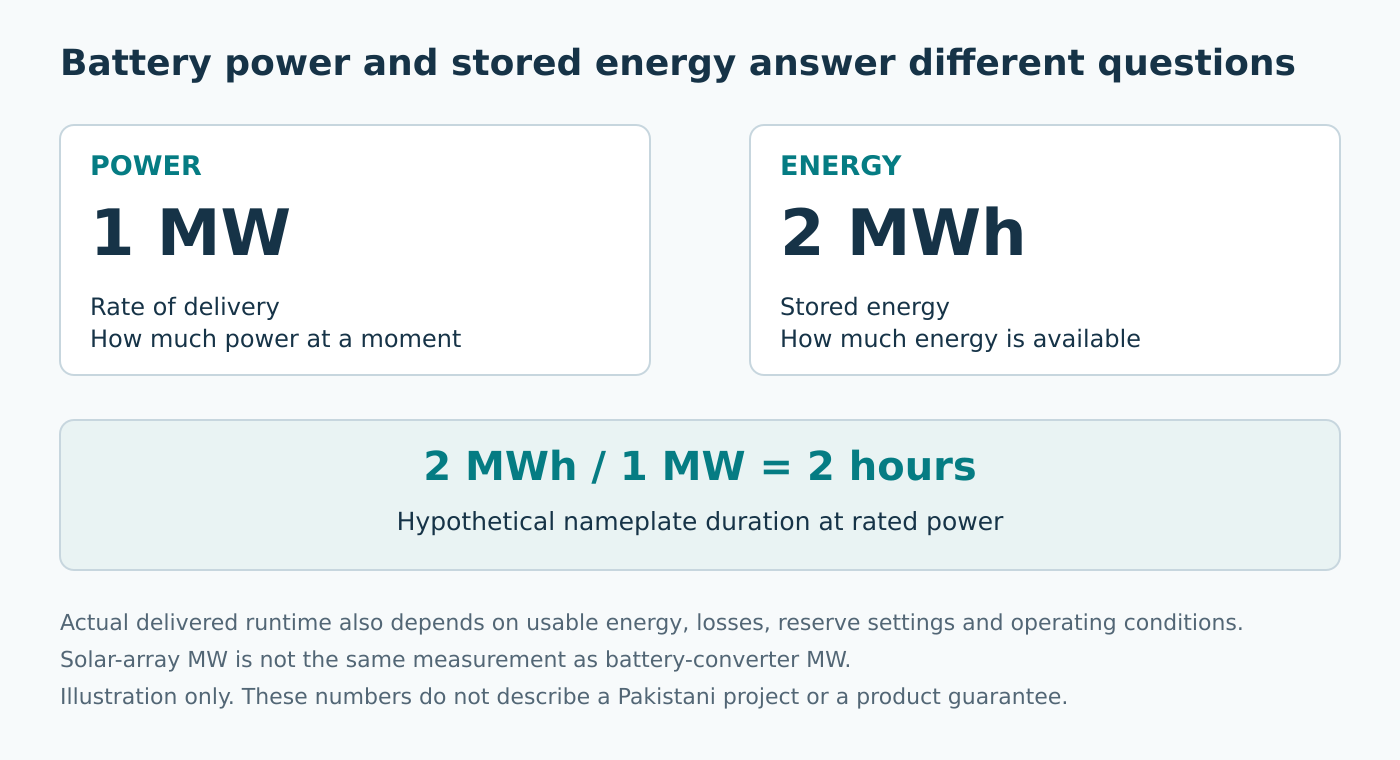
Start with two numbers MW and MWh
MW describes the rate at which a battery system can deliver power. MWh describes how much energy it can store. At household scale, the equivalent units are kW and kWh. The distinction changes what a project can do. [5]
A hypothetical 1 MW / 2 MWh system has a two-hour nameplate duration at rated power: energy divided by power. That is a sizing illustration, not a guaranteed runtime. Available energy, conversion losses, reserve settings and operating conditions affect actual delivery. A large energy figure alone cannot establish whether a system will support a factory’s sudden power requirement. [5][6]
Solar-array MW must also stay separate from battery MW. A project containing 8 MW of solar and 8 MWh of batteries does not automatically contain an 8 MW battery converter.
Documented industrial projects in Pakistan
Reon’s announcement dated 21 September 2023 reported deployment of a 5.58 MWh battery system for Lucky Cement alongside a captive solar project. This provides a historical example of industrial storage deployment, rather than merely an order book. The announcement does not establish today’s operating performance, and its promotional “largest” description should not be treated as a current ranking. [1]
For Lucky Cement’s subsequent Nooriabad project, Reon’s release dated 1 January 2025 describes approximately 22.7 MWh of storage intended to manage variable wind and solar generation and improve captive-power operation. Its headline and body are inconsistent about the associated MW description and mix signed, deployed and future-tense wording. We therefore use it as project evidence, not proof of an exact commissioning date or an independently reconciled battery-power rating. [2]
Reon’s Soorty Textile release dated 1 June 2025 identifies 7.88 MW of solar PV and 7.63 MWh of storage across Karachi facilities. It likewise combines agreement language with references to deployment and earlier projects. The defensible takeaway is documented investment in industrial renewable-energy integration; the figures should not be added to older Soorty announcements without checking whether they overlap. [3]
These cases matter because the battery’s job extends beyond saving midday electricity for night. Reon describes applications including renewable smoothing, spinning-reserve support and improved generator operation. A factory may value short, fast interventions that avoid inefficient generator loading, even when its storage cannot power the entire site for many hours. [7]
A larger grid proposal with a clear status boundary
ADB’s data sheet for Pakistan project 60126-001, last updated 3 June 2026, labels it “Proposed.” Preliminary feasibility findings envisage two installations, each approximately 500 MW / 1,000 MWh, for a combined 1,000 MW / 2,000 MWh. Their intended role is transmission-system flexibility and renewable integration. [4]
The sheet schedules fact-finding for 19-29 October 2026 and does not list an approval date. That timetable is a planning milestone, not a commitment that construction or commercial operation will begin then. The proposed capacity must remain outside any tally of operating Pakistani batteries. Locations, sizing and delivery arrangements can change during project preparation. [4]
Home factory and grid storage need different briefs
A household brief should describe the loads to be supported, their timing and the usable energy required. A commercial or industrial brief must also address production-critical equipment, power-quality requirements and interactions with existing generators. Reon’s industrial offering illustrates how generator support and renewable integration can drive the design. [7]
A grid project adds dispatch, network studies, protection coordination and institutional operating requirements. ADB’s proposal explicitly includes operational integration and capacity development, illustrating why utility storage cannot be assessed as a collection of residential batteries. [4]
For buyers, the practical question is: which measurable problem will this particular system solve? Ask the supplier to show the load or generation data behind the proposed power and energy ratings, rather than selecting a battery solely from the size of the solar array.
Procurement should test performance and safety
Request a proposal that distinguishes nameplate energy from usable delivered energy, beginning-of-life performance from expected later-life performance, and battery-cell efficiency from whole-system round-trip efficiency. Cycling, discharge depth and environmental conditions influence life and performance. Require the financial case to include charging energy, losses, cooling, maintenance and replacement assumptions instead of a universal payback promise. [6]
Safety evidence also needs a precise scope. UL describes UL 9540A as a test method for thermal-runaway fire propagation. A reference to that test is not a blanket assurance that every cabinet arrangement or installation location is safe. Ask which product configuration was tested, what the report covers and how the proposed site design addresses the identified hazards. [8]
Have qualified professionals assess siting, emergency access, detection, ventilation where required, protection and response procedures. Obtain written responsibilities for commissioning, alarm handling and servicing. Do not substitute a sales brochure for project-specific engineering.
Pakistan’s documented projects make BESS worth serious evaluation. The strongest purchase decision starts with a defined operating need, traceable project evidence and a complete performance specification, rather than a headline capacity or a promise of effortless savings.
Sources and references
- [1] Reon Energy news archive: Lucky Cement deployment announcement, 21 September 2023
Developer-reported historical deployment of 5.58 MWh; no independent current operating-performance or largest-ranking claim.
Source date: 2023-09-21. Verified: 2026-10-17.
- [2] Reon Energy Signs 20.70 MW / 22.76 MWh REFLEX Project with Lucky Cement Limited
Announcement body says 22.7 MWh and discusses renewable variability; internally inconsistent MW labelling and project-status language are explicitly disclosed.
Source date: 2025-01-01. Verified: 2026-10-17.
- [3] Reon Energy Signs 7.88 MW Solar PV and 7.63 MWh REFLEX Project with Soorty Textile
Solar MW and battery MWh are distinct; release contains mixed signing/deployment language and potentially overlapping earlier project figures.
Source date: 2025-06-01. Verified: 2026-10-17.
- [4] ADB: Grid-Integrated Battery Energy Storage System for Stability and Resilience Project, 60126-001
Proposed project; preliminary capacity, integration plans and scheduled fact-finding. No approval or operating-capacity claim.
Source date: 2026-06-03. Verified: 2026-10-17.
- [5] EIA: Duration of utility-scale batteries depends on how they are used
Stable definitions of power, energy and duration only; US market figures are not used for Pakistan.
Source date: 2022-03-25. Verified: 2026-10-17.
- [6] ADB: Handbook on Battery Energy Storage System
Sizing, efficiency, lifetime, cycling and project cost-benefit principles only; dated prices, forecasts and chemistry generalizations are not imported into 2026.
Source date: 2018-12. Verified: 2026-10-17.
- [7] Reon Energy: Reflex Energy Storage
Primary supplier description of industrial renewable smoothing, spinning reserve, generator operation and telecom applications; not independently audited savings.
Source date: Undated public document. Verified: 2026-10-17.
- [8] UL Solutions: UL 9540A Test Method for Battery Energy Storage Systems
Current official explanation of thermal-runaway propagation testing; not a claim that US/Canadian codes are automatically legally mandatory in Pakistan.
Source date: Undated public document. Verified: 2026-10-17.