BIFACIAL SOLAR PANEL GUIDE
Bifacial Solar Panels in Pakistan What Your Roof Must Contribute
Share on social media
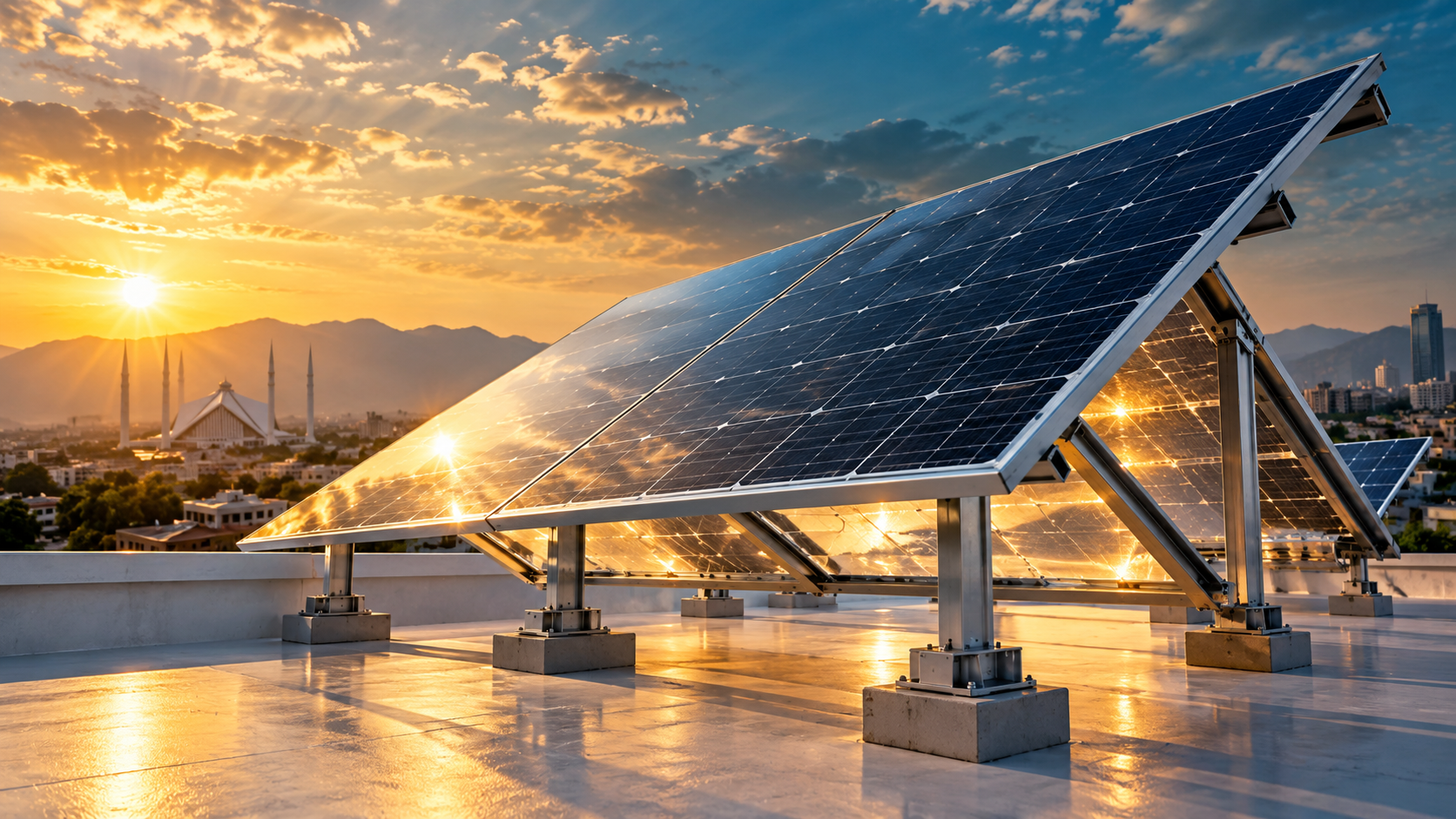
Bifacial solar panels can collect light from their rear as well as their front. That does not mean every Pakistani rooftop receives a fixed extra percentage of electricity. Before paying more for a bifacial option, ask whether the proposed roof layout gives its rear surface useful light and whether the energy estimate actually models that layout.
This guide is about evaluating a quotation, not changing a mounting structure yourself. It uses research and manufacturer documents checked on 16 October 2026. None establishes a universal Pakistan rooftop gain or a national winning brand.
Bifaciality is not the same as extra energy
Bifaciality describes the rear side's response relative to the front under specified, comparable test conditions. Bifacial energy gain describes additional energy relative to a stated reference configuration under the assessed conditions. Ask what that reference is, rather than assuming every estimate compares identical systems. The two figures answer different questions. A high bifaciality percentage printed on a datasheet is not a percentage bonus to annual generation. [1]
Trinasolar's article dated 8 October 2026 makes this distinction while promoting its own technology. Its comparisons remain manufacturer claims, not an independent ranking for Pakistan. The useful buying lesson is to request both the exact module datasheet and the assumptions behind the proposed system's energy estimate. [1]
Ask the seller to identify whether a quoted wattage is the front-side nameplate rating or an illustrative output with additional rear illumination. Do not let differently defined wattages enter the same price-per-watt comparison. Trina's bifacial white paper presents front and rear contributions separately, which is why the test condition belongs beside the number. [2]
The roof is part of the optical design
Rear-side light depends on more than panel technology. Surface reflectivity, also called albedo, matters, but so do panel height, tilt, row spacing and shadows. A bright-looking roof is not a measured albedo value, and a photograph cannot establish how much light reaches the rear throughout the year. [2,3]
The National Laboratory of the Rockies' bifacial_radiance toolkit explicitly models reflective surfaces, obstructions and array geometry. It can account for rear-side shading, mismatch and edge effects. That is a useful indication of what a serious assessment needs to consider; it is not evidence that a particular salesperson has run such a model. [3]
For a household quotation, request a roof sketch showing parapets, water tanks, nearby buildings and the proposed rows. Ask which of those objects the estimate includes. If the seller uses a standard brochure diagram instead of your site, treat the extra-energy figure as unverified until the assumptions are supplied.
More height is not automatically a better purchase
An elevated arrangement may expose more of the rear to reflected light, while rails, structural members or nearby rows can obstruct it. Trina's white paper examines these layout effects. The outcome depends on the complete arrangement, not one isolated dimension. [2]
Do not raise an array or widen rows solely because an online example reports a gain. A proposed change also needs a competent structural and installation assessment. Ask the supplier to separate the original mounting design from any more expensive alternative and explain what additional energy is expected, on what evidence, and at what added cost.
On a space-constrained roof, comparing only the best-performing individual panel can miss the purchasing question. Request the estimated annual energy of each complete layout, the installed panel count and the area kept available for access. Keep the assumptions consistent so a change in layout is not mistakenly credited entirely to a change in module technology.
Electrical design must include the rear contribution
A bifacial installation is not just an ordinary array with a free energy bonus. Trina's March 2026 Vertex manual tells designers to consider roof or ground albedo, row spacing and installation height when determining electrical ratings. Ask the qualified designer to document the relevant current and voltage checks for the proposed components. This is not a universal sizing recipe. [4]
The owner does not need to calculate protection settings or reconfigure strings. The useful request is a written design confirmation tied to the exact module, inverter and layout. A quotation should not promise rear-side gains while ignoring their consequences for the rest of the system.
Ask for a fair comparison
Use the same questions for competing offers, whether the modules come from Trina, LONGi, Jinko, JA Solar, Canadian Solar or another supplier. The names are examples, not a stock list, endorsement or ranking.
- What exact model and front-side rating are included?
- What roof reflectivity and geometry are assumed, and which are measured?
- Is the reported gain additional DC energy or delivered AC energy?
- What shading, electrical losses and uncertainty are included?
- Does the alternative use the same weather data and comparable roof constraints?
- What extra mounting or roof work is included in the complete price?
These are editorial comparison questions rather than a claim that any particular brand will perform better. If one quotation lacks the requested evidence, the honest conclusion is that it is not yet comparable, not that the technology cannot work.
Measure the claim before calling it a result
NLR's public rooftop test-bed dataset uses separate front- and rear-facing irradiance sensors. Its scaled-down reflective-roof arrangement is research context, not a measured household energy gain in Pakistan. It illustrates why rear illumination needs its own evidence. [5]
After installation, total generation alone cannot isolate a bifacial benefit. Ask a commercial-system operator what reference, instrumentation and method support any claimed rear contribution. For a household buyer without that measurement setup, retain the approved model assumptions and describe subsequent generation as the system's output, not a proven bifacial uplift.
Bifacial panels deserve consideration where the site and design support them. Buy the documented complete-system case, not a fixed bonus percentage attached to the word bifacial.
Sources
- [1] Trinasolar explanation of bifaciality and system conditions
2026-10-08. Manufacturer explanation and promotional comparisons; no independent Pakistan ranking inferred.
- [2] Trina Solar Bifacial White Paper
2022. Dated engineering context; no field-test result extrapolated to Pakistan.
- [3] NLR Photovoltaic Bifacial Irradiance and Performance Modeling Toolkit
Undated live page. Model capabilities are not a project-specific simulation.
- [4] Trina Vertex Series User Manual version O
2026-03. Applicable module models listed in manual; not a universal electrical sizing rule.
- [5] NLR Bifacial PV Test-Bed Irradiance Measurements
Dataset submitted 2019-12-10; catalogue updated 2026-03-12. Scaled-down reflective-roof research; no Pakistan household yield established.