SOLAR BATTERY COLD-CHARGING GUIDE
Charging Solar Batteries in Cold Weather: Read the Cell-Temperature Limit
Share on social media
Winter charging limits are model-specific and may differ from discharge limits. Learn how to read temperature ranges, derating, heating options and BMS reports without bypassing protection.
1. A sunny morning does not establish charging permission
Consider a hypothetical winter morning: the solar inverter shows available generation, but the battery accepts little current or none. Before calling the battery faulty, check its reported temperature, alarms and allowed charging current against the exact manual.
Where cell-temperature data are available, retain the minimum and maximum readings, not only a room thermometer reading. Victron's Lithium NG monitoring documentation, for example, exposes minimum and maximum cell temperatures. Not every app offers these data. [1]
For Pakistan buyers, this is an installation-specific issue. Do not assume every home experiences the same winter conditions, or that an outdoor weather reading proves the temperature inside a particular battery.
2. Why charging deserves its own temperature check
Low-temperature charging is more than a question of temporarily reduced output. Experimental lithium-ion research by Sun and colleagues found that lower temperatures and higher charging rates increased lithium plating under the tested conditions. Plating means lithium depositing in an unwanted metallic form rather than following the intended storage process. [2]
That research explains why temperature and current must be considered together; it does not provide a universal charging threshold for every commercial LFP battery. Cell design, pack controls and the approved operating conditions matter.
The practical distinction is straightforward: permission to discharge in cold conditions does not automatically grant permission to charge at the same temperature. Read both rows. A battery continuing to power a load is not proof that it can safely accept the inverter's normal charging current.
3. Three published examples show why there is no universal rule
Deye's SE-G5.1 page specifies charging from 0°C to 55°C and discharging from -20°C to 55°C. Those lower limits are different. [3]
Victron's Lithium NG 51.2 V instructions permit charging only from +5°C to +50°C. Within its permitted low-temperature charging region, temperatures below 15°C require charge current no higher than 0.3C. Its discharge range extends down to -20°C, with separate current restrictions. [1]
BYD's published Premium LVS operating manual takes another approach: its temperature table permits reduced charging current in the -10°C to below +5°C bands, with model-specific module and tower conditions. This is documented derating, not permission to copy those values into a different battery. [4]
These examples disprove both shortcuts: 'all lithium batteries can charge at 0°C' and 'all lithium batteries have exactly the same below-zero rule'.
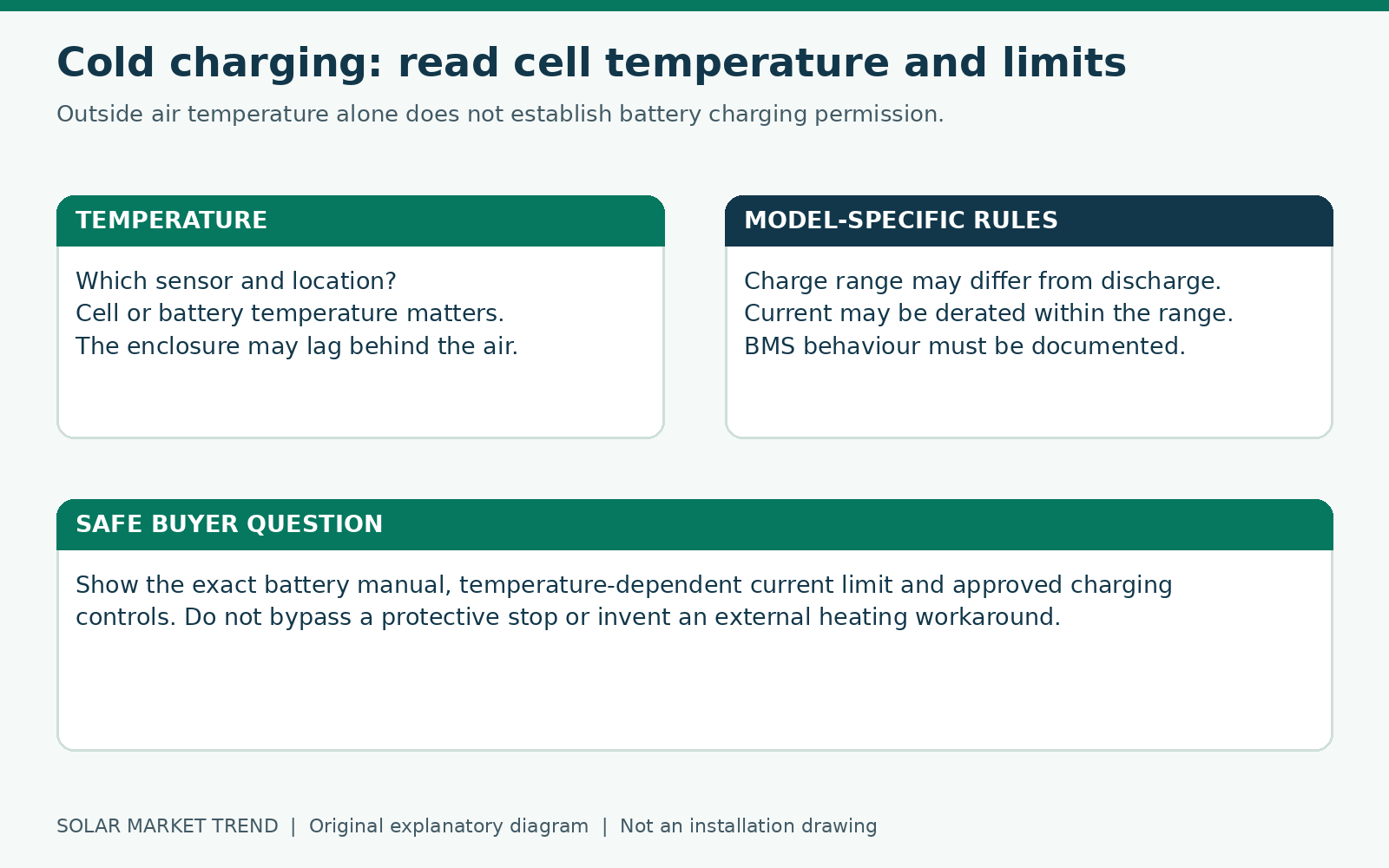
Original companion diagram
4. An operating range is not a complete BMS specification
Keep four items separate when reviewing paperwork: the approved operating range, the current-derating schedule, the protective shutdown threshold and the restart condition. A brochure's minimum charging temperature does not necessarily disclose the exact sensor logic or recovery threshold programmed into its BMS.
Request the applicable manual or manufacturer confirmation rather than guessing those missing details. If a battery remains outside its approved charging range as the air warms, do not force charging.
BYD's LVS manual is useful because it provides a temperature-dependent current table, not only a broad operating range. Even that table must be read for the specified product and configuration. [4]
5. Check whether heating is actually included
Deye's SE-G5.1 Pro-B product page lists an optional-heating charging range extending to -20°C, alongside its ordinary 0°C lower charging limit. The word 'optional' is essential. It does not establish that every unit offered by a Pakistani seller contains that feature. [5]
Ask the supplier to identify the exact heating-equipped variant and provide its operating instructions, activation conditions, required energy source and expected limitations. An advertised ambient operating range for a heated product must not be reinterpreted as permission to push current into unheated cells below their approved limits.
Do not bridge a temperature sensor, disable protection or add an improvised heater to a battery cabinet. Deye's user manual prohibits disassembly or modification and reserves installation for trained personnel. Obtain a manufacturer-approved solution through the installer. [6]
6. Make the Pakistan winter check local
Pakistan Meteorological Department material documents substantial geographic differences in minimum temperatures, with colder northern conditions. This supports local assessment, not a forecast for the coming winter or a claim that every battery in a particular city will reach a specific temperature. [7]
For an exposed or unheated installation, ask the installer to review recorded overnight battery temperatures alongside the site's weather and the installation manual. Check indoor installations too. Choose monitoring times that include the period when charging is expected to restart, not only a mild afternoon.
Avoid solving winter exposure by blocking ventilation or enclosing equipment contrary to its instructions. Any relocation or thermal-management proposal should preserve the manufacturer's environmental, clearance and installation requirements.
7. Ask for a winter handover record
Request a short handover sheet listing the model and firmware, document revision, charging and discharging temperature ranges, any cold-current limits, and the documented protection and recovery behavior. If a threshold is unpublished, label it 'confirmation required'.
Keep a dated screenshot of reported battery temperatures, charging permission or current limit where available, and any alarm code when an issue occurs. This gives the installer something specific to investigate instead of a vague complaint that charging was slow.
The purchasing test is whether the proposed installation can remain within its own approved conditions through the site's winter, with working protection and a clear support procedure. A larger charger is not a substitute for establishing that permission.
Sources and references
- [1] Victron Lithium NG 51.2 V manual: Operation, cell monitoring and temperature-dependent limits
- [2] Sun et al., Pattern Investigation and Quantitative Analysis of Lithium Plating under Subzero Operation of Lithium-Ion Batteries, 2023; original research abstract
- [3] Deye SE-G5.1 product specifications, separate charge and discharge temperature ranges
- [4] BYD Battery-Box Premium LVS Operating Manual V1.2, section 8.3 Maximum Current at Different Temperature
- [5] Deye SE-G5.1 Pro-B product page, optional heating specification
- [6] Deye SE-G5.1 AS/AF/LA user manual V03, 20260318: safety and trained installation requirements
- [7] Ahmad et al., Practices for Management of Climate Change Adaptation Plans in Decision Support Systems Engaged by Stakeholder Agencies of Pakistan, Pakistan Journal of Meteorology 15(29), January 2023