EV BIKE BUYER GUIDE
Checking EV Bike Quality in Pakistan: A Practical Buyer’s Guide
Share on social media
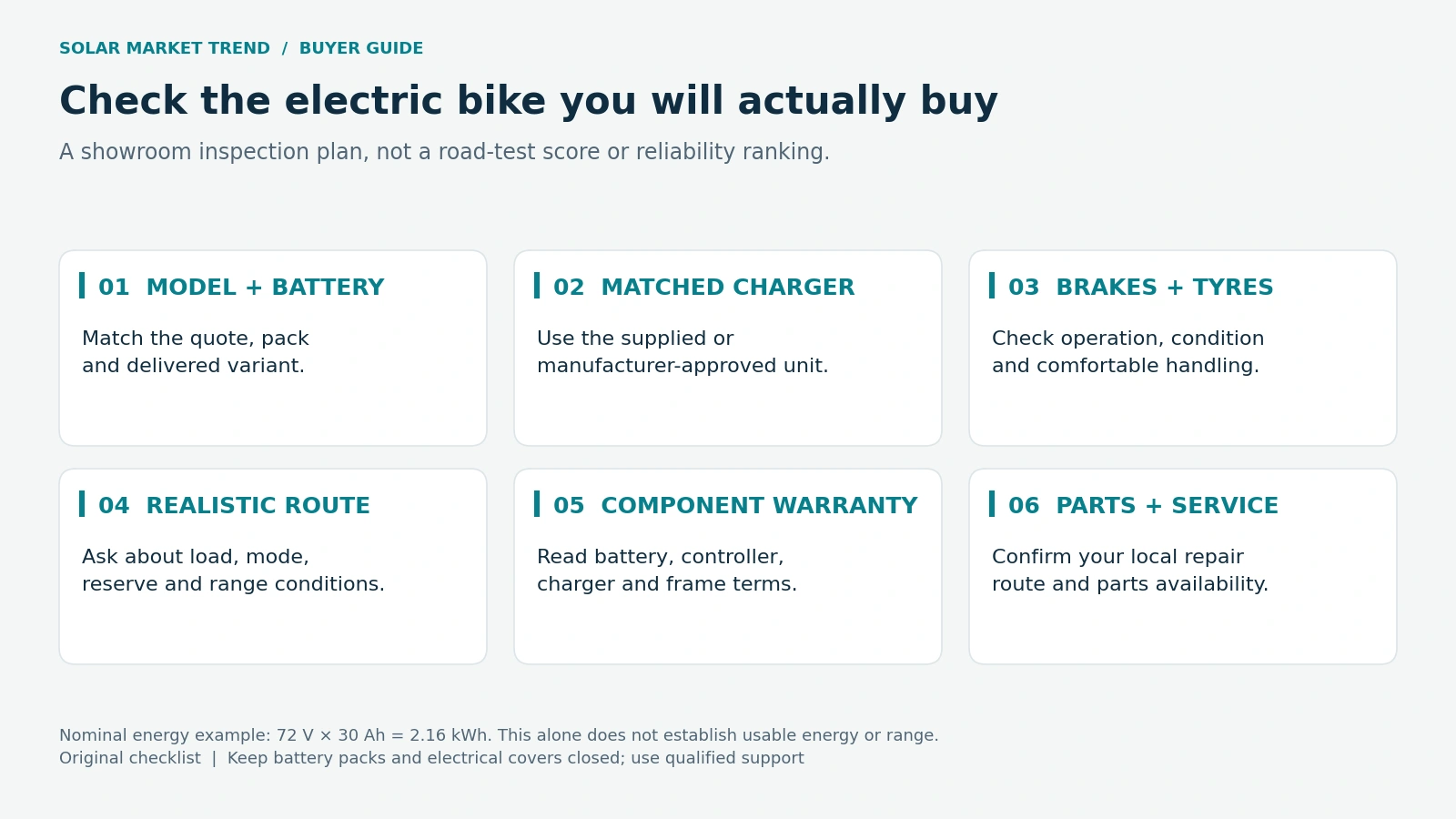
For a Pakistani commuter, electric-bike quality comes down to whether the exact bike can complete the daily journey, stop predictably and receive dependable repairs. A large range claim or a glossy battery label answers only part of that question.
This guide explains what to inspect before paying. It uses Pakistan-market manufacturer information checked on 14 October 2026. Solar Market Trend has not road-tested or laboratory-tested these vehicles, and the examples are not a reliability ranking.
1. Identify the exact bike and battery
Put the model, battery version, manufacturing details and charger model on the quotation. Similar-looking scooters can have different packs and warranty terms.
For example, Yadea Pakistan's T5L page specifies a 72V 30Ah lithium iron phosphate battery, 1,500W rated motor power and 2,700W peak power. Evee's S1 Air page lists a 76.8V 35Ah Phylion lithium option and a 72V 38Ah graphene-labelled option. Its 2,200W motor figure is not identified there as rated or peak. Ask for that distinction before comparing it with Yadea's figures.
Volts multiplied by amp-hours gives approximate nominal energy: 72V × 30Ah equals 2,160Wh, or 2.16kWh. This calculation does not establish usable energy, real-world range or battery quality. Ask what chemistry sits behind a marketing label, which protection system is fitted and whether the supplied charger matches that exact pack.
2. Put range claims into everyday conditions
Yadea advertises 80-100km per charge for the T5L. Evee's S1 Air product page advertises 90-110km, while its homepage gives a 90km headline. These are manufacturer claims, with no common test protocol established in the pages reviewed. They cannot support a precise head-to-head efficiency verdict. Sources: T5L, S1 Air, Evee homepage.
Ask the dealer which mode, rider weight, speed, temperature and route produced the claim. Then arrange a representative demonstration, within the manufacturer's load limit, with your usual luggage. Record distance, starting charge, finishing charge and riding mode.
A short test ride can reveal comfort and handling; it cannot prove full-charge range or long-term durability. Plan a useful reserve for detours and battery ageing, and avoid buying a bike whose advertised maximum barely covers the essential journey.
3. Inspect the hardware you will use every day
Before riding, ask the dealer to check tyre pressure, wheel alignment, brake operation and fasteners. Look for damaged insulation, exposed connectors, loose battery retention, cracked body mounts, corrosion and evidence of impact or water entry. Leave electrical covers and battery packs closed.
During a supervised ride in a safe area, check:
- Smooth, controllable take-off and a throttle that returns normally
- Predictable braking without pulling, scraping or excessive lever travel
- Stable steering and suspension over ordinary surface imperfections
- Clear mirrors, working indicators, brake lights, headlight and horn
- A seat, stand and riding position you can manage comfortably
Disc brakes, a high motor rating or a screen full of features cannot establish stopping performance on their own. Ask how the fitted braking system works and whether any advertised ABS or combined braking is actually present on the quoted variant. Never conduct a high-speed emergency-braking experiment on a public road.
4. Read the warranty by component
Yadea's T5L page advertises a battery-pack replacement warranty of four years/50,000km. Evee's S1 Air table separately lists 24 months for the motor, 20 months for battery and controller, 36 months for the frame and three months for the charger. Confirm the applicable limits and complete conditions in the paperwork supplied with your bike. Sources: Yadea, Evee.
Request written answers about capacity-loss coverage, exclusions, inspections, commercial use, labour, transport and claim approval. Ask whether a successful claim means repair, replacement or a proportionate credit. A long warranty headline is useful only when you understand what triggers coverage.
Treat cycle-life claims similarly. Ask for the test temperature, depth of discharge and remaining-capacity threshold. A cycle count alone cannot tell you how many years your particular battery will last.
5. Check charging and local support
Ask an appropriately qualified electrician to assess the intended charging point and follow the charger manual. Request a demonstration of normal charging indications and shutdown. Keep charging equipment dry and away from escape routes and combustible clutter.
For lithium-powered bikes, charger compatibility deserves particular attention. A US Consumer Product Safety Commission commissioner's safety statement recommends the supplied charger or a manufacturer-sourced replacement and warns against packs modified by unqualified people. This is safety guidance, not a claim about Pakistani certification requirements. Stop using damaged equipment and have the supplier assess it.
Call the service point you would actually use. Ask about brake parts, tyres, controllers, chargers and replacement batteries, including current written quotations and realistic delivery times. Evee's service-centre page and Yadea's support page provide starting points; a listing alone does not verify stock or repair speed.
The buying decision
Shortlist the bike that fits your route, passes inspection and comes with clear support and warranty documents. Keep the invoice, chassis and battery identifiers, warranty booklet and delivery-condition photographs. If a seller cannot resolve conflicting specifications or provide essential paperwork, delay payment until the missing information is supplied.
Editorial note: AI-assisted, source-checked buyer guidance. Manufacturer specifications and warranties may change. Confirm the exact delivered variant before purchase.