SOLAR ELECTRICAL PROTECTION GUIDE
Circuit Breaker A vs kA: Why the Bigger Number Is Not the Load Rating
Share on social media
Separate breaker current, breaking capacity and voltage ratings, and ask for fault-level evidence before choosing protection for a solar installation.
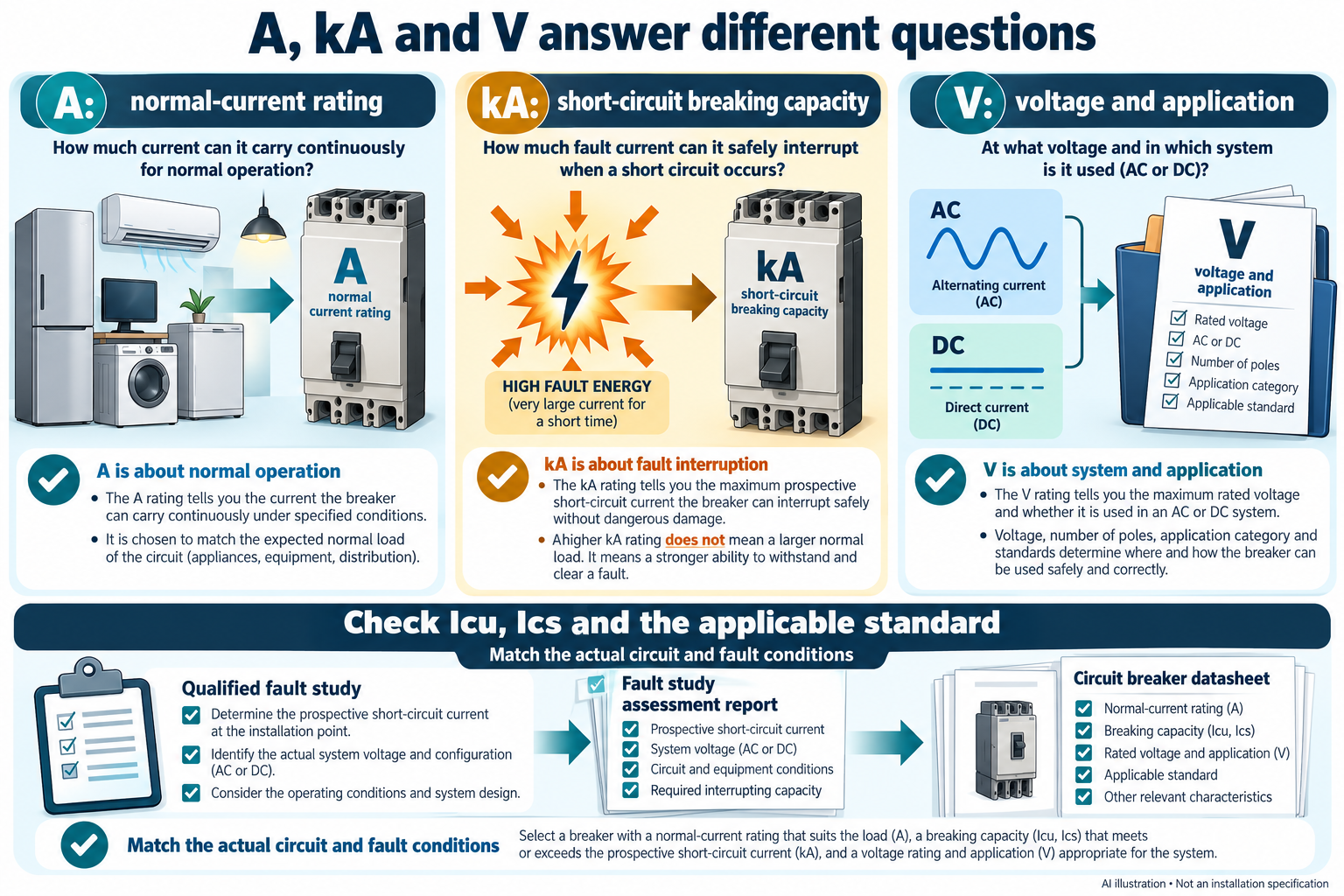
Original companion diagram
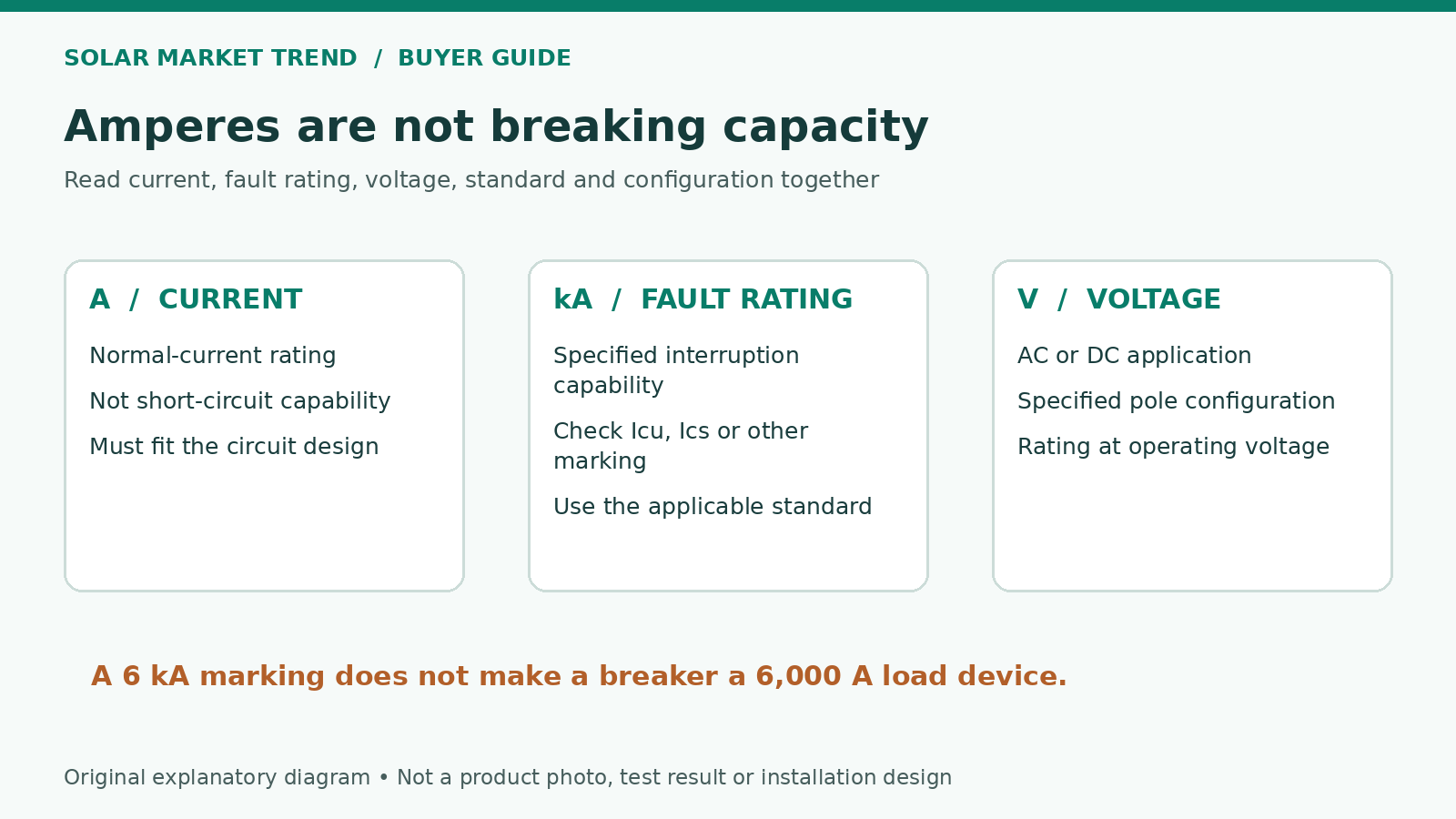
One breaker carries several different ratings
A circuit breaker can show a current rating in amperes and a much larger number in kiloamperes. They do not describe two alternative load capacities. Confusing them can turn a reasonable-looking solar quotation into a poorly specified protection package.
For a Pakistan buyer, the practical aim is not to choose the largest printed number. It is to obtain a device selected for the circuit’s load, voltage, fault conditions and installation. Eaton’s technical overview treats ampere, voltage and interrupting ratings as separate selection dimensions. None should disappear from the purchase specification. [1]
Amperes describe normal-current capability
ABB’s technical glossary distinguishes rated uninterrupted current from the short-circuit ratings. The current rating concerns what the breaker can carry under its specified conditions. It is not the magnitude of every fault that the device can safely interrupt. [2]
A breaker marked 32 A and 6 kA is therefore not a 6,000 A load switch. The 6 kA marking concerns a specified short-circuit rating, subject to its standard, voltage and configuration. This is an illustrative label, not an actual recommended product. Do not use the example to size a cable or decide the protective-device setting. [1,2]
Breaking capacity must match the fault study
Schneider Electric’s DC selection guidance separates nominal current from maximum short-circuit current at the installation point. The latter informs breaking capacity; system voltage and topology also affect the selection. On DC applications, the time constant and the required number of series poles matter as well. [3]
Ask the designer for the prospective fault-current basis at the actual installation point and the matching protective-device rating. Do not substitute the inverter’s advertised kilowatt output for a fault assessment. A complete system can have more than one source, and the responsible engineer must evaluate the applicable operating arrangements rather than assume a single device label answers every case.
Keep Icu and Ics distinct
For the relevant industrial circuit-breaker classifications, Icu denotes ultimate short-circuit breaking capacity and Ics denotes service short-circuit breaking capacity. ABB explains different test sequences and the post-test current-carrying requirement for Ics. Schneider’s PowerPact explanation likewise distinguishes ultimate interruption from remaining suitable for service. [2,4]
That distinction matters when two quotations advertise the same large headline figure. Ask which rating is being quoted and at what operating voltage. Do not assume an Icu claim proves the same Ics value. Equally, a general discussion of these industrial ratings should not be used to relabel a household device’s different standard marking. The actual datasheet controls the comparison. [4]
Voltage and pole configuration are part of the rating
A DC label is not a decorative alternative to an AC label. Schneider’s selection note ties rated voltage to the series poles participating in interruption and system type to the arrangement for each polarity. Follow the exact manufacturer configuration through a qualified designer; do not invent connections by adding individual pole voltage numbers. [3]
Eaton also warns that voltage and, in some applications, single-pole interrupting capability require attention. A rating under one specified arrangement does not automatically transfer to another. Ask for the relevant datasheet page showing the offered part number and its intended use, not a generic catalogue cover carrying the brand logo. [1]
Make the quotation comparable
Schneider’s MCB selection checklist separately asks for pole count, curve, ampere rating, breaking capacity and operating voltage. Use those fields as the starting point for a comparable quotation. Then have the designer identify the applicable standard, AC or DC service, coordination requirements and any installation limitations. [5]
Ask the supplier to retain the complete model reference on the invoice. Require written review of substitutions instead of accepting a product because its handle, width or current marking resembles the originally specified one. Also ask who will document commissioning and future replacement requirements. This is procurement discipline, not a claim that paperwork alone verifies a genuine or correctly installed device.
Buy the documented fit rather than the loudest label
A higher breaking-capacity option may be necessary for a particular fault level, but it does not alone establish the correct load rating, tripping characteristic or complete installation protection. Price comparisons should follow technical comparability, not precede it.
This article explains rating terminology using manufacturer material checked on 19 October 2026. The older ABB glossary is used for definitions, not as evidence that a listed legacy model is currently supplied in Pakistan. No actual site fault study, local product certification or installation approval is implied. Electrical selection and work belong with qualified professionals.