SOLAR DC DEVICE BUYER GUIDE
DC Isolator vs Circuit Breaker: Different Jobs in a Solar Installation
Share on social media
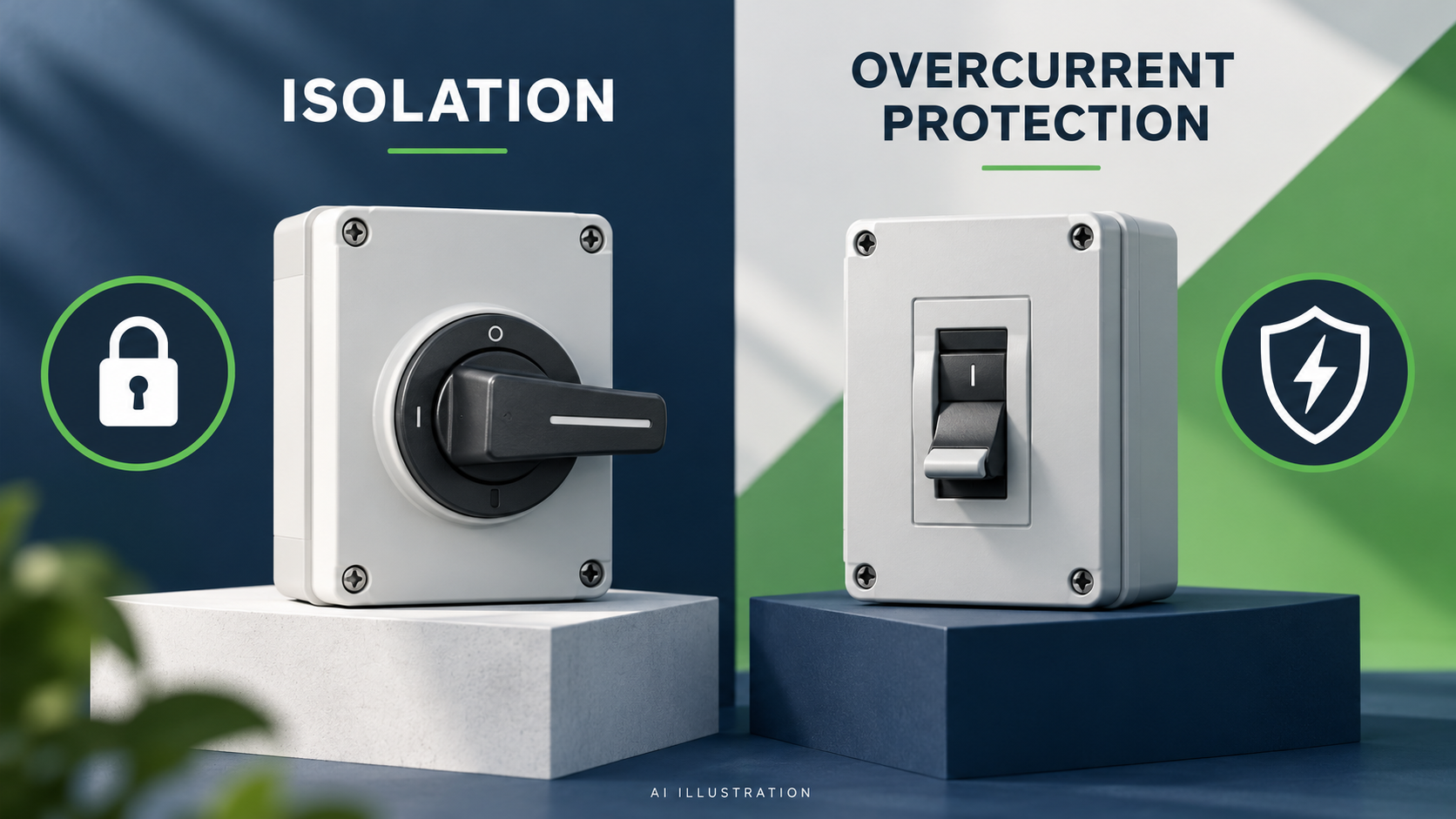
A solar buyer’s guide to the differences between disconnectors, load-rated switch-disconnectors and circuit breakers, with practical questions for a qualified designer.
Start with the job, not the handle
A solar quotation may list a ‘DC isolator’, a ‘DC breaker’ or both. The names can sound interchangeable, especially when each device has an ON/OFF handle. Before comparing prices, ask what function each exact model performs: isolation, switching a normal load, automatic overcurrent protection, or a documented combination. These are distinct capabilities. A neat enclosure and a familiar brand name cannot answer the question by themselves. [1][5]
For buyers in Pakistan, the useful outcome is a clear device schedule supported by manufacturer documents and a qualified electrical designer’s selection.
‘Isolator’ can conceal an important distinction
A disconnector provides an isolation function but is not intended to interrupt normal load current. A switch-disconnector combines isolation with the ability to switch load current within its stated rating and utilization category. The IET’s 2026 explanation highlights why calling both devices simply ‘isolators’ can be misleading: the name alone does not establish whether on-load operation is permitted. [2]
IEC 60947-3 covers switches, disconnectors, switch-disconnectors and fuse-combination units. Its current consolidated publication incorporates the 2025 amendment. However, seeing this standard on a product does not tell you which of those device types it is. Ask for the manufacturer’s precise classification and intended application. Never assume an unidentified ‘isolator’ can be operated under load. [1]
Automatic overcurrent protection is a separate function
A plain switch-disconnector does not, by itself, detect an overload or short circuit and automatically clear it. Schneider Electric’s guidance distinguishes its normal switching function from the protection it needs against those conditions. If a product combines switching with fuses or other protective elements, request documentation for the complete combination rather than assigning every function to the switch. [3]
A suitably selected overcurrent circuit breaker has a protective trip function. For example, Schneider’s PV DC thermal-magnetic trip-unit documentation identifies separate thermal and magnetic protection characteristics. The exact trip behaviour belongs to the specified product and settings, not to the word ‘breaker’ alone. Settings and selection are engineering work, not homeowner adjustments. [8]
IEC 60947-2:2024 addresses circuit breakers within its defined scope, including DC applications. It is a different product standard from IEC 60947-3. A standards reference helps identify the evidence to examine; it is not a substitute for an installation design. [4]
Can one device perform more than one job?
Sometimes, but it must be documented. A circuit breaker may also be suitable for isolation when designed and marked for that purpose. Conversely, a device that looks like a circuit breaker may be a switch-disconnector without the protective trip function the buyer expects. Schneider’s DC range includes both product types, making the exact model important. [5]
The IET also distinguishes circuit protection from frequent functional switching. Where repeated operation is intended, the designer must check the manufacturer’s operating-duty limits. Do not conclude that every breaker replaces every isolator, or that every installation needs two separate devices solely because the names differ. [2]
DC suitability requires more than an ampere number
The specification must cover the actual DC application. ABB’s OTDC range, for example, identifies photovoltaic switching duties and utilization categories such as DC-PV2. These details are more informative than a generic ‘solar suitable’ sticker, but they still do not select a device for an individual roof. [6]
Ask the designer to check the applicable DC operating voltage, operating current, switching duty and manufacturer-approved configuration. For a circuit breaker, fault-breaking capability and protective characteristics also matter. Schneider’s DC documentation distinguishes operational voltage, insulation voltage and short-circuit breaking capacities, demonstrating why a single large number is not a complete specification. [5]
An AC rating must not be treated as an equivalent DC rating. Require the manufacturer’s explicit DC rating for the selected application. Do not improvise pole arrangements or polarity assumptions from an online photograph. [5][6]
A buyer’s handover checklist
Request these items before accepting the installation:
- The manufacturer and full model number for each DC switching or protective device.
- A plain-language description of its job, including whether it has automatic overcurrent protection.
- The datasheet and applicable certification identifying DC ratings and permitted use.
- The designer’s confirmation of isolation suitability, switching duty and required fault protection.
- A labelled system record explaining which equipment each device relates to.
- Manufacturer-approved owner instructions, maintenance requirements and a service contact.
Keep the paperwork with your inverter and module documents. If a later replacement is proposed, ask whether it preserves the original functions and ratings rather than accepting ‘same amperes’ as sufficient.
An OFF handle is not permission to work
PV modules exposed to light can generate hazardous DC voltage, as SMA’s safety guidance warns. Opening a device does not establish that every solar cable or component is safe to touch. [7]
Do not open enclosures, test terminals, bridge contacts or change wiring to investigate these differences. Have a qualified professional identify the devices and assess any concerns. The buyer’s role is to demand a documented design, not to prove isolation by experiment.
Sources and references
- [1] IEC 60947-3:2020+AMD1:2025: Switches, disconnectors, switch-disconnectors and fuse-combination units
- [2] IET Wiring Matters, July 2026: Protective, isolation and switching devices explained
- [3] Schneider Electric: Switch-disconnectors and their protective requirements
- [4] IEC 60947-2:2024: Circuit-breakers
- [5] Schneider Electric: ComPacT NSX DC range, classification and device ratings
- [6] ABB: OTDC disconnects for photovoltaic and energy-storage applications
- [7] SMA: PV array connection safety warnings
- [8] Schneider Electric: TM-DC PV thermal-magnetic trip units for photovoltaic circuit breakers