SOLAR & WATER MANAGEMENT
Drip Irrigation with Solarisation Benefits for Pakistani Farms
Share on social media
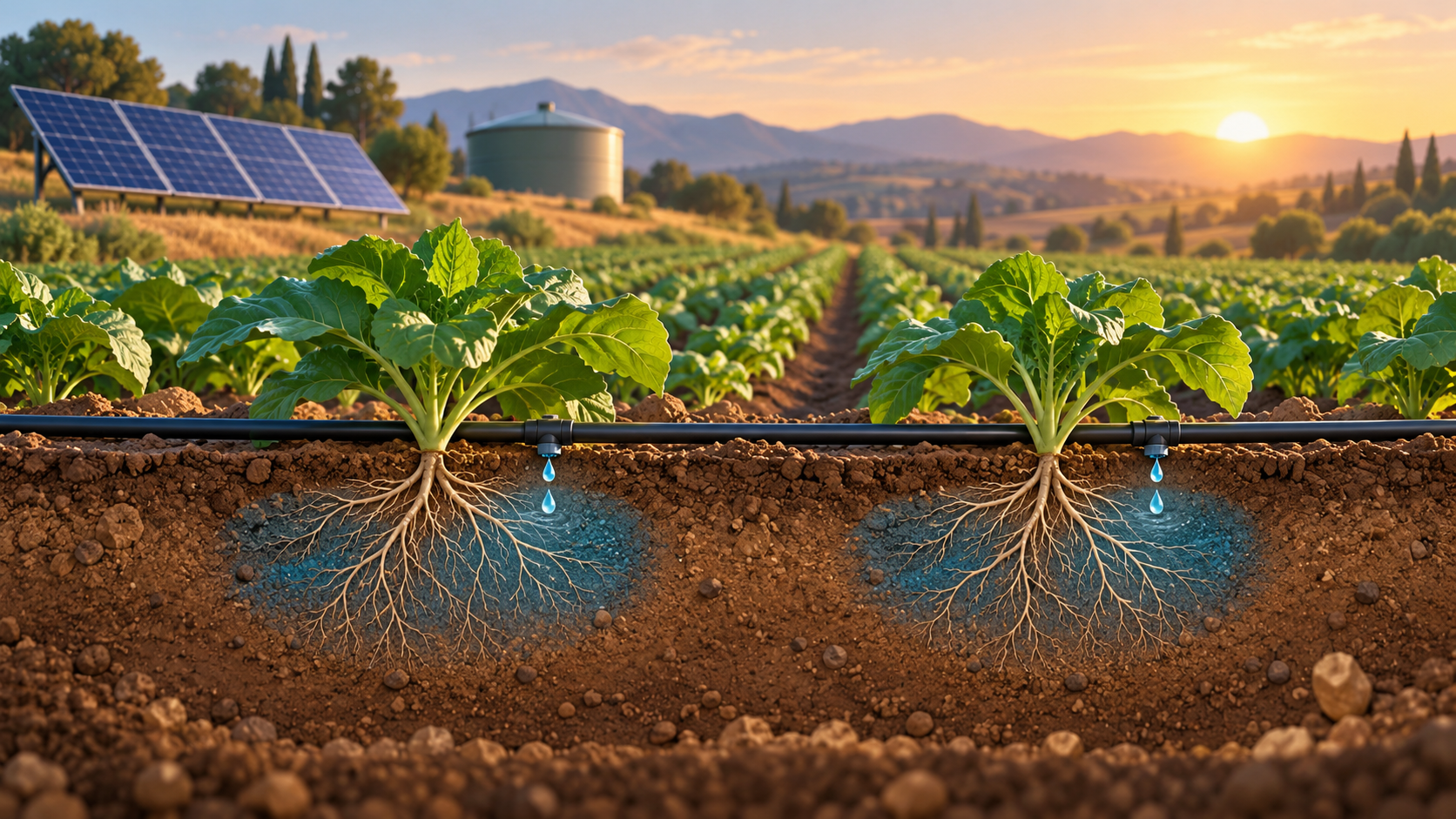
Solar power can change the energy source for pumping while drip irrigation improves where water is applied. The combination works best when crop demand, water quality and groundwater limits guide the design.
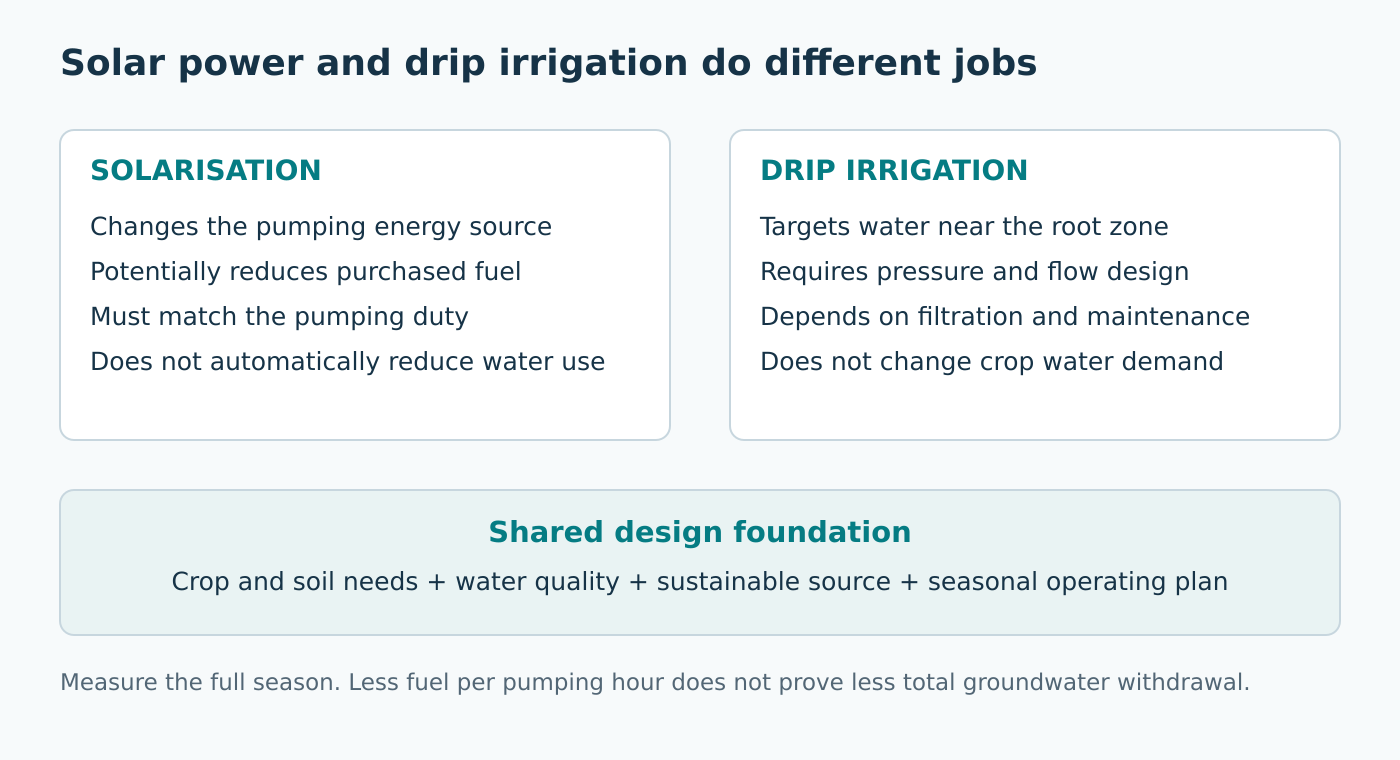
Solarisation and drip irrigation solve different problems. Solar photovoltaic equipment can supply energy for pumping. Drip equipment delivers water close to the crop through controlled outlets. Combining them can reduce dependence on purchased pumping fuel and make irrigation more deliberate, but adding panels does not automatically save water and laying drip lines does not guarantee a profitable crop.
For a Pakistani farmer, the right starting point is the crop and water source, not a standard solar package. Ask how much water is required through the growing season, whether the source can supply it sustainably and what pressure and flow the irrigation layout needs.
Two useful technologies with different jobs
FAO's drip-irrigation guidance explains that emitters wet only part of the root zone. Potential water savings come from reducing avoidable runoff, deep percolation and soil evaporation, not from changing the crop's biological water requirement. The method and the operator both influence the result. It is commonly useful for row crops, orchards and other crops where targeted application fits the planting pattern. [1]
Solar pumping can replace purchased fuel, but viability depends on well depth, configuration, storage, soil, crop markets and incentives. Check those conditions before treating fuel savings as a payback guarantee. [2]
The useful combination is therefore planned water delivery supported by an appropriate energy system. An oversized pump and an uncontrolled irrigation schedule can undermine that purpose even when both technologies are individually capable.
Pakistan already has an integrated policy context
Punjab's On Farm Water Management overview describes high-efficiency irrigation, solar systems for operating those systems, water storage ponds and farmer capacity development as linked interventions. Its programme listing also identifies solar-coupled lift irrigation and high-efficiency irrigation within the 2025-26 to 2027-28 Pothohar agriculture programme. These are published programme activities and targets, not proof that a particular farmer is eligible or that applications are open today. [3][4]
Before relying on a subsidy, obtain the current district-level application instructions, eligibility conditions, farmer contribution and approved technical scope. Do not apply the terms of an old tubewell scheme to a new drip project merely because both use solar panels.
Size the system around a seasonal water plan
The irrigation designer should account for crop demand, soil, field levels, planted area, water quality and the pressure required across the proposed layout. Pump selection also needs the source's pumping conditions and the losses through pipes and equipment. A single horsepower recommendation without these inputs is not a complete design.
IWMI's December 2024 Pakistan analysis highlights both sides of sizing: excessive solar capacity can encourage over-abstraction and impose unnecessary capital cost, while insufficient capacity can undermine the farmer's investment. The article reports Pakistan fieldwork and financing challenges; its historical prices and adoption estimates should not be used as current quotations. [5]
Discuss how water will be delivered when solar output changes, whether storage is appropriate, and which contingency protects the crop during an equipment outage. Storage capacity, battery use and grid or generator backup are design choices, not compulsory parts of every farm. Get an operating plan rather than assuming the largest equipment package is the safest option.
Filtration and maintenance are part of the benefit
A drip system's small passages make water quality important. FAO describes physical, chemical and biological contributors to blockage and notes that partially blocked emitters can be difficult to spot. Planning to prevent clogging is preferable to discovering uneven watering after the crop is affected. [6]
Ask who will inspect filters and lines, how performance will be checked, which spare parts are stocked and who responds during the growing season. Obtain a water-quality assessment and a written maintenance plan. Chemical treatment or fertigation should be designed and supervised by competent specialists; a general blog cannot prescribe a safe treatment dose for an unknown water source.
The solar installation also needs appropriate equipment protection, safe access and an accountable service provider. Keep the electrical and irrigation responsibilities clear so a pumping problem is not passed endlessly between two contractors.
Protect the water source as well as the energy budget
FAO warns that cheaper pumping can encourage expansion of irrigated area or more water-intensive crops, cancelling anticipated water savings. It recommends water-management planning and cautions against assuming drip automatically reduces total farm withdrawals. [2]
This matters in Pakistan's Indus Basin. The World Bank's groundwater assessment identifies over-abstraction, waterlogging and contamination as distinct problems. A successful local design must fit its actual source and conditions; one national slogan cannot describe every aquifer or farm. [7]
Record water use alongside crop results and energy costs. Compare a full season with a clearly defined baseline, allowing for changes in crop, weather and planted area. A percentage copied from another farm or a sales brochure is not a measured saving at yours.
Solar-powered drip irrigation can support more reliable, targeted farming when the water plan, equipment and maintenance fit together. Buy the complete design and service arrangement, not just panels and pipes, and judge success by sustainable crop production as well as a smaller fuel bill.
Sources and references
- [1] FAO Irrigation Water Management Chapter 6 Drip Irrigation
Foundational drip operation and crop-water principles, not a current savings estimate.
Source date: Undated chapter on current public archive; checked 17 October 2026. Verified: 2026-10-17.
- [2] FAO Positive prospects for solar-powered irrigation systems
Solar-irrigation benefits, viability conditions and water-use rebound risks.
Source date: 12 April 2018. Verified: 2026-10-17.
- [3] Punjab Agriculture Department On Farm Water Management overview
Published integrated water-management interventions, not current scheme eligibility.
Source date: Undated live page; checked 17 October 2026. Verified: 2026-10-17.
- [4] Punjab Agriculture Department Transformation of Agriculture in Pothohar 2025-26 to 2027-28
Official Pothohar project detail: 2025-28 period, solar-coupled lift irrigation and high-efficiency irrigation activities; no application-window or completion claim.
Source date: Live listing includes 2025-26 to 2027-28 programme; checked 17 October 2026. Verified: 2026-10-17.
- [5] IWMI Business and finance models for solar-powered irrigation in Pakistan
Pakistan fieldwork, system sizing, financing and groundwater risks; historical statistics not reused.
Source date: 5 December 2024. Verified: 2026-10-17.
- [6] FAO Water quality for agriculture Clogging in localized irrigation
Clogging mechanisms and preventive design; not a chemical-treatment prescription.
Source date: Foundational technical guidance; checked 17 October 2026. Verified: 2026-10-17.
- [7] World Bank Managing Groundwater Resources in Pakistan Indus Basin
Pakistan groundwater context; over-abstraction, waterlogging and contamination.
Source date: 25 March 2021. Verified: 2026-10-17.