BATTERIES & STORAGE
ESS vs BESS vs On Grid vs Hybrid Solar Systems Explained
Share on social media
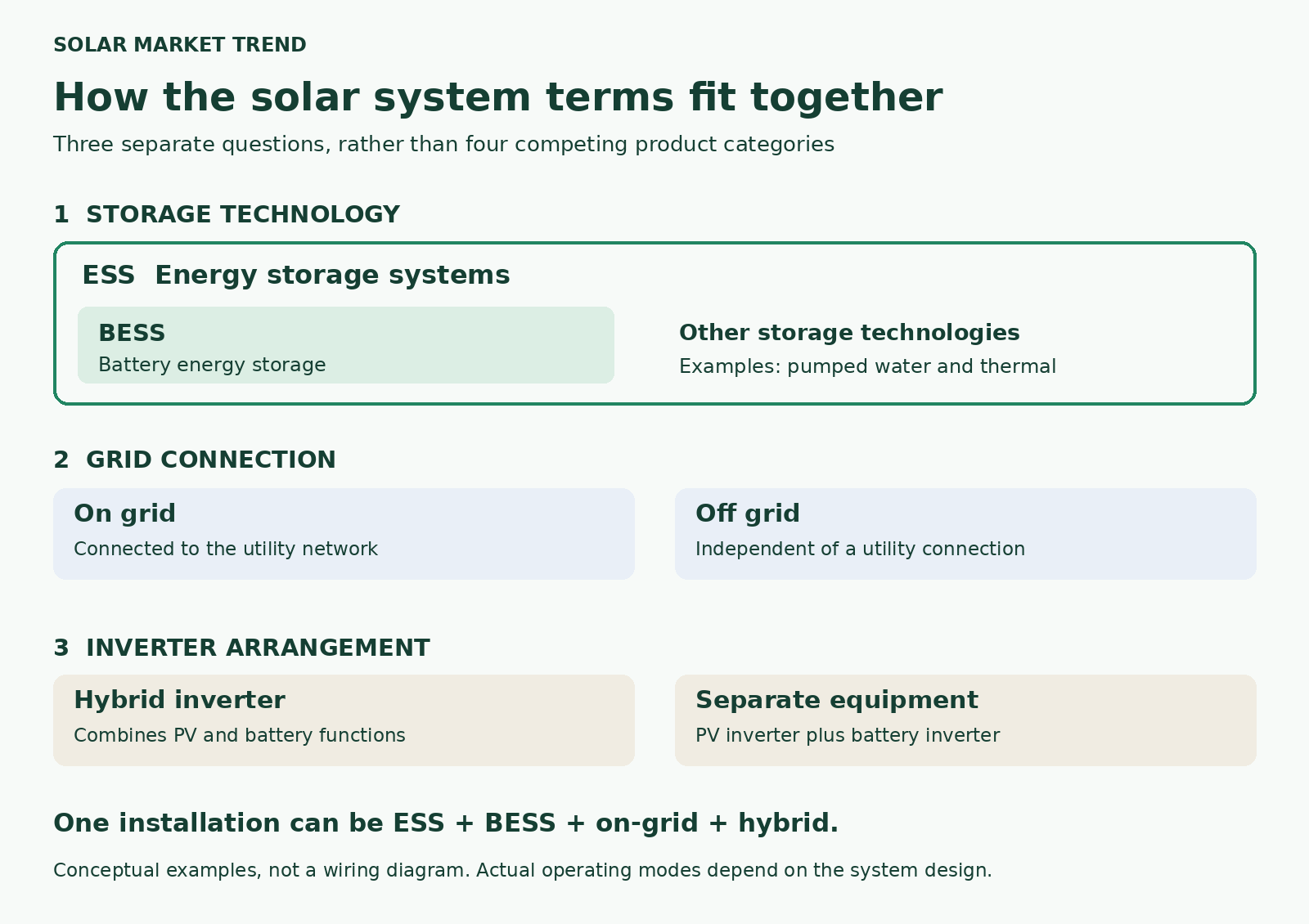
ESS, BESS, on-grid and hybrid describe different aspects of an energy system. They are not four mutually exclusive products. A grid-connected home with a battery and a hybrid inverter can fit all four descriptions at once.
For Pakistan solar buyers, understanding that overlap makes quotations easier to compare. Start by separating storage technology, grid connection and inverter arrangement.
ESS is the broad storage category
ESS means energy storage system: equipment that stores energy for later use. Batteries are one option; pumped-water and thermal storage are others. The US Department of Energy explains these different storage technologies in its solar and storage overview.
In a home-solar quotation, a seller may use ESS for a packaged battery-based system. Ask what the package actually includes. The label alone does not specify a battery chemistry, inverter, usable capacity or backup function.
BESS identifies battery storage
BESS means battery energy storage system, so it is a type of ESS. It identifies the storage technology rather than whether the property is connected to the grid. Battery storage can be part of a residential, commercial or larger electricity system.
Check both its power rating and energy capacity. Power, expressed in kW, describes how quickly energy can be delivered; energy capacity, expressed in kWh, describes how much can be stored. Nominal and usable energy are not automatically equal. NREL's battery-storage guide explains these distinct ratings.
On grid describes the connection
On-grid, or grid-connected, means the system operates in connection with the utility network. A conventional PV-only on-grid installation need not contain battery storage. A grid-connected installation can also include a BESS.
Do not assume ordinary grid-connected solar will keep the house powered during a blackout. Backup requires a system that can safely separate from the utility and supply a supported local circuit. SMA's backup explanation describes the additional functions and components involved.
Hybrid describes a combined arrangement
In residential solar quotations, a hybrid inverter commonly brings PV and battery functions into one unit and manages their interaction with loads and the grid. Depending on the model and installation, it may also support a generator or off-grid operation. The word hybrid alone does not confirm every operating mode.
Separate PV and battery inverters are another possible arrangement. Solis explains how an existing PV installation can be extended with energy storage through AC coupling. Adding a battery does not always require replacing the existing PV inverter; compatibility and design must be checked.
Compare the operating plan
Ask each installer to answer the same questions:
- Which loads will receive power during an outage?
- What are the supported continuous and surge power limits?
- What usable battery energy and backup reserve are specified?
- Which components, switching equipment and commissioning work are included?
- Can the proposed system meet the required operating modes with the exact battery and inverter models?
Backup duration depends on available battery energy, solar production, connected loads and configuration. Solis makes these dependencies clear in its hybrid installation guidance.
Choose the documented operating capability that matches your needs. ESS and BESS tell you about storage; on-grid tells you about connection; hybrid tells you about the combined equipment or architecture. None of those labels, on its own, guarantees whole-home backup.
Ratings & comments
Published automatically. Everyone can read and join the discussion.
Discussion
Loading community posts…