EV AND PHEV BUYING GUIDE
EV vs PHEV Cars in Pakistan: Charging, Range and Ownership Compared
Share on social media
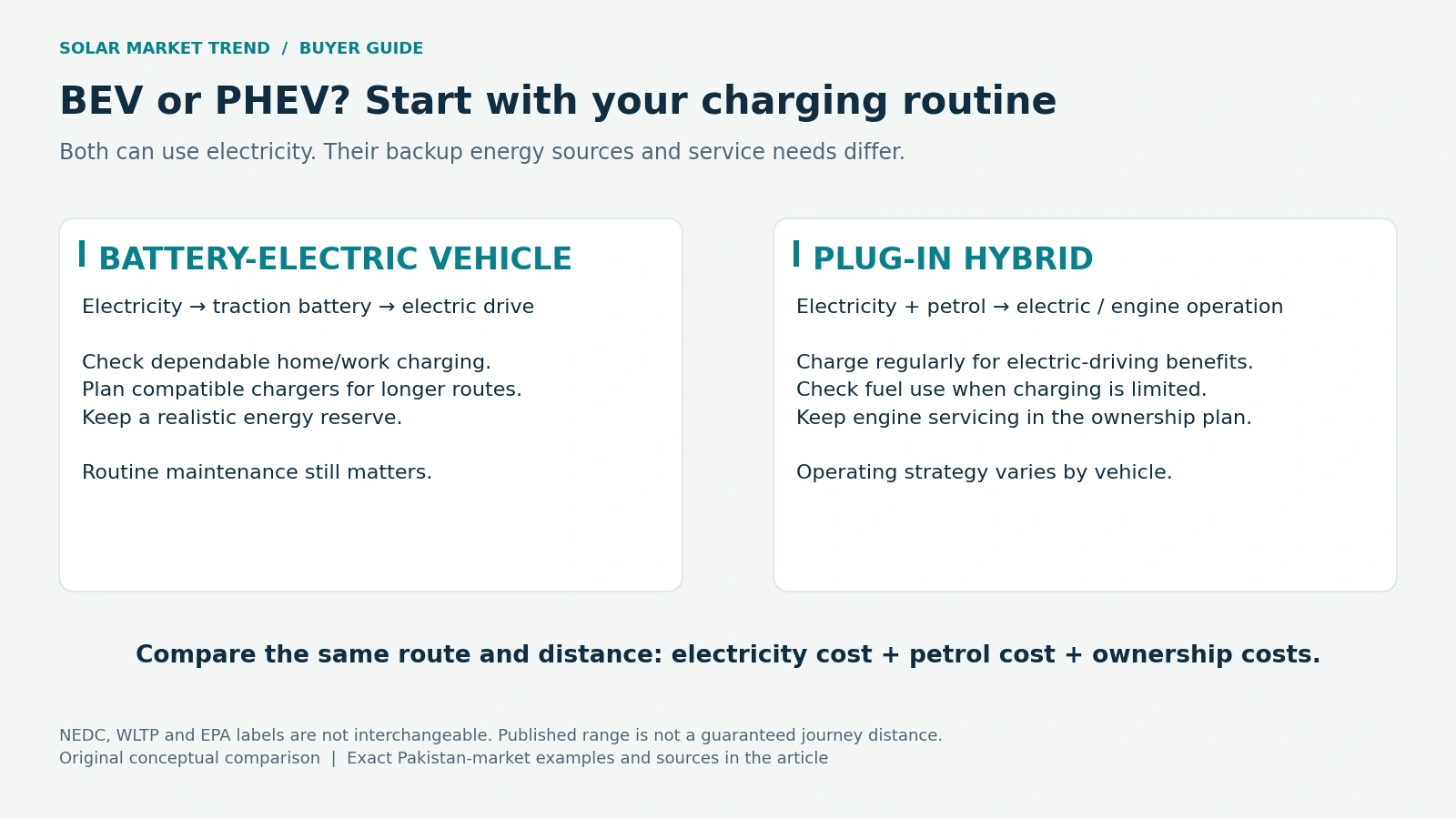
An electric car and a plug-in hybrid can both cover daily travel using electricity, but they place different demands on the owner. In Pakistan, the most useful starting questions are where you can charge, how far you regularly travel and what support exists along those routes.
This comparison uses official information checked on 14 October 2026. It is a desk-researched buying guide; Solar Market Trend has not independently tested the cars, measured local running costs or verified dealer inventory.
Understand the two powertrains
A battery-electric vehicle, or BEV, stores energy in its traction battery and uses electric propulsion. A plug-in hybrid, or PHEV, combines an externally rechargeable battery with a combustion engine. A conventional hybrid also combines an engine and electric drive, but ordinarily has no external charging connection.
A PHEV's engine may operate when charge is low or when operating conditions demand it, depending on the vehicle's control system. Regular charging is central to getting its electric-driving benefits. The US Department of Energy's PHEV explainer describes these operating principles; its US model examples and incentives should not be treated as Pakistani specifications.
Two confirmed Pakistan-market examples
| Item | BYD ATTO 3 Advance | MG HS Super Hybrid |
|---|---|---|
| Powertrain | Battery-electric | Plug-in hybrid |
| Published battery capacity | 49.92kWh | 24.7kWh nominal |
| Manufacturer electric-range claim | 410km, NEDC combined | Up to 135km, NEDC |
| Longer-trip energy source | Electricity | Electricity and petrol |
The figures come from BYD Pakistan's ATTO 3 page and MG Pakistan's Super Hybrid page. They are illustrative options, rather than a ranking of vehicles with identical size, equipment or purchase cost.
MG also lists an older HS PHEV separately. Keep its specifications separate from the new-generation HS Super Hybrid. Likewise, overseas ATTO 3 variants and battery sizes should not be substituted for the Pakistan Advance specification reviewed here.
Range: read the label before planning the journey
Both examples publish NEDC figures. These are test-cycle claims, not guaranteed motorway distances. Do not convert NEDC to WLTP or EPA range using an assumed fixed percentage, or compare one vehicle's electric range with another's combined petrol-and-electric range.
Speed, driving style and climate-control use affect energy demand. The US EPA's testing explanation shows why laboratory results need careful interpretation, including the effects of air conditioning and aggressive or high-speed driving. Its US adjustment procedure is not a conversion formula for these Pakistani cars.
For a recurring intercity journey, map compatible charging stops and a backup option. Check availability, access hours, payment method and the energy needed to reach the next stop with a reserve. A map pin cannot establish that a charger will be operational when you arrive.
Charging: start with the place you park
Ask a qualified installer to assess the electrical supply, earthing, protective equipment and cable route before buying a wallbox. Apartment residents should obtain permission for the installation and parking arrangement. Confirm the vehicle's connector and onboard AC limit against the equipment being quoted.
BYD advertises a 30-80% charging interval of 30 minutes for the ATTO 3 under stated controlled-condition caveats. This is a partial-charge claim, rather than a zero-to-full promise. Do not use it to estimate home AC charging time: confirm the charger type, power and conditions required. Source.
MG's Pakistan brochure specifies a Type 2 connection, approximately four hours for a full charge using 7kW charging and 7.5 hours using a portable charger. Actual supply and charging conditions matter. Its brochure does not provide a DC fast-charging specification, so obtain written confirmation before planning around one. Source.
If home solar is part of the plan, establish how much surplus is available while the car is parked there. An evening charging habit may rely on grid electricity or stored energy; installed panel capacity alone does not establish the charging cost.
Calculate costs using your own inputs
Use energy taken from the charging point, including charging losses, rather than assuming all billed electricity reaches the battery. The EPA explains this distinction.
- Electric cost per 100km = measured charging kWh per 100km × applicable rupees per kWh
- Petrol cost per 100km = measured litres per 100km × current rupees per litre
- For a PHEV, add electricity and petrol costs over the same distance
Compare a normal week, a long-trip week and a week with limited charging. Include charger installation, servicing, insurance, tyres and financing where relevant. Use your bill's applicable incremental charges and an actual fuel receipt. Neither a national average tariff nor a headline PHEV fuel-economy number can establish your personal savings.
Maintenance and warranty deserve equal weight
BEVs generally have fewer routine powertrain maintenance requirements. PHEVs retain an engine and its associated service needs, alongside the electric system. Both still require the scheduled inspections and wear-item care specified by their manufacturer. US Department of Energy maintenance guidance.
MG's Super Hybrid brochure advertises vehicle coverage of five years/150,000km and high-voltage battery coverage of eight years/150,000km, whichever comes first for each warranty. Obtain the complete applicable terms. For either car, verify the Pakistan warranty, capacity-loss provisions, service schedule, exclusions, transferability and authorised repair location in writing. Warranty duration is not a prediction of battery lifespan.
Which fits your routine?
A BEV is worth shortlisting when dependable charging and a workable route plan cover your routine. A PHEV is worth considering when you can charge regularly but also need petrol flexibility on journeys with uncertain charging access. If plugging in will be difficult, compare the PHEV's actual uncharged operation and ownership costs before paying a premium for its electric capability.
The stronger choice is the car supported by your parking arrangement, representative test drive, route evidence and written ownership costs.
Editorial note: AI-assisted, source-checked guidance. Manufacturer claims are identified; no independent range, reliability or cost test is implied.