SOLAR PANEL BUYER GUIDE
Glass-Glass vs Glass-Backsheet Solar Panels: What Pakistani Buyers Should Compare
Share on social media
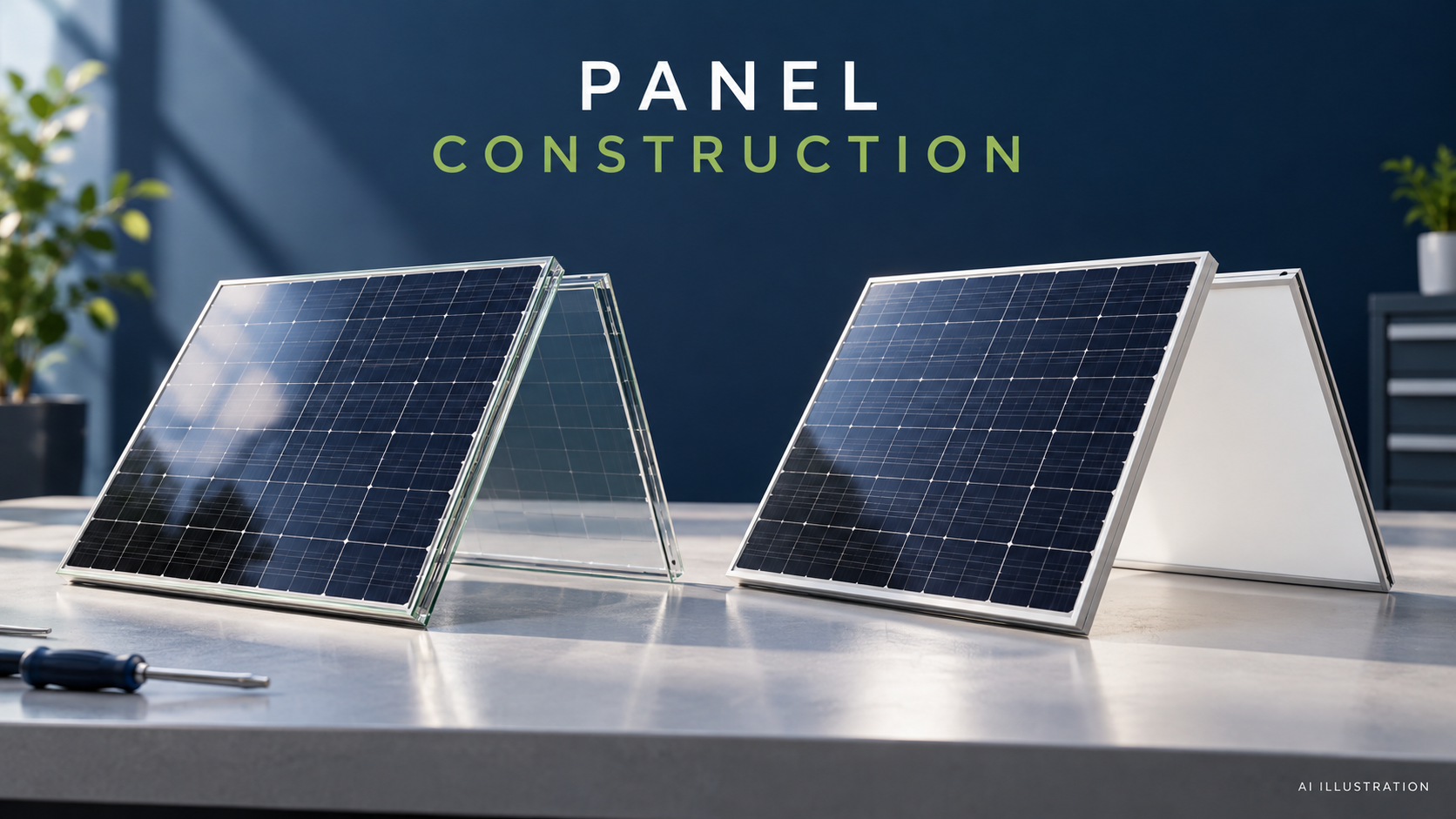
Compare solar-module construction using exact glass specifications, weight, material reliability and mounting requirements rather than treating dual glass as a universal quality grade.
Construction is a comparison point, not a verdict
A solar quotation may describe a panel as double glass, dual glass or glass-glass. These terms describe a module with glass at the front and rear. A glass-backsheet design instead uses a polymer-based rear covering. The label alone does not establish which complete product is better suited to your building.
For buyers in Pakistan, a useful comparison starts with the exact module specification, the roof and the evidence behind the seller’s reliability claims. Avoid paying for a construction slogan before seeing those details.
Keep bifacial and dual glass separate
Bifacial describes a module’s ability to generate using light on both faces; dual glass describes its construction. The terms should not be treated as interchangeable. JinkoSolar’s 2019 Swan launch, for example, documented a bifacial product using a transparent polymer backsheet rather than rear glass. That historical example establishes the distinction, not its present availability in Pakistan. [1]
Ask the supplier to identify construction and optical function separately. A rear-glass description should never substitute for the actual datasheet’s statement about whether the module is bifacial.
Read the physical specification line by line
Record the dimensions, mass, front-glass thickness, rear covering and frame specification for each offered model. These are product-level facts, not values that can safely be assigned to a whole category.
For example, Trina Solar’s TSM-NE19R.70 600–630W datasheet, version TSM_EN_2025_A, specifies a white backsheet, 3.2 mm tempered front glass and a module weight of 27.7 kg. These figures describe that particular product and revision; they do not mean all backsheet panels weigh the same or suit the same roof. [2]
If a supplier substitutes a different wattage series or model suffix, repeat the physical comparison. A similar brand name or appearance is not enough.
Ask about the complete material package
The front and rear covers are only part of a module. Encapsulants, which surround the cells, and their interaction with other materials also matter. IEA PVPS’s assessment of field failures explains that degradation depends on the combination of materials and components, with no universal rule covering every module. It also describes how backsheet barrier properties affect moisture and other degradation processes. [3]
Glass-glass construction can help protect moisture-sensitive cell technologies, as the 2025 IEA PVPS report discusses. It does not remove the need to assess the complete design. [4]
When a salesperson says one construction always lasts longer, ask which tests or field observations support that claim for the offered model. A result from a different material combination is not a product-specific answer.
More glass does not settle impact resistance
Glass thickness, treatment, dimensions and module design need consideration together. The 2025 IEA PVPS report discusses thin-glass breakage and a study comparing particular glass-glass modules using 2 mm glass and glass-backsheet modules using 3 mm front glass. Both passed the referenced baseline hail test, yet their behaviour under more demanding impacts differed. That is a warning against assuming that two glass layers automatically make a panel more hail resistant. [4]
Ask for the relevant test report and tested configuration, rather than a verbal claim of being unbreakable. A result for one construction should not be converted into a universal ranking of all glass-glass and backsheet products.
Bring the comparison back to your roof
The installer should evaluate the complete supported array, including modules and mounting equipment, against the building’s requirements. Canadian Solar’s May 2020 bifacial manual assigns load calculations and support design to the designer and installer for its specified BiKu and BiHiKu products. It also makes mounting arrangements model-specific. [5]
Use that as a purchasing principle, not as a mounting instruction for another brand. Ask who is responsible for checking the actual roof and proposed support system. Neither a low module weight nor a strong laboratory load rating alone establishes that the complete installation is suitable.
A comparison sheet to request before ordering
Have both suppliers complete the same short list:
- Full model code, rated power and datasheet revision.
- Front and rear materials, including stated glass thickness and treatment.
- Dimensions and weight for the exact supplied product.
- Whether it is monofacial or bifacial, stated separately from construction.
- Relevant mechanical and environmental test evidence for that model.
- Manufacturer-approved mounting information and the responsible roof assessor.
- Total installed price with any different mounting or handling requirements identified.
Keep the answers with the order. If a seller cannot identify the product beyond a construction label, pause the comparison until the missing information is supplied.
Choose the documented fit
Both constructions deserve a fair assessment. Prefer the offer that makes its exact product, material evidence and roof requirements clear. If dual glass is recommended at a higher price, ask what specific advantage the complete proposal provides for your site. If backsheet is recommended, ask for the same level of evidence. Construction should help explain the buying decision, not replace it.
Sources and references
- [1] JinkoSolar: Swan bifacial module with transparent DuPont backsheet, launch announcement, 15 May 2019
- [2] Trina Solar: TSM-NE19R.70 600–630W datasheet, TSM_EN_2025_A
- [3] IEA PVPS Task 13: Assessment of Photovoltaic Module Failures in the Field, 2017
- [4] IEA PVPS Task 13: Degradation and Failure Modes in New Photovoltaic Cell and Module Technologies, February 2025
- [5] Canadian Solar: Installation Manual of Bifacial Module, EN-Rev IM/GN-BM-EN/1.6, May 2020