HYBRID INVERTER AND GENERATOR GUIDE
Hybrid Solar Inverters and Generators What Compatibility Really Requires
Share on social media
Before pairing an existing generator with a hybrid solar system in Pakistan, separate the power connection, start signal, electrical acceptance limits and simultaneous charging demand.
Ask what the generator feature actually does
A hybrid inverter advertised as generator compatible does not automatically accept every generator already installed at a home, shop or farm. The useful buying question is narrower: can this exact inverter, firmware, battery and generator operate together in the proposed electrical arrangement?
Start by asking the supplier for a marked-up system description identifying the generator power input, the start and stop control, the protected loads and the grid isolation arrangement. A feature label is not that design. These are procurement checks, not instructions to reconnect equipment yourself.
Manufacturer documents show why the distinction matters. Solis describes a generator arrangement for its S6-EH3P 10K using the grid port, while its newer installation guide discusses separate Smart Ports on equipped models. Neither arrangement should be assumed from the brand name alone. [1][2]
A start signal is not a power input
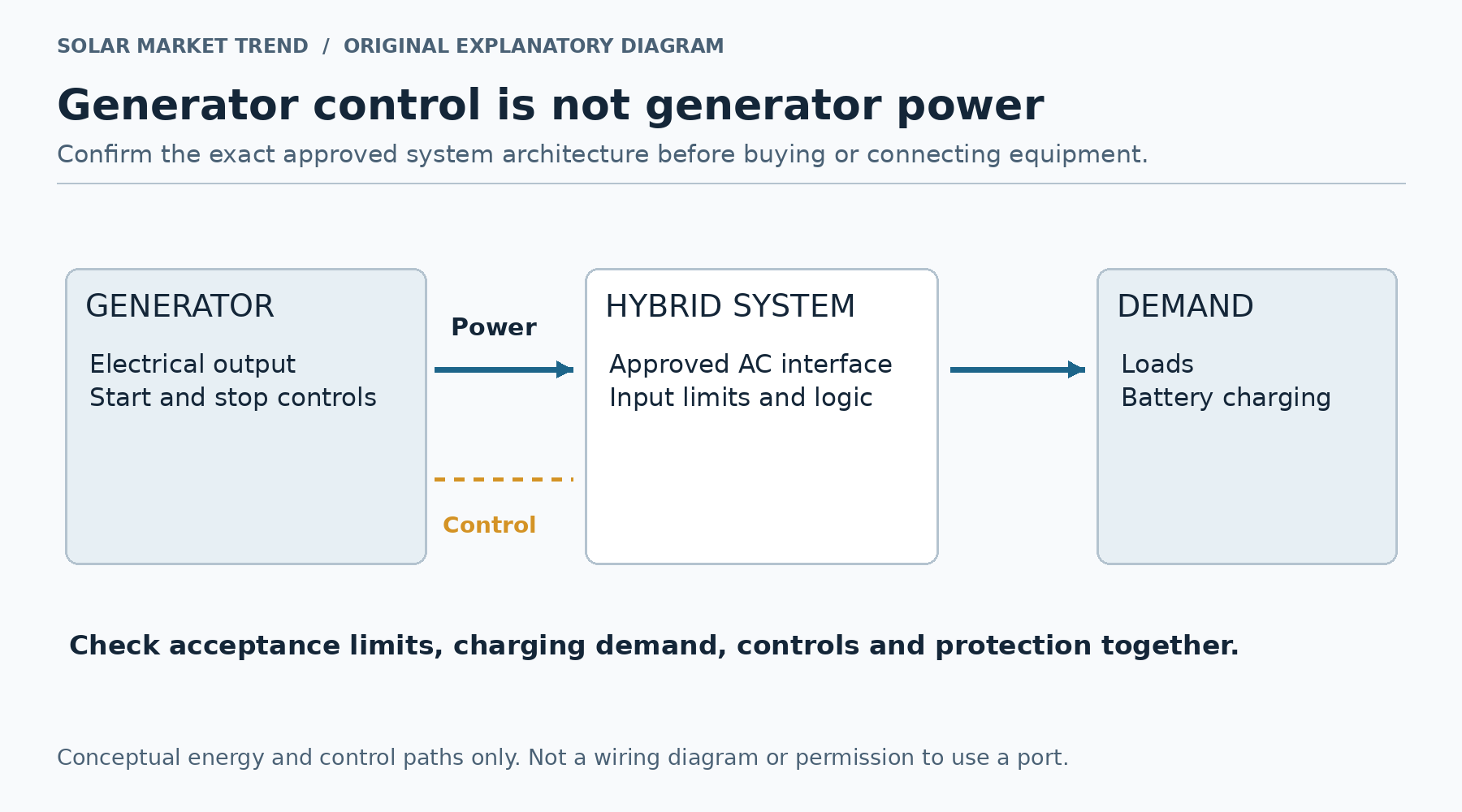
The generator's AC output carries energy. A remote-start connection carries a command. Those are different functions with different electrical requirements. In Deye's SUN-(3-12)K-SG05LP3-EU-SM2 manual, G-start is described as a dry-contact generator-start signal with no voltage output. The same manual separately describes generator input and other possible uses of the GEN power port. [3]
Our suggested quotation check is to require two separate answers: where does the generator's power enter, and how is starting controlled? If automatic starting is promised, ask whether the actual generator has a compatible remote-start interface and which equipment supplies the automation.
Do not infer that a socket labelled GEN can simultaneously be a generator input, a controllable load output and an AC-coupled solar input. Ask the installer to identify the selected function and what other proposed functions that choice excludes.
Read the architecture before comparing brands
The Solis S6-EH3P 10K guide says the described model lacks a dedicated generator power port and requires separation between generator and grid, or an appropriate transfer arrangement. Its hardware list specifies a three-phase generator. The October 2026 Solis installation guide separately restricts generator use at the Smart Port of three-phase hybrids to compatible three-phase generators. In that documented Smart Port scenario, generator operation is permitted only in off-grid mode. [1][2]
There are also systems where generator operation is expressly excluded. SMA's Home Energy Solution backup-planning section permits only the utility grid as the external source for the battery-backup arrangement it describes, including that arrangement when using Sunny Island. This is a restriction on the documented system, not a claim that every Sunny Island application prohibits generators. [4]
For a Pakistani buyer, these examples support a simple rule: ask for the exact applicable manual and system approval, not a screenshot from another inverter family.
Electrical acceptance is more than matching nominal voltage
Victron's MultiPlus Generator FAQ explains that an inverter/charger can reject generator power outside its configured acceptance conditions. Voltage, frequency and waveform behaviour matter, including how the generator responds when demand changes. Matching nominal ratings is necessary, but does not establish stable operation under load. [5]
Ask the designer to state the permitted generator operating envelope and how it will be verified with the proposed equipment. A demonstration with a small lamp is not the same acceptance test as supplying the agreed loads while charging a depleted battery.
Repeated connection and disconnection needs diagnosis. Do not widen protective settings or disable safeguards merely to make an incompatible generator connect. Request the event log and measured operating conditions, then have the installer resolve the cause within the equipment instructions.
Charging and ordinary loads share the available supply
Battery charging is an additional demand, not free energy alongside the building load. Victron warns that charger demand can overload a generator, while Solis describes surplus generator power being used to charge the battery after supplying backup loads in its Smart Port operating scenario. [2][5]
Consider a deliberately simplified example: the agreed loads require 3 kW and the charger draws another 2 kW at its AC input. The generator must supply 5 kW at that moment. If 2 kW instead describes power delivered into the battery, conversion losses mean the AC input is higher. These are invented arithmetic inputs, not a generator-sizing recommendation.
The real assessment must also consider apparent power, load changes and the generator's applicable duty rating. Cummins' sizing paper treats ambient conditions, duty cycle and load characteristics as design inputs. Its older publication is engineering context, not a current Pakistan product offer. [6]
Agree how the system starts stops and fails safely
Automatic operation needs an agreed sequence, not only a working start button. Our recommended handover questions cover who authorizes generator operation, what happens when fuel runs out, how grid return is handled, and what the owner should do after a failed start or repeated alarm. Ask for those answers in the operating instructions.
The evidence pack should identify the generator's continuous operating allowance, the intended charging limit, supported battery controls, required transfer equipment and the responsible installer. Have the professional demonstrate the agreed modes without asking the owner to open energized enclosures or improvise switching.
Portable-generator placement is a separate safety issue. The US Consumer Product Safety Commission warns against operating portable generators inside homes or garages, even with openings, and recommends outdoor placement at least 20 feet from homes with exhaust directed away. The agency also recommends working battery-operated carbon-monoxide alarms, or alarms with battery backup, on every level and outside sleeping areas. This is safety guidance, not a Pakistan electrical-code citation. [7]
What a defensible quotation should contain
Compare proposals on documented compatibility rather than the largest generator badge. Request exact model identifiers, the manufacturer's permitted power route, the control-interface description, a simultaneous load-and-charging assessment, and a professionally prepared isolation and protection design.
Ask the seller to distinguish included hardware from optional transfer or control equipment, and to state what has actually been tested. A manual showing a supported feature is manufacturer evidence; a signed commissioning record concerns your assembled system. Neither is a substitute for the other.
The examples here do not verify current Pakistan stock, prices, warranty acceptance or a particular generator pairing. They establish the questions that must be answered before an existing generator becomes part of a new solar purchase.
Sources and references
- [1] Solis S6-EH3P 10K Generator Function
Modified 18 February 2025 · Checked 2026-10-22
Grid-port generator architecture; separate grid/generator isolation; three-phase generator hardware; remote-start capability.
Manufacturer guide for the described S6-EH3P 10K arrangement; not permission for other Solis models or any proposed Pakistan installation.
- [2] Solis Installation Guide
Modified 1 October 2026; technical update September 2026 · Checked 2026-10-22
Smart Port availability; three-phase generator compatibility restriction; generator supplies backup loads and surplus charges battery.
Broad manufacturer guide; Smart Port availability and operating restrictions remain exact-model dependent. No universal generator size is taken from this guide.
- [3] Deye SUN-(3-12)K-SG05LP3-EU-SM2 User Manual
Version 2.1.0; official file dated 19 March 2026 · Checked 2026-10-22
G-start is a dry contact with no voltage output; GEN port roles are distinct from the control contact.
Manufacturer manual, PDF pages 14 and 44; feature availability and settings must be checked for supplied firmware and regional model. No wiring or setting values reproduced.
- [4] SMA Home Energy Solution with Battery Backup Function Utility Grid
Current online planning guide; page date not stated · Checked 2026-10-22
The described SMA backup architecture permits utility grid only as external energy source and does not support generator operation.
Restriction applies to the specific battery-backup architecture described, not all SMA or Sunny Island applications. Regional design requirements are not transferred to Pakistan.
- [5] Victron Energy MultiPlus Generator FAQ
Last modified 28 March 2025 · Checked 2026-10-22
Generator voltage/frequency/waveform acceptance; changing load can affect input; battery charging can overload generator.
Manufacturer guidance for MultiPlus/Quattro systems. Its example sizes and adjustment procedures are deliberately not generalized or reproduced.
- [6] Cummins Power Topic 7007 How to Size a Genset
2007 white paper by Jim Iverson · Checked 2026-10-22
Duty cycle, ambient conditions, load types and electrical loading affect generator sizing.
Older general engineering context, not current product specifications or a site sizing calculation.
- [7] US Consumer Product Safety Commission Carbon Monoxide Safety
Current public safety page; date not stated · Checked 2026-10-22
Portable generators must not run inside homes/garages; outdoor separation and exhaust direction guidance.
US public safety guidance for portable generators, not a Pakistan regulatory requirement or an engineered stationary-generator design.