INVERTER BUYER GUIDE
Knox Inverter Handover The Settings Record Buyers Should Keep
Share on social media
A buyer-focused handover checklist for a Knox inverter: exact model identification, an installer-signed settings record, monitoring access and documents for future service.
A running inverter is only the start
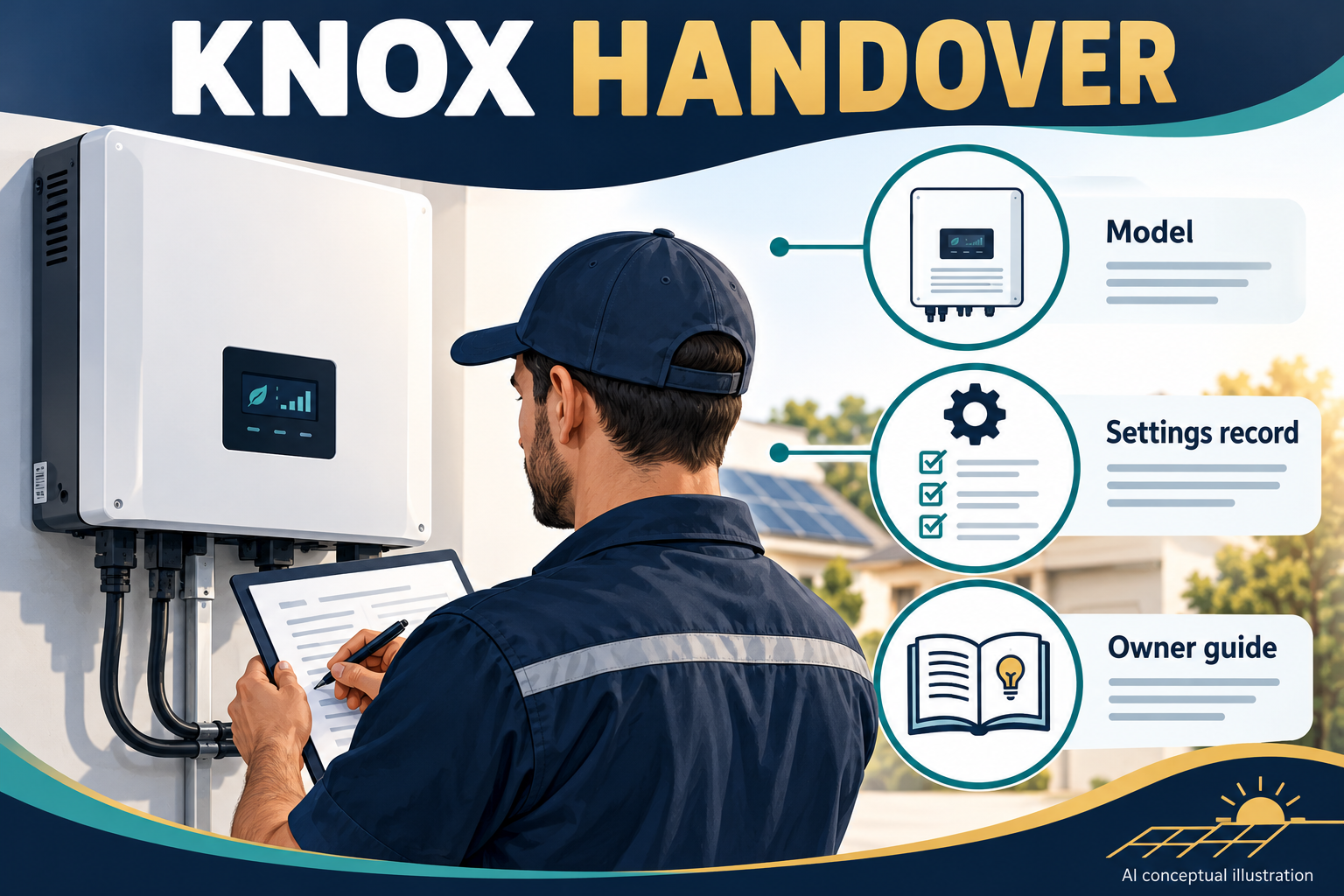
For a household or shop in Pakistan, handover should explain what the installed Knox inverter is configured to do, not merely show that its display lights up. A useful buyer file connects the physical unit, the agreed operating behaviour and the installer's test results. This is a documentation checklist, not a guide to changing electrical protection or battery settings yourself.
Identify the unit before discussing its settings
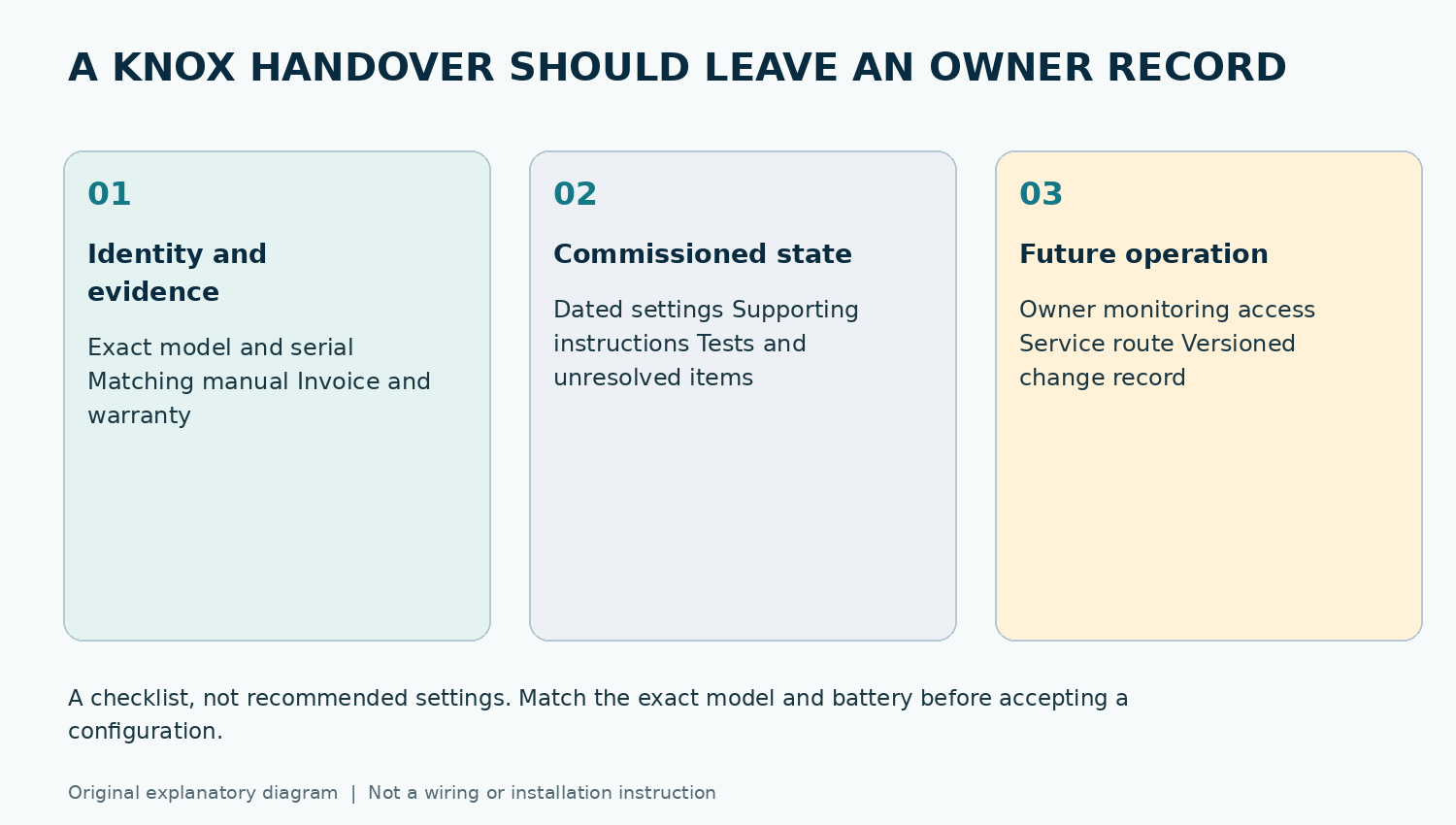
Ask the installer to record the complete model designation, serial number, installation date and displayed firmware version where available. Photograph the accessible identification label without opening the enclosure. Keep the matching user manual and dated datasheet, rather than a document for a similarly named series. NREL's operations-and-maintenance guidance recommends retaining equipment identities, manuals, as-built drawings and commissioning records. NREL document-management guidance
Knox's published Krypton 9000 datasheet, for example, names model 6.2kW-48-pV9000-TWIN and lists configurable output timing and prioritisation. That is model evidence, not permission to assume every Knox inverter has identical menus or operating options. If a quotation, webpage and supplied manual disagree, request written clarification before accepting the configuration. Official Knox datasheet
Make a dated settings record
Request a table containing each relevant menu name, the commissioned value, its purpose and the supporting manual reference. Depending on the actual model and installation, this may cover operating mode, source priorities, schedules, battery selection, communication protocol and export-control configuration. Mark unavailable features as not applicable. Screenshots help, but add a plain-language explanation of what the owner should expect.
Record who approved the settings and which battery manufacturer's instructions were used where storage is installed. NREL's commissioning example includes inverter set points and battery-charger settings based on battery-manufacturer recommendations. It is a general technical checklist, not a Pakistan-specific compliance certificate. Do not copy charging limits or protection thresholds from another installation, and do not treat factory defaults as evidence that the installed combination is correctly commissioned. NREL commissioning checklist
Ask for demonstrations and results not promises
Have the qualified installer explain and demonstrate the agreed operating states using the equipment's prescribed procedures. Identify which circuits are included in backup, where applicable, and which are not. Request a written record of tests performed, results, unresolved items and the responsible technician. NREL's example includes functional disconnects, loads, monitoring and appropriate electrical checks. Owners should not reproduce these checks by opening equipment or unplugging live connectors. Commissioning checklist, page 32
Make any unfinished task specific: what remains, who will resolve it and when the result will be supplied. A screenshot of power flowing at one moment should not replace the commissioning report.
Verify your monitoring access
Record the app actually supported by the installed unit and its logger identity. Knox publishes a KNOXHYBRID connection guide covering registration, device identification and a monitoring dashboard; confirm applicability rather than assuming it covers every Knox product. Ask the installer to show the correct device in the owner's account and explain its status indicators. Official Knox monitoring guide
Keep account recovery under the owner's control and store credentials privately, not in a publicly shared handover folder. Agree who may provide remote support. Learn how to capture the time, displayed fault code and operating context when reporting a problem, without changing settings to hide it.
Keep the service route with the documents
Retain the invoice, written warranty terms, installer contact, dated configuration and subsequent service changes together. NREL recommends version-controlled records so future technicians can distinguish the original installation from later modifications. NREL record-keeping guidance
For enquiries to Solaris Engineering, the official contact routes provided for this guide are its website and Facebook page. Their inclusion is not an endorsement or evidence of current stock, Knox authorisation, compatibility or commissioning quality. Ask the contracted supplier to confirm its responsibilities in writing.
Sources and references
- [1] KNOX Krypton 9000 — manufacturer datasheet KN27AUG25
Checked 2026-10-25
Inspected both PDF pages through web on 25 October 2026. Page 1 names model 6.2kW-48-pV9000-TWIN and configurable AC/PV output usage timer and prioritization. Used only for model identification and presence of configurable features, not numerical settings. Primary manufacturer document. Product-page prose and PDF disagree on some specifications, so neither is generalized to other models; no disputed specifications reproduced.
- [2] KNOX — Complete Inverter Wi-Fi Connection Guide
Checked 2026-10-25
Inspected full public manufacturer guide through web on 25 October 2026, especially registration, PN/logger identification and dashboard sections. Supports presence of a model-specific monitoring handover; article deliberately does not generalize its app/network instructions to every Knox unit.
- [3] NREL — Best Practices for Operation and Maintenance of Photovoltaic and Energy Storage Systems, 3rd Edition
Checked 2026-10-25
Primary laboratory technical report, December 2018, NREL/TP-7A40-73822. Inspected sections 6.4 and 6.4.1, printed pages 49–50 (PDF pages 62–63): equipment identities, manuals, commissioning records, change control and warranty documentation. Retrieved from laboratory's current docs.nlr.gov host; old nrel.gov links failed. General technical guidance, not Pakistani law or a Knox commissioning manual.
- [4] NREL — Installation, Operations, and Maintenance of Off-Grid Solar Systems
Checked 2026-10-25
Primary laboratory training material, Foundations of Off-Grid Solar in Haiti. Inspected disclaimer page 4 and commissioning checklist page 32 (PDF index 31). Supports qualified-professional safety boundary, recorded set points, battery manufacturer recommendations, functional loads/disconnects and monitoring verification. Clearly identified as general guidance, not Pakistan certification.
- [5] Solaris Engineering — official website contact route supplied for this guide
Checked 2026-10-25
User-designated official contact URL. Direct web open failed on 25 October 2026; therefore not used as technical evidence, stock verification, authorisation evidence or endorsement. Linked only as a contact route.
- [6] Solaris Engineering — official Facebook contact route supplied for this guide
Checked 2026-10-25
User-designated official contact URL. Direct web open failed/cache miss on 25 October 2026; not counted among the four successfully inspected primary technical sources. No Facebook claims or offers reproduced.