BATTERY BUYER GUIDE
Lithium-Ion vs Sodium-Ion Batteries: A Pakistan Solar Buyer’s Guide
Share on social media
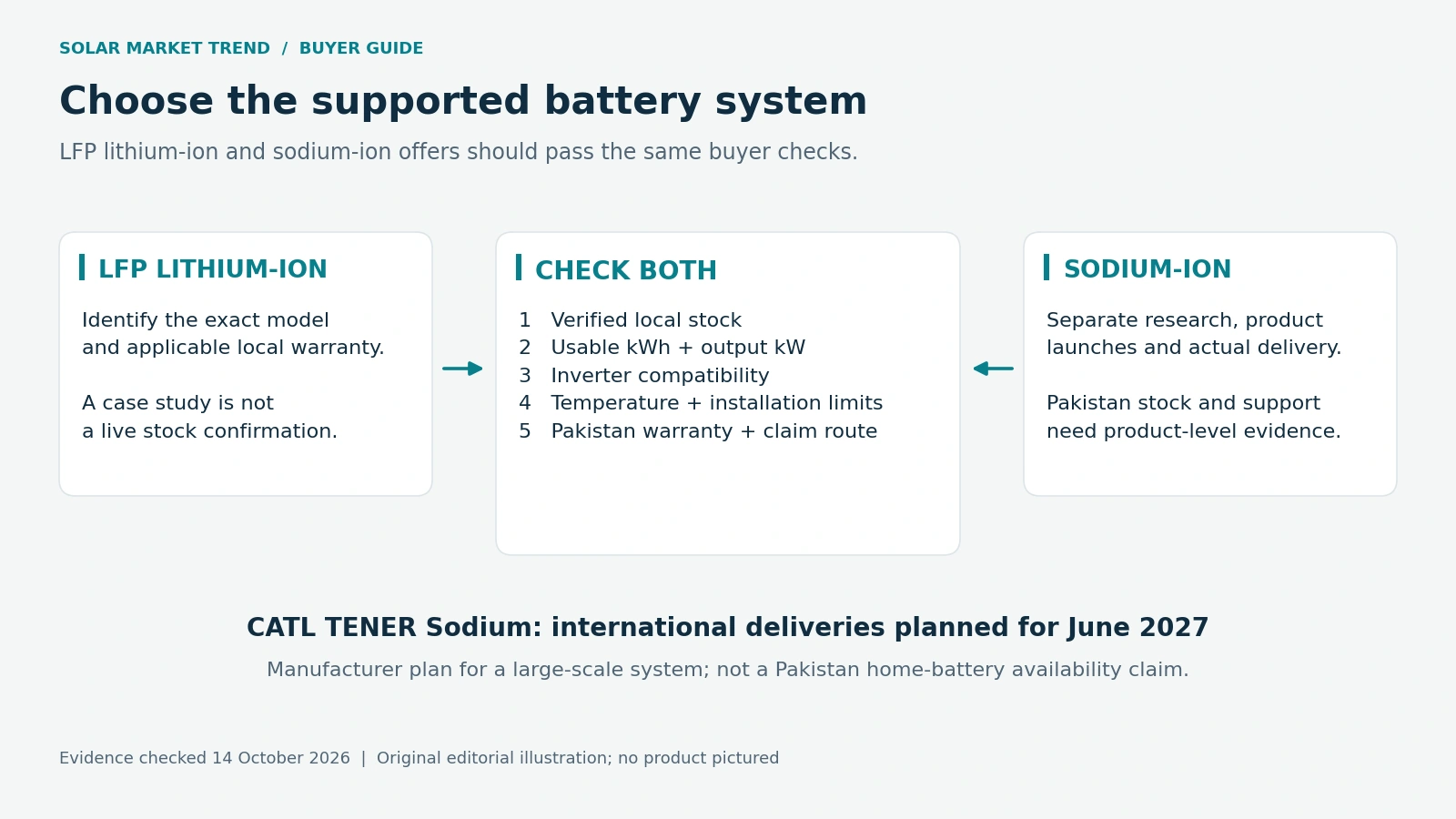
If you need dependable solar backup in Pakistan today, start by comparing documented lithium iron phosphate battery systems with verified local support. Sodium-ion deserves attention, but a technology announcement alone cannot tell you whether a particular home battery is available, compatible or covered by a usable warranty.
Our recommendation is practical: buy the complete, supported system that meets your household's requirements. Keep future battery promises separate from the equipment on your quotation. This guide was checked against public primary sources on 14 October 2026.
What is the difference between lithium-ion and sodium-ion?
Lithium-ion is a broad battery family. Lithium iron phosphate, usually written LFP or LiFePO4, is one member of that family. For example, Victron identifies its Lithium Smart batteries as LFP and explains how their cell-monitoring system works with a battery management system, or BMS. Compare an identified chemistry and product rather than an unspecified "lithium battery." Victron's product explanation
Sodium-ion batteries move sodium ions rather than lithium ions between their electrodes. Their attraction includes more widely available raw materials and potential supply-chain and cost advantages. IRENA also identifies trade-offs, including generally lower energy density and an industry that is still scaling. Chemistry, construction and application all matter; one universal specification cannot describe every sodium-ion battery. IRENA technology brief
Is sodium-ion commercially ready in 2026?
Commercial development has progressed beyond laboratory research. In June 2026, CATL announced its TENER Sodium energy-storage system, described manufacturing readiness and scheduled Chinese deliveries from September 2026. Its stated international delivery start was June 2027. Those are manufacturer announcements and delivery plans, rather than independent confirmation that every planned shipment has happened. The described system is large-scale storage. CATL's June 2026 announcement
That announcement does not establish the availability of a residential sodium-ion battery in Pakistan. For this review, we did not verify a specific sodium-ion home-storage offer backed by a manufacturer-issued Pakistani warranty and confirmed local stock. This is a limit of the evidence reviewed, not a claim that no seller anywhere can supply one.
There is clearer manufacturer documentation for LFP residential installations: Dyness publishes a Pakistan DL5.0C installation case. A case study demonstrates an installation, however, and should not be treated as today's stock confirmation or an endorsement of every dealer. Dyness Pakistan case study
Compare usable energy and output power
Ask for both usable kilowatt-hours and continuous output power. They answer different questions: how much energy you can draw, and how large a load the battery can support at once.
For an illustrative calculation, suppose a battery stores 5 kWh nominally and permits 90% usable discharge. That gives 4.5 kWh before downstream losses. A steady 1 kW load would have a theoretical 4.5-hour runtime before allowing for inverter consumption, conversion losses and reserve settings. These are assumed numbers, not specifications for a product.
Have the installer list the appliances you want during an outage. Separate essential lighting, fans and internet equipment from larger loads. Ask for a written runtime estimate and confirmation that the battery and inverter can support both continuous demand and appliance starting requirements.
Heat, safety and inverter compatibility
Demand the model's actual charging and discharging temperature limits. An impressive cold-weather result for one battery says little about the suitability of another battery for a hot enclosure.
Victron's Lithium Smart manual, for example, gives different permitted charging and discharging temperature ranges and describes BMS-controlled protection. Those limits belong to that product family; they should not be copied into another brand's settings. Victron operating conditions
Before purchase, ask the supplier to document:
- The exact inverter model and firmware supported
- Required communication cable and protocol
- Charge-current limits, protective equipment and installation clearances
- Indoor or outdoor suitability and any cooling requirements
- The installer responsible for commissioning and recording settings
Have a qualified installer follow the manufacturer's instructions. Do not assume a sodium-ion pack can replace an LFP pack simply because both are advertised as "48V."
Will sodium-ion cost less?
Lower-cost raw materials do not automatically mean a cheaper installed system. IRENA notes that sodium-ion's competitiveness depends on production scale and lithium-ion pricing. Its technology outlook is not a Pakistani retail price list. IRENA's cost discussion
Request itemised quotations that include delivery, protection, installation and any required inverter changes. Compare the installed total against usable capacity, then assess warranty and support separately. Avoid converting an overseas cell-price headline into an assumed Pakistan household price.
Read the warranty for Pakistan
Warranty years can vary by region and operating conditions. Dyness's published DL5.0C Asian warranty places Pakistan in its seven-year category and describes a shorter term for operation without communication. That is an example of why the applicable written document matters more than a generic advertising headline. Obtain the current terms for your exact unit and invoice. Dyness Asian warranty
The buying decision
For an immediate purchase, favour a documented system with confirmed stock, compatible equipment and a clear local claim route. Consider sodium-ion when a specific offer can pass those same checks. Waiting makes sense only if your existing backup remains adequate and you are comfortable with uncertain product and delivery timing.
Before paying, collect the datasheet, serial numbers, invoice, applicable warranty, installation plan and written load estimate. Those documents will help you judge either chemistry far more reliably than an exciting announcement.
Editorial note: AI-assisted, source-checked buyer guidance. Sources checked 14 October 2026.