SOLAR INVERTER BUYER GUIDE
MPPT in Solar Inverters: Why Tracker Count Is Not the Whole Design
Share on social media
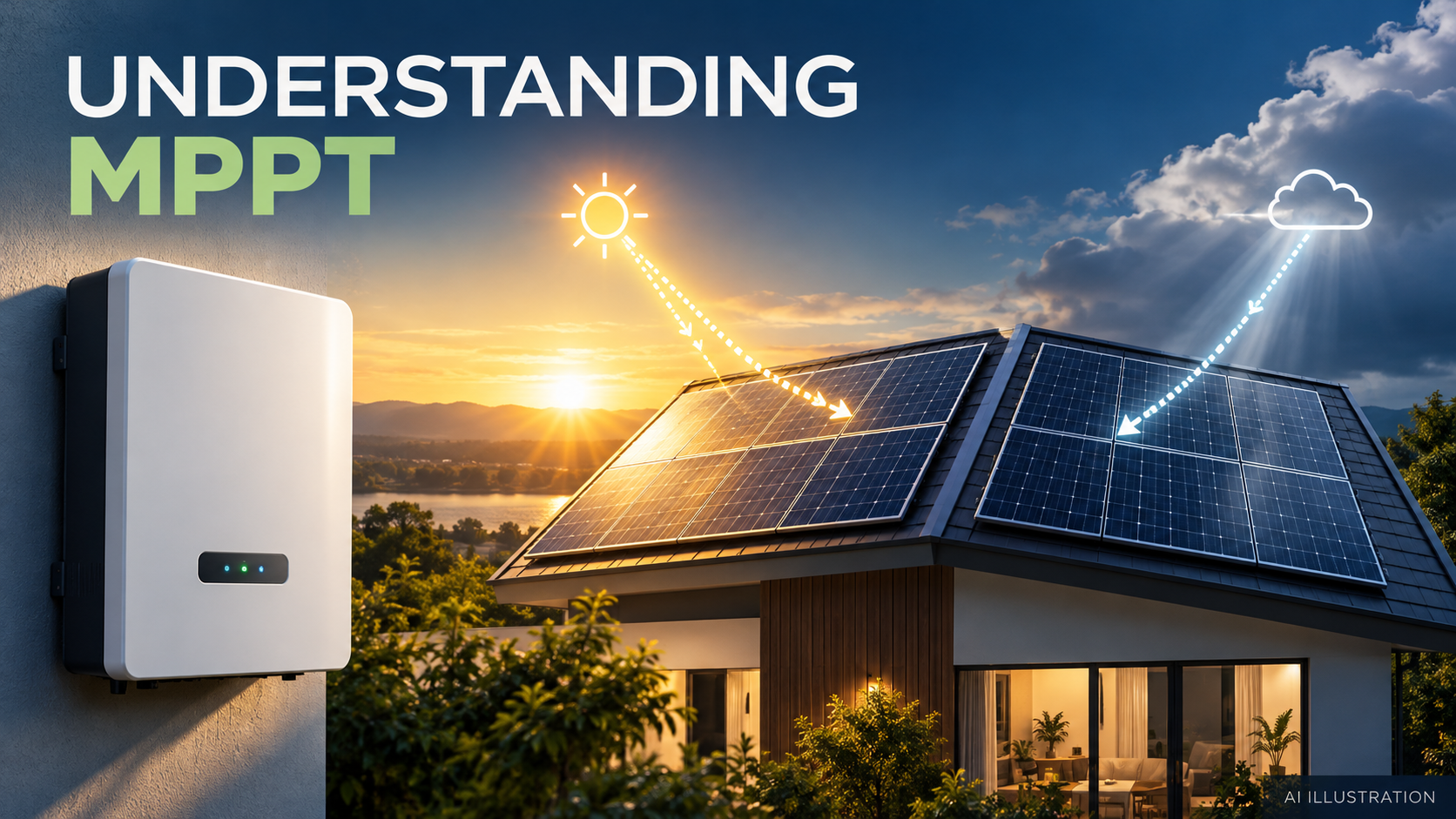
Understand independent MPPTs, shared inputs, current limits and voltage windows before comparing inverter specifications for a Pakistani rooftop.
Start with the roof, not the tracker total
A quotation advertising more MPPTs can sound automatically better. The useful question is what those trackers will do on your particular roof. A uniform array and a roof divided by different slopes, orientations or moving shadows present different design problems. The inverter should match those conditions, rather than win a specification-sheet contest.
MPPT means maximum power point tracking. The control system adjusts the electrical operating point of the connected PV array as sunlight and module temperature change. An independent tracker can seek an operating point separately from another tracker. It does not physically turn the panels toward the sun. [1]
Count independent trackers separately from connections
An inverter can have more DC connection positions than independent trackers. Several connections may share the same tracking channel, so plugging strings into different sockets does not necessarily give them independent control.
For a concrete, model-specific example, Fronius lists two MPP trackers and a “2+1” DC connection arrangement for its Symo GEN24 5.0. That is not three independent trackers. The example explains the terminology; it is not a product recommendation or a specification for every GEN24 model. [2]
Ask for a drawing that identifies which roof sections connect to each independent tracker and which connections share a channel. A quotation that only states “multiple PV inputs” leaves this important question unanswered.
Read the voltage and current limits together
Tracker count says little about whether the proposed modules suit the inverter electrically. Important fields include the permitted DC voltage, startup voltage, MPPT operating range, any narrower full-power range, usable current and short-circuit current limits.
These labels are not interchangeable. SMA's Sunny Tripower 125 documentation, for example, distinguishes an MPP voltage range from the range for rated power. An inverter being able to track at a particular voltage therefore does not automatically mean it can deliver its full rated output there. [3]
Huawei's regional specification page for the SUN2000-3/4/5/6/8/10KTL-M1 High Current Version separately lists input current per MPPT, short-circuit current and inputs per tracker. Preserve that exact version description when comparing proposals. A similarly named model or another regional variant should not inherit those specifications by assumption. [4]
Have the designer document compliance for the exact module and inverter combination across the site's expected conditions. A spare connection is not evidence that another string can safely be added.
Treat orientation and shade as different design questions
Different orientations can make independent tracking useful, but “one roof direction always needs one MPPT” is too absolute. SMA documents a conditional polystring arrangement in which differently oriented strings share a tracker. It specifies matching electrical characteristics and other design requirements. This is a professional design option, not permission to combine arbitrary arrays. [5]
Shade needs its own analysis. A parapet or water tank on a Pakistani rooftop can affect different modules as the sun moves. In its guidance for strongly shaded arrays, SMA recommends separating shaded and unshaded groups and considering the tracking algorithm's ability to locate multiple power peaks. More trackers alone cannot compensate for an unexamined shading pattern. [6]
Ask the installer to compare the proposed layout against a sensible alternative using a site-specific shade and yield assessment. The question is how much useful energy the additional tracking flexibility is expected to recover, not simply whether the hardware offers it.
Ask for a design explanation you can keep
Before accepting an inverter proposal, request clear answers to these questions:
- What are the full module and inverter model codes, regional versions and supporting datasheet revisions?
- Which independent tracker serves each roof section, and why was that grouping selected?
- Which inputs share current limits, and has the designer checked the proposed array against every relevant limit?
- Are startup, operating and full-power voltage requirements addressed separately?
- What seasonal shading assumptions were used, and which shade-management features apply to this model?
- What changes would be required for a future expansion?
Keep the approved layout and commissioning records with the quotation. They make later performance checks more meaningful than comparing your daily graph with a neighbour's system.
Choose demonstrated suitability
A higher MPPT count can provide valuable flexibility. It can also add little when the roof and electrical design do not need it. Judge the complete proposal by its documented compatibility, realistic energy estimate and explanation of tracker allocation.
This guide is for reviewing a professional design, not calculating or changing string wiring. PV circuits can remain live in daylight. Leave connection changes and electrical testing to a qualified installer. [1]
Sources and references
- [1] SMA: PV Inverters – Basic Facts for Planning PV Systems
- [2] Fronius: Symo GEN24 5.0 technical data
- [3] SMA Sunny Tripower 125 operating manual: DC Input
- [4] Huawei Egypt: SUN2000-3/4/5/6/8/10KTL-M1 High Current Version specifications
- [5] SMA commercial system planning: Polystring operation
- [6] SMA commercial system planning: Shade Management with SMA ShadeFix