SOLAR POLICY GUIDE
Net Metering Latest Update in Pakistan October 2026 Rules Explained
Share on social media

A source-checked October 2026 guide to new net billing, protection for qualifying older agreements, the 25 kW approval change and pending transition applications.
Pakistan’s net-metering update needs two separate answers: what applies to a new solar connection, and what protects an older agreement. Treating every solar customer as having the same billing arrangement can produce an expensive mistake.
This October 2026 review was checked against official sources on 17 October. NEPRA’s legal index lists the February Prosumer Regulations alongside subsequent April and August notifications. Read them together, rather than relying on the original February document alone. [7]
The four notifications that matter
- 9 February 2026: S.R.O. 251 introduced the Prosumer Regulations, effective immediately, replacing the 2015 framework subject to its savings provisions. New-framework billing separates electricity imported from the grid from electricity exported to it. [1]
- 2 April 2026: S.R.O. 547 replaced the transitional protection clause. Qualifying existing agreements retain the earlier rate and billing mechanism until their term expires, subject to the modification exception explained below. This amendment expressly applies retrospectively from 9 February. [2]
- 28 April 2026: S.R.O. 709 set the concurrence-application fee at nil for facilities of 25 kW or less, and PKR 1,000 per kW as a one-time NEPRA fee above 25 kW. It is also deemed effective from 9 February. [3]
- 6 August 2026: S.R.O. 1330 removed the NEPRA-concurrence requirement for facilities of 25 kW or below. The relevant distribution licensee now provides the approval for that category. [4]
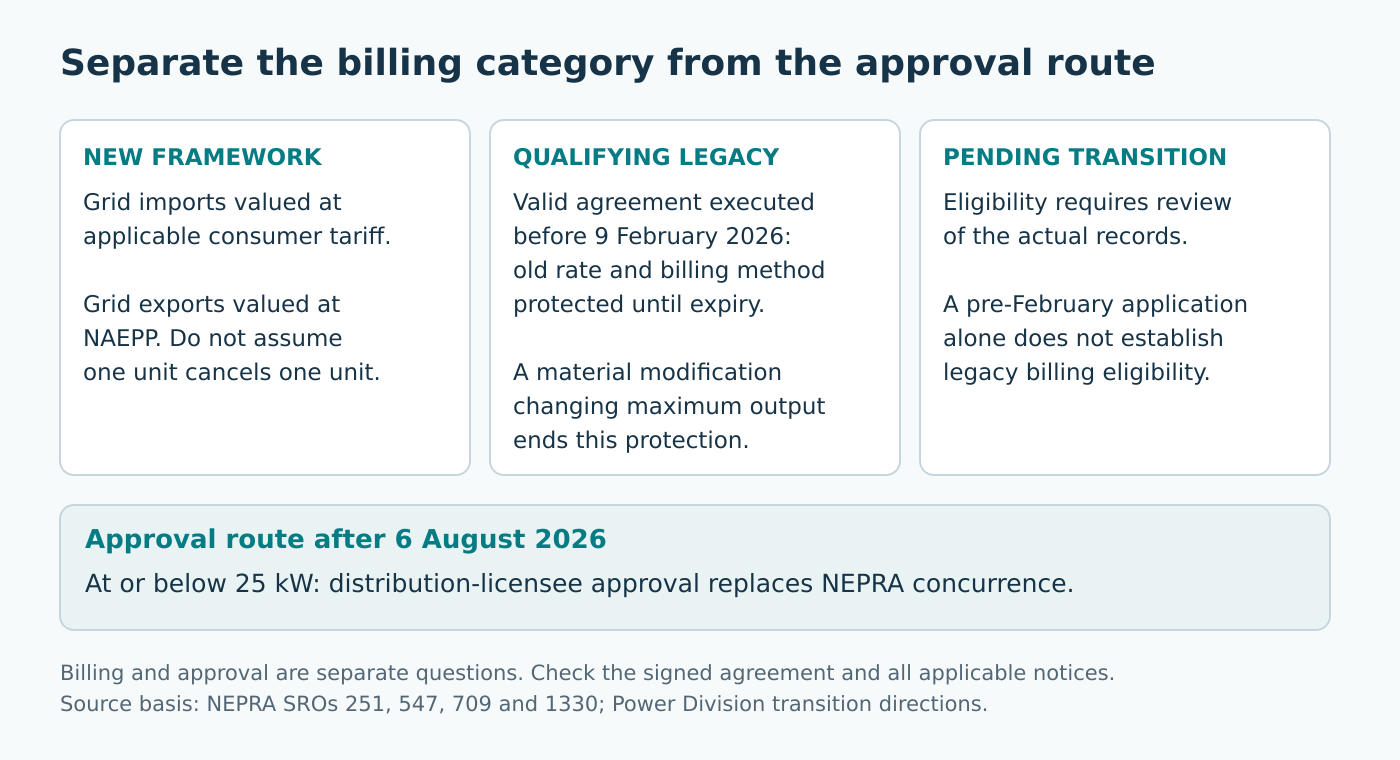
The August amendment is an approval-process change. Its text does not restore the older billing arrangement for new small systems. A claim that every new residential installation qualifies for legacy net metering therefore needs a separate, applicable legal basis. [4]
New applicants understand net billing before calculating savings
Regulation 14 prices grid imports at the applicable consumer tariff and exports at the National Average Energy Purchase Price, or NAEPP. Where export value exceeds import value, the regulation provides for credit to the next billing cycle or quarterly payment. It also allows NEPRA to revise the applicable rate by notification during an agreement. [1]
That is a monetary-credit arrangement, so do not assume one exported unit cancels one imported unit. Ask for a calculation that separates expected daytime self-consumption, exports and grid imports. Compare proposals using your own consumption pattern, not another household’s bill.
This article does not quote a single current rupee-per-unit export rate. The governing formula is verified, but a rate used in a purchase decision should be matched to the applicable notification and billing period. An old screenshot or an installer’s verbal estimate is not sufficient evidence.
Existing customers check the agreement before expanding
The April amendment protects a distributed generator holding a valid agreement executed under the repealed framework before the new regulations commenced. Its protection covers both the old rate and the old billing mechanism, rather than merely preserving an export price. [2]
There is a significant exception: protection ceases where a material modification changes the facility’s maximum electrical output. Before accepting an expansion quotation, obtain written confirmation of the proposed modification’s regulatory and billing treatment. Do not assume that an existing meter automatically preserves the previous arrangement after a capacity change. [2]
Keep the signed agreement, approval or concurrence, commissioning record and recent bills together. Ask the distribution company to identify your agreement’s expiry date and the basis for any proposed change in billing. This document-first approach is more useful than debating whether your installation is simply “old” or “new.”
Pending pre February cases received separate attention
A Power Division announcement dated 25 August 2026 addressed pending transition cases. It directed distribution companies and PITC to verify records, with particular emphasis on demand notices paid before 9 February and completion of the prescribed formalities. It should not be read as automatic legacy eligibility for anyone who merely submitted an early application. [5]
On 5 September, the government reported that 11,695 of 16,654 pending applications had been cleared, with 4,959 still under verification. Those are September progress figures, not a verified October backlog count. The announcement also warned that consumers need not pay an individual to expedite or further process these applications. [6]
If your case remains unresolved, prepare a dated evidence bundle: application acknowledgment, demand notice, proof of payment, agreement, licence or concurrence, and meter-related records where available. Request a written status against those records. A general news announcement cannot establish an individual customer’s eligibility.
Avoid confusing proposals with operative notifications
NEPRA’s February consultation document contains blank notification fields and identifies itself as a draft seeking public opinion. It is not the signed April amendment. The final April text also includes the material-modification exception, which the earlier draft does not contain. [8] [2]
Similarly, the March 2025 ECC announcement belongs to the policy-development history. It discusses proposed guidelines and Cabinet ratification; it should not replace the later notified 2026 regulations when explaining today’s billing framework. [9]
Five questions before you commit to a system
- Which billing framework will apply to this specific connection, and what document establishes that?
- What import tariff and export-rate notification does the quotation use, and for which billing period?
- For a system at or below 25 kW, does the application follow the August distribution-licensee approval route?
- Are connection, metering, installation and approval-related charges separately itemised, with receipts and responsible parties identified?
- If modifying an older installation, has the potential loss of transitional protection been assessed in writing?
The practical takeaway is to establish your connection’s legal category before choosing system size or accepting a savings projection. The latest rules make the agreement, amendment history and approval pathway essential parts of a solar purchase. This is a general regulatory explainer, not a determination of any individual account or a guarantee of approval or returns.
Sources and references
- [1] NEPRA (Prosumer) Regulations, 2026, S.R.O. 251(I)/2026
Notified base regulations. Read regulations 1, 14 and 21; regulation 21(2) is superseded by S.R.O. 547 and approval provisions are amended by S.R.O. 1330.
Source date: 2026-02-09. Verified: 2026-10-17.
- [2] NEPRA S.R.O. 547(I)/2026: amendment to regulation 21(2)
Signed notified amendment replacing the legacy-protection clause; deemed retrospective effect. Includes maximum-electrical-output material-modification exception.
Source date: 2026-04-02. Verified: 2026-10-17.
- [3] NEPRA S.R.O. 709(I)/2026: concurrence application fees
Notified fee schedule: nil at or below 25 kW and PKR 1,000/kW above 25 kW; deemed retrospective effect. Read with August removal of concurrence for <=25 kW.
Source date: 2026-04-28. Verified: 2026-10-17.
- [4] NEPRA S.R.O. 1330(I)/2026: prosumer approval amendments
Signed notified amendment: <=25 kW facilities need distribution-licensee approval instead of NEPRA concurrence; related wording changes in regulations 3 and 4 and Schedule I. No separate commencement or retrospective date appears in this one-page notice.
Source date: 2026-08-06. Verified: 2026-10-17.
- [5] Power Division Moves to Expedite Net-Metering Approvals Following Regulator’s Directives, PID PR No. 295
Official implementation statement about pending transition cases, documentary verification and pre-9-February demand-notice payment. Not a substitute for individual eligibility verification.
Source date: 2026-08-25. Verified: 2026-10-17.
- [6] 11,695 Pending Net Metering Applications Resolved; Direct Contact with Consumers Initiated, PID PR No. 57
Official dated progress report: 16,654 transition applications, 11,695 cleared, 4,959 under review on that date, plus warning against payments to individuals for processing.
Source date: 2026-09-05. Verified: 2026-10-17.
- [7] NEPRA legal index: Prosumer Regulations and amendments
Live index checked 17 October 2026, entries 3.32 through 3.32.3. Used to identify the amendment chain, not as a consolidated legal text.
Source date: Undated public document. Verified: 2026-10-17.
- [8] Draft amendment to NEPRA Prosumer Regulations for public opinion
Explicit draft with blank date and SRO number; February 2026 consultation record, not operative final notification. Used only to explain draft/final distinction.
Source date: Undated public document. Verified: 2026-10-17.
- [9] ECC Approves Amendments to Net-Metering Regulations to Address Growing Burden on Grid Consumers, PID PR No. 85
Historical policy announcement including proposed guidelines and Cabinet-ratification language. Not used as current authority for export rates or eligibility.
Source date: 2025-03-13. Verified: 2026-10-17.