LOCAL MANUFACTURING
Manufacturing Pixel Distribution Boxes in Faisalabad, Pakistan: Local Production, Practical Quality
Share on social media
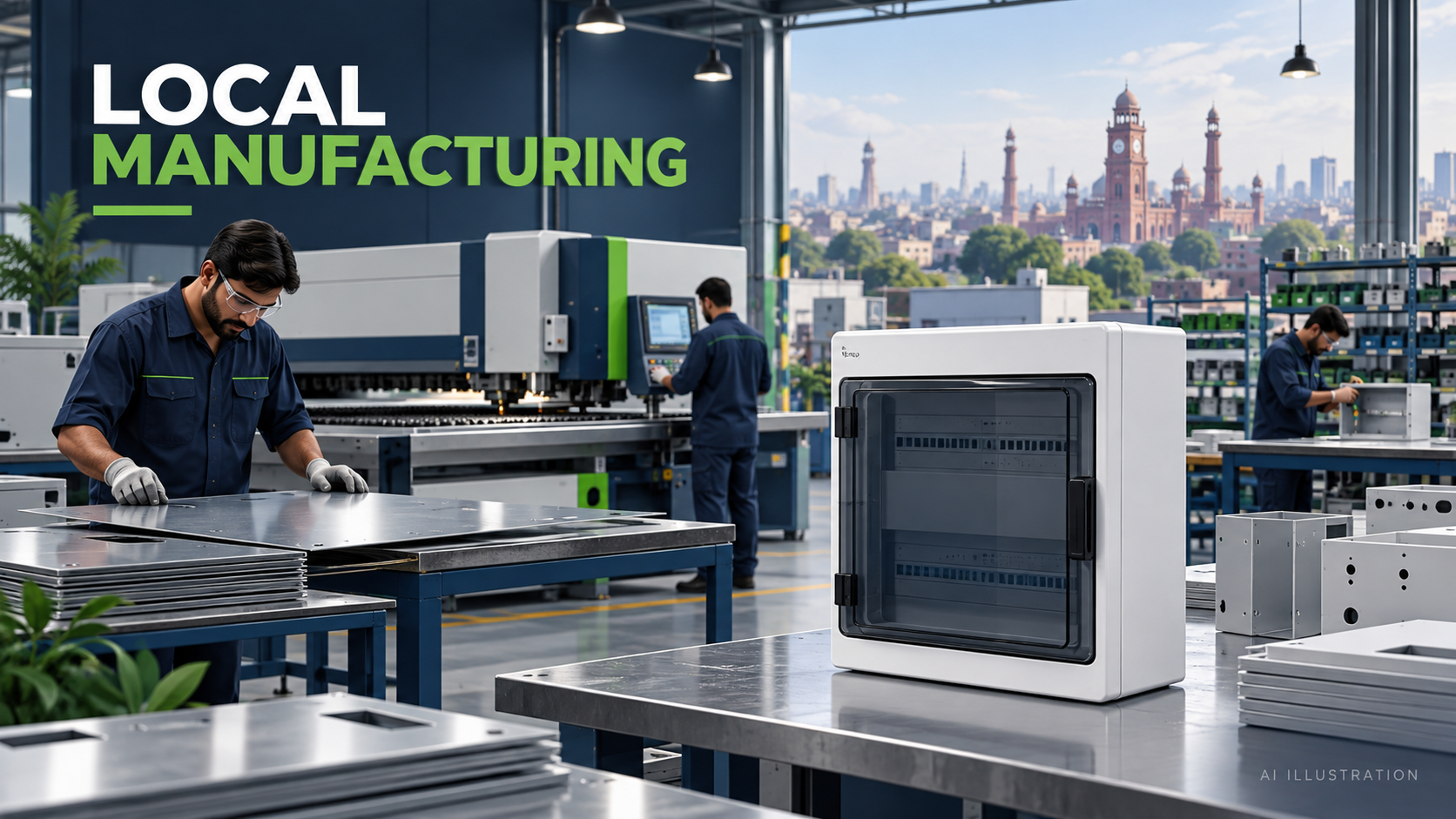
A transparent look at Pixel Voltic’s company-described local manufacturing approach, with practical questions installers and buyers should ask before specifying a distribution box.
A local manufacturing story, with quality at its centre
A distribution box may look like a small part of a solar installation, but it deserves serious attention. It is where enclosure design, protective-device selection and installation workmanship meet. For a homeowner, it should be understandable. For an installer, it should be practical to assemble, label and maintain. For a manufacturer, it is an opportunity to turn careful design into a consistent product.
According to founder Awais Farooq, Pixel Voltic manufactures distribution boxes in-house in Faisalabad, Pakistan, as part of a broader ambition to build local manufacturing capability. This manufacturing description is company-provided, not an independent factory audit. Pixel Voltic’s public website separately identifies electrical distribution boxes among its product categories and lists a Faisalabad business address. [1]
What does “locally manufactured” mean for a buyer?
The useful question is not simply whether a product is local or imported. It is which parts are manufactured locally, which components are sourced elsewhere, and who takes responsibility for the finished product. Local manufacture does not automatically mean every part is Pakistani-made.
For a buyer, the potential advantage is a closer conversation with the business behind the enclosure. Dimensions, mounting preferences, replacement requirements and installer feedback can be discussed directly. These are opportunities created by local production, not promises that every custom request, delivery date or spare part is guaranteed. Confirm such details in the written quotation.
From an enclosure idea to an installer-friendly product
A practical manufacturing review starts before a box is finished. The proposed layout should allow room for the intended devices and cable routing, rather than simply fitting the largest possible number of components into the smallest space. Access for maintenance, clear identification and sensible installation arrangements belong in the design conversation.
For a metal enclosure, buyers can ask how edges, mounting points, cover alignment and the surface finish are checked. They can also ask how protective-earth connections are provided where required by the design. These are suggested review questions, not claims that a particular Pixel production process or test has been independently witnessed.
A sample can make that conversation concrete: inspect how the cover closes, whether the selected devices fit properly, and whether the proposed installation leaves the electrician sufficient working space. Final electrical suitability still needs assessment by a qualified professional.
An empty box and a complete distribution board are different
A good-looking enclosure is not the same thing as a fully verified electrical assembly. The completed board also depends on the devices fitted inside, connections, ratings and intended operating conditions. Buyers should establish whether a quotation covers an empty enclosure, a partially equipped box or a complete assembled board.
IEC 61439-3:2024 addresses distribution boards intended to be operated by ordinary persons within its stated scope. Photovoltaic assemblies can have different requirements; IEC 61439-8:2026 addresses assemblies used in PV installations. Mentioning these standards does not establish that any Pixel model is certified to them. Request model-specific documentation and have the applicable requirements checked for the actual application. [2][3]
Five questions before placing an order
- Which exact model, dimensions and mounting arrangement are included?
- Is the product an enclosure only, or does it include named protective devices and wiring?
- What evidence supports its declared electrical and environmental ratings?
- Which installation instructions, identification labels and warranty terms are supplied?
- Who handles a mismatch, damaged delivery or later replacement requirement?
Record the answers against the model being purchased. Avoid carrying a specification from one product photograph or catalogue entry across the entire range.
Building confidence in Pakistani manufacturing
Pixel Voltic’s local-manufacturing story is strongest when it combines ambition with verifiable product information. Clear drawings, consistent samples, written specifications and responsive handling of feedback give customers something more useful than broad quality slogans.
For installers and dealers considering Pixel DBs, the next step is straightforward: share the application, obtain the current model details and review a sample before committing to a larger order. Supporting local manufacturing and asking demanding technical questions are not competing goals. Together, they create a better standard for products made in Pakistan.