SOLAR ELECTRICAL PROTECTION GUIDE
RCDs for Solar Inverters: Read the Type, Not Just the Amps
Share on social media
Understand RCD type, current rating and sensitivity, then check the exact inverter manual and installation design before buying solar protection.
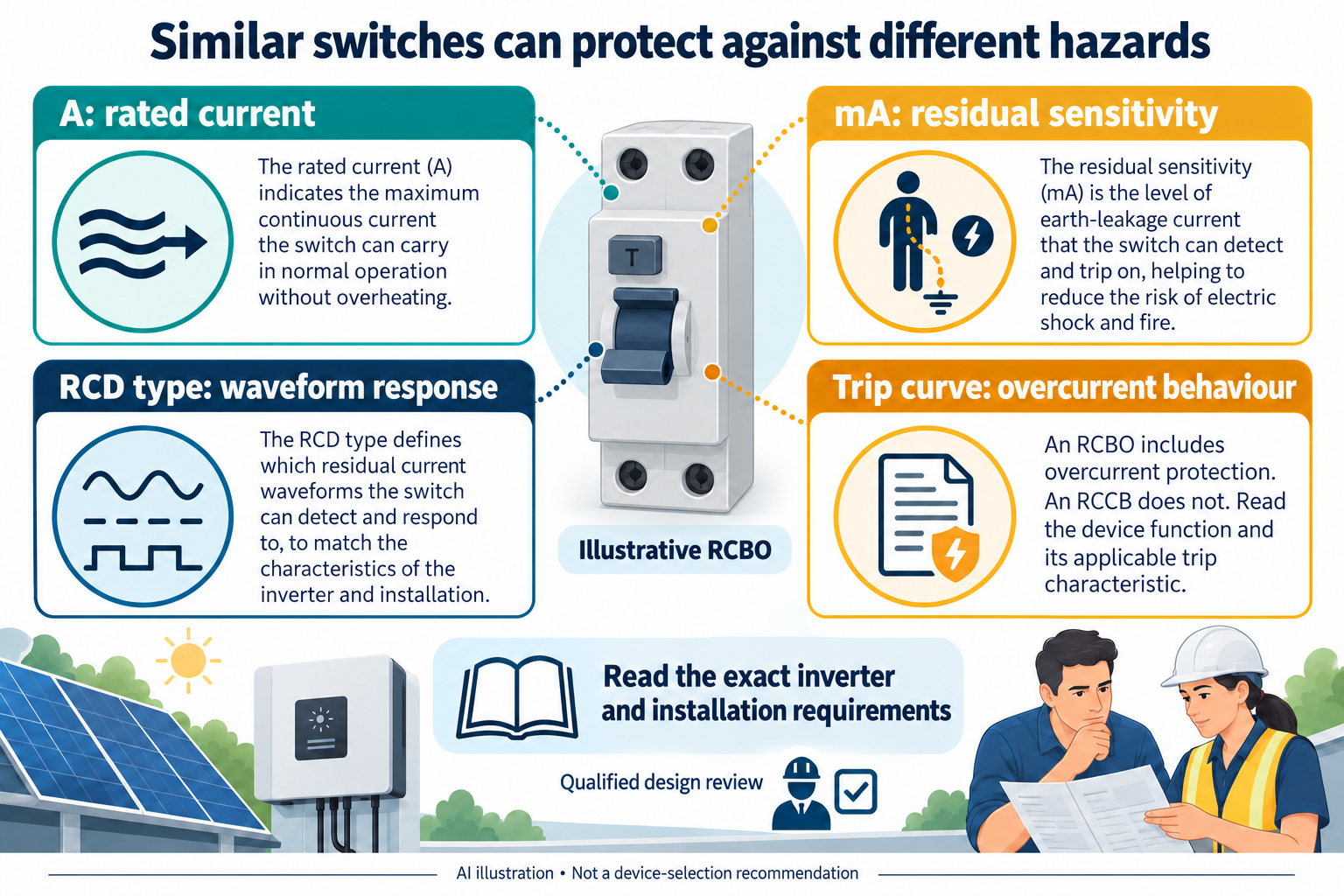
Original companion diagram
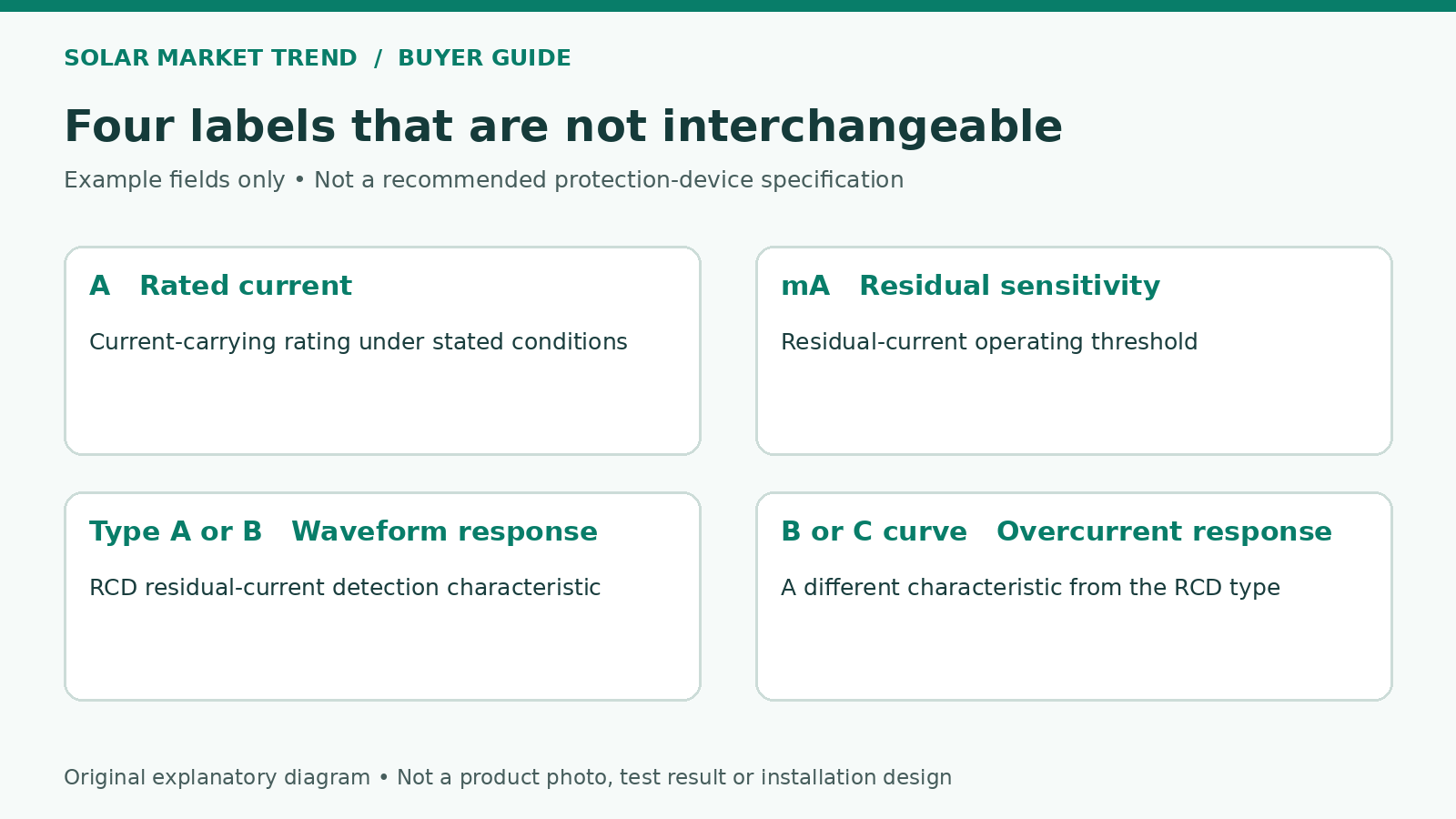
A familiar switch can perform a different job
A solar distribution board can contain several devices with similar handles but different protective functions. Buying the cheapest device with the same ampere number is not a reliable replacement method. For a Pakistani home or business, the important question is what hazard each device addresses and whether the complete protection arrangement matches the inverter and installation.
An RCCB provides residual-current protection but does not include thermal-magnetic overcurrent protection. An RCBO combines residual-current and overcurrent functions. An ordinary overcurrent breaker is not automatically an RCCB or RCBO. Schneider Electric explicitly distinguishes these functions in its technical FAQ. The distinction concerns the device, not a promise that any one component makes an installation safe. [1]
Separate the numbers on the label
Current rating in amperes and residual-current sensitivity in milliamperes describe different things. The first concerns the device’s rated current; the second concerns its residual-current operating threshold. Do not treat a higher ampere number as evidence of more sensitive leakage protection.
A useful real example is Schneider Electric’s R9D01616 listing: it separately identifies 16 A, B curve, Type A residual-current protection and 30 mA sensitivity. This is a label-reading example from its Netherlands catalogue, not a recommendation for a Pakistan inverter circuit or confirmation of local availability. The B curve and Type A coexist because they describe different characteristics. [2]
Type A and Type B are not quality grades
RCD type describes the residual-current waveforms the device can respond to. Hager’s selection guidance distinguishes Type AC for sinusoidal AC, Type A including pulsating DC, Type F for additional frequency-related conditions, and Type B including smooth DC residual current. These are application distinctions, not a simple good-better-best ranking. [3]
Electronic equipment makes waveform suitability important. However, a generic list showing PV beside Type B is not enough to override the exact inverter manufacturer’s declaration. Conversely, a salesperson saying every solar inverter works with Type A is too broad. The manufacturer’s documented design and the applicable installation requirements must be considered together. [3,4]
Read the exact model and firmware conditions
SMA’s declaration dated 9 May 2025 lists specific Sunny Boy, Sunny Boy Smart Energy, Sunny Boy Storage, Sunny Island and Sunny Tripower models as compatible with Type A RCDs. It also gives firmware-dependent conditions for some models. The document itself says the need for an RCD and permissible types depend on the applicable installation regulations. [4]
A separate Sunny Tripower manual page states compatibility with Type A and B devices of 100 mA or higher for the models covered by that manual. This does not mean 100 mA is the right personal-protection threshold for every circuit, nor that the 30 mA conditions in a different declaration can simply be copied across products. Read the model, revision and context rather than selecting the most convenient sentence. [5]
Ask for a documented selection before installation
Request the exact inverter model, firmware where relevant, manufacturer RCD guidance, protection-device part number, residual-current type, rated current and sensitivity. Have the qualified designer explain which circuit the device protects and how it coordinates with the other protection. Obtain the applicable local requirements from the responsible professional rather than importing a UK or European rule from a web article.
Keep that evidence with the invoice and commissioning record. If the proposed device changes during procurement, require the selection to be checked again. Two products carrying the same ampere marking can differ in residual-current function, waveform response and other essential ratings. The manufacturer examples here explain how to compare documentation; they do not establish a universal approved bill of materials. [1–5]
Treat repeated tripping as a fault to investigate
Do not remove or bypass protection, or increase its threshold merely to stop nuisance trips. Ask a qualified electrician to investigate the installation and confirm the manufacturer’s requirements before changing equipment. A change that restores power is not by itself evidence that protection remains suitable.
This guide is procurement education, not live-work or wiring instruction. Its sources were checked on 19 October 2026. They do not establish Pakistan-specific statutory requirements, the condition of any existing installation, or approval for a particular RCD substitution.