SOLAR BATTERY CALENDAR AGEING GUIDE
Solar Battery Calendar Ageing Why Low Cycle Counts Do Not Mean No Wear
Share on social media
Learn why time, storage conditions and operating history matter alongside cycle count, and what evidence a buyer should request before accepting a long-life claim.

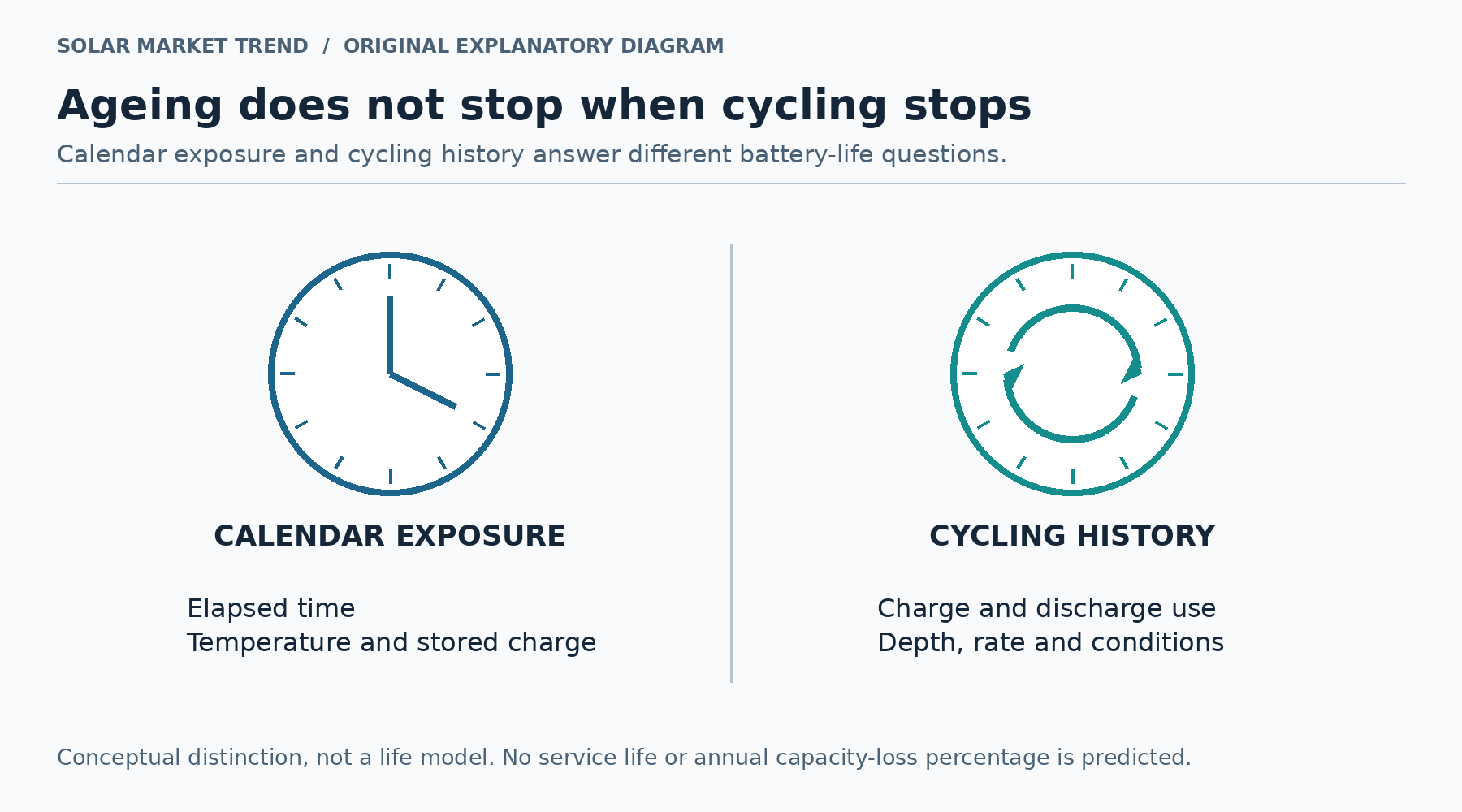
A lightly used battery can still grow older
A battery installed mainly for backup may complete relatively few charge-discharge cycles. That does not put its chemistry on pause. Calendar ageing describes deterioration associated with time and the conditions in which the battery spends that time; cycling introduces additional stresses associated with use. The National Laboratory of the Rockies treats both calendar time and cycling as necessary parts of battery-lifetime modelling. [1]
For a Pakistani household or business, the purchasing implication is straightforward: a large advertised cycle figure does not answer how an occasionally used backup battery will perform after many years. Ask about the evidence for the intended duty, not just the largest number on the brochure. This is a guide to interpreting ageing evidence, not a warranty comparison or a forecast for any named product.
Loss of stored charge is not the same as loss of capacity
A battery can return from an idle period with less charge remaining without having permanently lost that same amount of storage capacity. In a 2022 experimental study, researchers distinguished reversible self-discharge and related reversible effects from irreversible calendar-related capacity loss. Their results also showed why a short accelerated measurement should not be converted casually into a precise lifetime estimate. [3]
This is why a single before-and-after dashboard reading is weak evidence for permanent ageing. Conversely, recharging successfully does not establish that the unit retains its original capacity. Ask how health was measured, under what test conditions, against which initial reference and with what uncertainty. Repeated comparable observations are more useful than one attractive reading selected for a sales demonstration.
What temperature and charge level can change
Schimpe and colleagues studied a commercial Sony US26650FTC1 lithium-iron-phosphate/graphite cell in storage and cycling tests for a 2018 primary research paper. Within their tested storage conditions, warmer temperatures and higher state of charge were associated with faster capacity loss. The fitted behaviour was not a simple universal straight-line relationship. [2]
The technical explanation includes side reactions that consume lithium available for normal cycling; growth of the solid-electrolyte interphase at the anode is an important mechanism in the study. This interface is part of how the cell functions, not a foreign substance that an owner can clean away. [2]
Do not turn those findings into a fixed annual percentage for every LFP pack, a claim that a fully charged battery is automatically unsafe, or a home-made charging limit. Cell design, electrolyte, pack controls and actual conditions matter. A result for one tested cell is evidence about that experiment, not a certificate for every cabinet using the same chemistry name.
Ageing history is more complicated than two independent counters
Calendar time continues while a battery is in service, so calendar and cycling effects are not two separate lifetimes that can simply be added. NLR describes models that account for operating windows, temperatures, charging and discharging rates, storage environment and cycling patterns together. [1]
A Jülich-hosted original-study abstract reports tests on 50 LFP/graphite cells and notes non-obvious behaviour, including early reversible capacity increases and different ageing behaviour at elevated temperature. [4] The point is not to reproduce its unusual results as buying rules. It is to recognise that real measurements can depend on mechanism and test history. A smooth generic curve or a cycle-counter screenshot cannot, by itself, establish the remaining life of a specific retail pack.
Request a lifetime claim that can be checked
Our suggested evidence request begins with product identity: which cell and complete battery model was tested, and is it the same version being offered? Then ask for the temperature history, state-of-charge window, time spent resting, charge and discharge protocol, test duration and the capacity or power threshold used to define the end of the test.
Separate a measured result from an extrapolation. If a seller presents a ten-year forecast, ask how much real elapsed-time data supports it, what model extends that data and which conditions could invalidate the forecast. Ask whether the evidence concerns cells alone or the assembled battery, including its controls and auxiliary equipment. These are verification questions, not a demand that a manufacturer expose confidential designs. A limited public dataset can still be useful if its limits are stated honestly.
Balance standby readiness with the approved operating strategy
A backup system has a service objective: enough available energy when the grid fails. A strategy that keeps less reserve may conflict with that objective, even if it appears attractive in a simplified ageing comparison. The right decision depends on the load that must be supported, outage expectations and the manufacturer's permitted operating strategy, not on a universal internet percentage.
For long periods out of service, use the exact storage procedure rather than treating everyday operating settings as storage instructions. BYD's LV Flex manual, for example, has a separate maintenance-and-storage table relating conditions to storage time. [5] Ask your installer to document which procedure applies when the premises are occupied, unattended or shut down. Do not defeat protection, temperature limits or required service procedures in pursuit of an assumed longevity gain.
Keep records that make future decisions possible
At handover, retain the battery identity, commissioning date, initial diagnostic report, manufacturer documents and the agreed operating purpose. Thereafter, keep service records and available logs of temperature, alarms and usage. Record changes in the system or load so a later reduction in backup duration is not automatically blamed on the battery chemistry.
When performance changes, ask the qualified service provider to assess the battery and system under comparable conditions. Do not infer permanent ageing solely from one shorter outage run, and do not dismiss a consistent trend merely because the cycle count remains low. The useful conclusion is modest but important: cycle count is one piece of history, not the whole condition report. A credible lifetime discussion combines time, conditions, measured performance and uncertainty without promising that any one setting will stop ageing.
Sources and references
- [1] National Laboratory of the Rockies Battery Lifespan research overview
Current official research overview checked 22 October 2026; publication date not stated · Checked 2026-10-22
Both calendar and cycle ageing; multi-factor lifetime models and health diagnostics.
Research overview, not a prediction for an individual Pakistan installation.
- [2] Schimpe and colleagues Comprehensive Modeling of Temperature-Dependent Degradation Mechanisms in Lithium Iron Phosphate Batteries
Journal of The Electrochemical Society 165 A181-A193, published 12 January 2018; DOI 10.1149/2.1181714jes · Checked 2026-10-22
Original LFP/graphite storage and cycling experiments; higher storage temperature and SOC effects within the study; SEI-related model; model bounds.
Full official repository PDF downloaded and inspected. Uses Sony US26650FTC1 cells; findings are not a universal pack lifetime or a settings recommendation.
- [3] Schulze and colleagues Critical Evaluation of Potentiostatic Holds as Accelerated Predictors of Capacity Fade during Calendar Aging
Journal of The Electrochemical Society 169 050531, 2022 · Checked 2026-10-22
Reversible versus irreversible effects; limits of translating accelerated voltage-hold measurements to quantitative ageing.
Original research includes several cell/electrode systems. Article uses methodological distinction, not numerical retail-battery claims.
- [4] Lewerenz and colleagues Systematic aging of commercial LiFePO4 Graphite cylindrical cells including a theory explaining rise of capacity during aging
Journal of Power Sources 345 254-263, 2017; DOI 10.1016/j.jpowsour.2017.01.133 · Checked 2026-10-22
Original-study abstract describes 50-cell testing, reversible early capacity effects and condition-dependent ageing.
Only the public author-institution abstract was accessible; restricted full text was not accessed. No detailed numerical performance extrapolated.
- [5] BYD Battery-Box LV Flex Operating Manual section 12 Maintenance and Storage
Current official download listing: V1.2_250808 (8 August 2025); PDF cover: V1.0; internal PDF metadata: V0.2 Draft. Version discrepancy unresolved. · Checked 2026-10-22
Separate manufacturer storage table relating environmental conditions, storage duration and charge condition.
Relevant pages of this image-based official PDF were visually inspected. The listing, cover and internal metadata carry inconsistent version labels; the applicable revision must be confirmed for the actual unit. Used only for a conditional storage example, not a universal operating SOC target or Pakistan warranty claim.