BATTERY BUYER GUIDE
Solar Battery Condensation: Why an IP Rating Is Not a Humidity Plan
Share on social media
Read the non-condensing condition separately from the enclosure rating, then ask whether the proposed battery location remains suitable through changing conditions.

Read the condition after the humidity number
A battery quotation may prominently display an IP rating while saying little about the conditions in the proposed installation space. For Pakistan buyers, the more revealing question is whether the exact battery is approved for that location through its expected changes in temperature and humidity. A sheltered corner and a dry operating environment are not automatically the same thing.
Victron’s Lithium NG 12.8 V manual gives a clear example: its technical data specifies IP65 and a maximum humidity of 95% non-condensing, while its mounting section requires indoor installation in a dry location. The enclosure rating does not cancel those separate conditions. This example applies to that battery family, not every product carrying IP65. [1]
Condensation is about a surface, not just the weather app
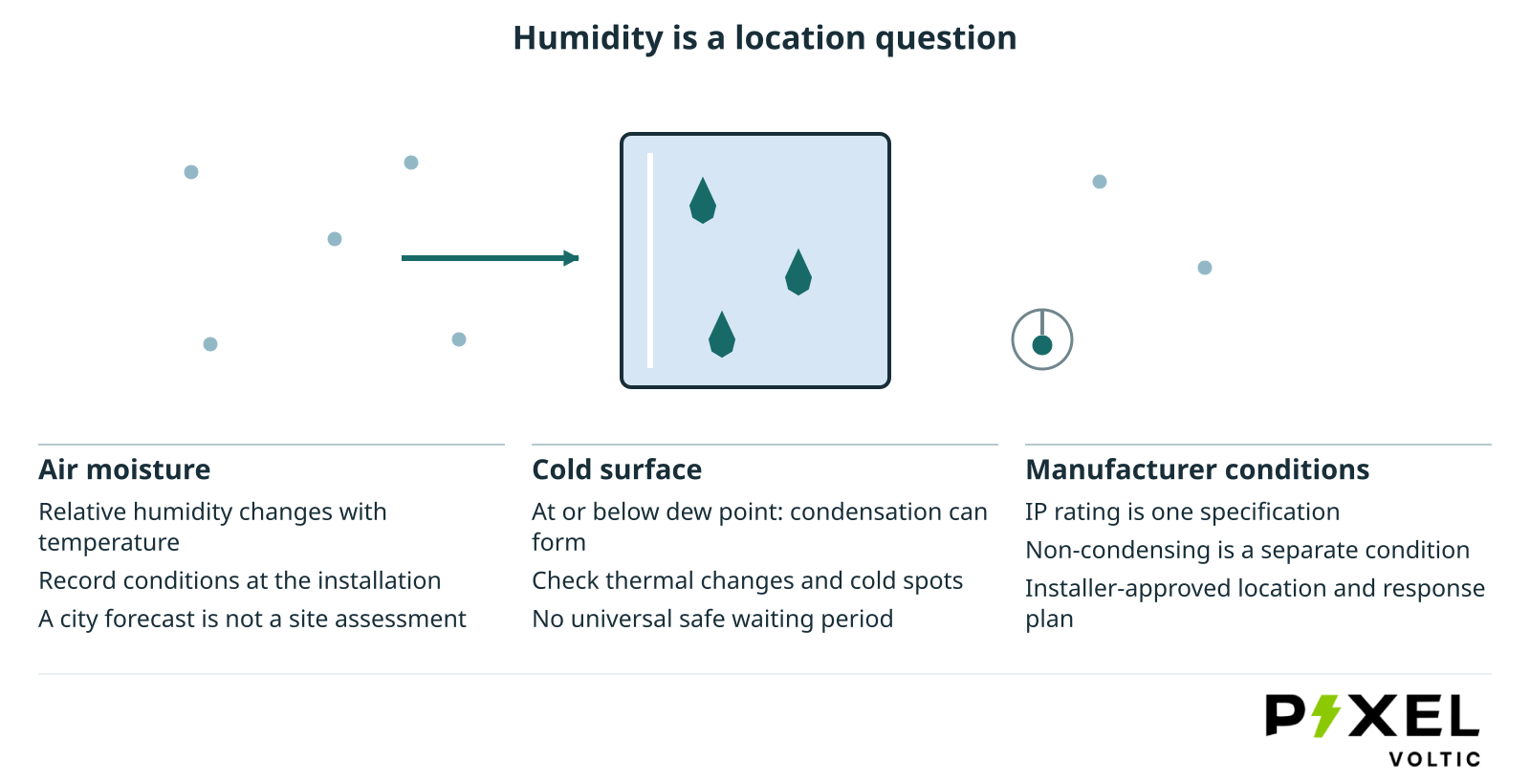
Vaisala’s humidity application note defines dew point as the temperature at which water vapour begins to condense when cooled. Relative humidity depends on temperature. Consequently, a room reading on its own does not tell you whether a colder equipment surface is approaching condensation conditions. [2]
Think of three separate questions for a site assessment: how much moisture is present, how the surrounding air temperature changes, and which relevant surfaces may be cooler. No city-wide label such as coastal, inland or dry answers all three. A weather forecast is background information; it is not a measurement of the battery’s immediate installation environment.
Check the whole equipment lifecycle
Semikron Danfoss’s application note on power electronics distinguishes the wider environment from conditions around and inside equipment. It identifies transport, storage, changing operating conditions and temperature differences within cabinets as relevant to humidity or condensation exposure. This is engineering research about power-electronic systems, not a failure-rate study of residential batteries sold in Pakistan. [3]
The practical inference is to ask about more than normal daytime operation. Where will the battery wait before installation? Could a cold delivery be brought into a warmer humid space? What happens when cooling stops or equipment sits idle? The installer should determine the applicable precautions; there is no universal waiting time or drying procedure that this article can safely assign.
Require a location plan, not an extra box by default
BYD’s HVS/HVM BCU2.0 operating manual, version 1.2, permits its stated indoor or outdoor use only under specified installation conditions. Those include avoiding direct rain exposure and an ambient humidity range of 5–95% non-condensing. Its storage section sets separate conditions. Buying an outdoor-capable product therefore does not eliminate the need to check the proposed site and storage arrangements. [4]
Before ordering, request a written location assessment covering nearby water sources, rain entry, drainage, cooling airflow and required equipment clearances. If an outer cabinet is proposed, ask who confirms compatibility with the battery manufacturer’s instructions. Adding a cabinet should be an assessed design decision, not a substitute for explaining how the actual environment remains acceptable.
Ask for measured evidence and a clear response owner
Our recommended handover checklist records the exact battery model, manual revision, permitted operating and storage humidity conditions, assessed location and responsible service contact. Where moisture is a plausible concern, ask the installer whether temperature-and-humidity logging is warranted, where measurements would be representative, and what findings would trigger reassessment. Agree this before a suspicious water mark becomes a dispute.
A single comfortable-looking reading is not a history of the space. Equally, moisture on a nearby wall does not diagnose water inside the battery. Describe observations precisely, with dates and safely taken photographs, rather than declaring a failed seal or failed battery. Ask the professional to distinguish a building moisture problem, direct water exposure and condensation instead of assuming they require the same remedy.
Do not attempt a homemade condensation cure
Do not open the battery, improvise internal heaters, drill ventilation holes or insert loose drying material. BYD explicitly says its battery modules are not user-serviceable and must not be opened or modified. Visible moisture or a suspected exposure deserves manufacturer-led service advice, not an experiment with energised equipment. [4]
The purchasing decision is simple: require an explanation of how the stated non-condensing condition will be respected, not only an enclosure-rating badge. This guide offers a screening framework, not a moisture diagnosis or permission to modify equipment. Manufacturer documents checked on 27 October 2026 provide the examples; the exact delivered model and approved installation remain the deciding references.
Sources and references
- [1] Lithium NG 12.8 V Battery Manual, §§4.4 and 8 Technical Data
Victron Energy
Dry indoor location, IP65 and maximum 95% non-condensing humidity appear as separate requirements.
- [2] How to Choose the Right Instrument for Measuring Humidity in Your Application
Vaisala
Application note explains dew point, temperature dependence of relative humidity and representative measurement locations.
- [3] Effect of Humidity and Condensation on Power Electronics Systems, AN 16-001, Rev. 02, 7 October 2024
Semikron Danfoss
Sections 1 and 4 distinguish micro-environments, storage and thermal changes; not residential-battery field statistics.
- [4] Battery-Box Premium HVS&HVM BCU2.0 Operating Manual, V1.2, 18 September 2025
BYD
Sections 2, 5.1 and 12 specify no user modification, location conditions, non-condensing humidity and separate storage requirements. Downloaded original inspected.