SOLAR BATTERY BUYER GUIDE
Solar Battery Cycle Life and Throughput Warranty: How to Read the Fine Print
Share on social media
A Pakistan-focused purchasing checklist that separates advertised cycle life, warranted retained energy and throughput limits, with model-specific manufacturer examples and a worked calculation.
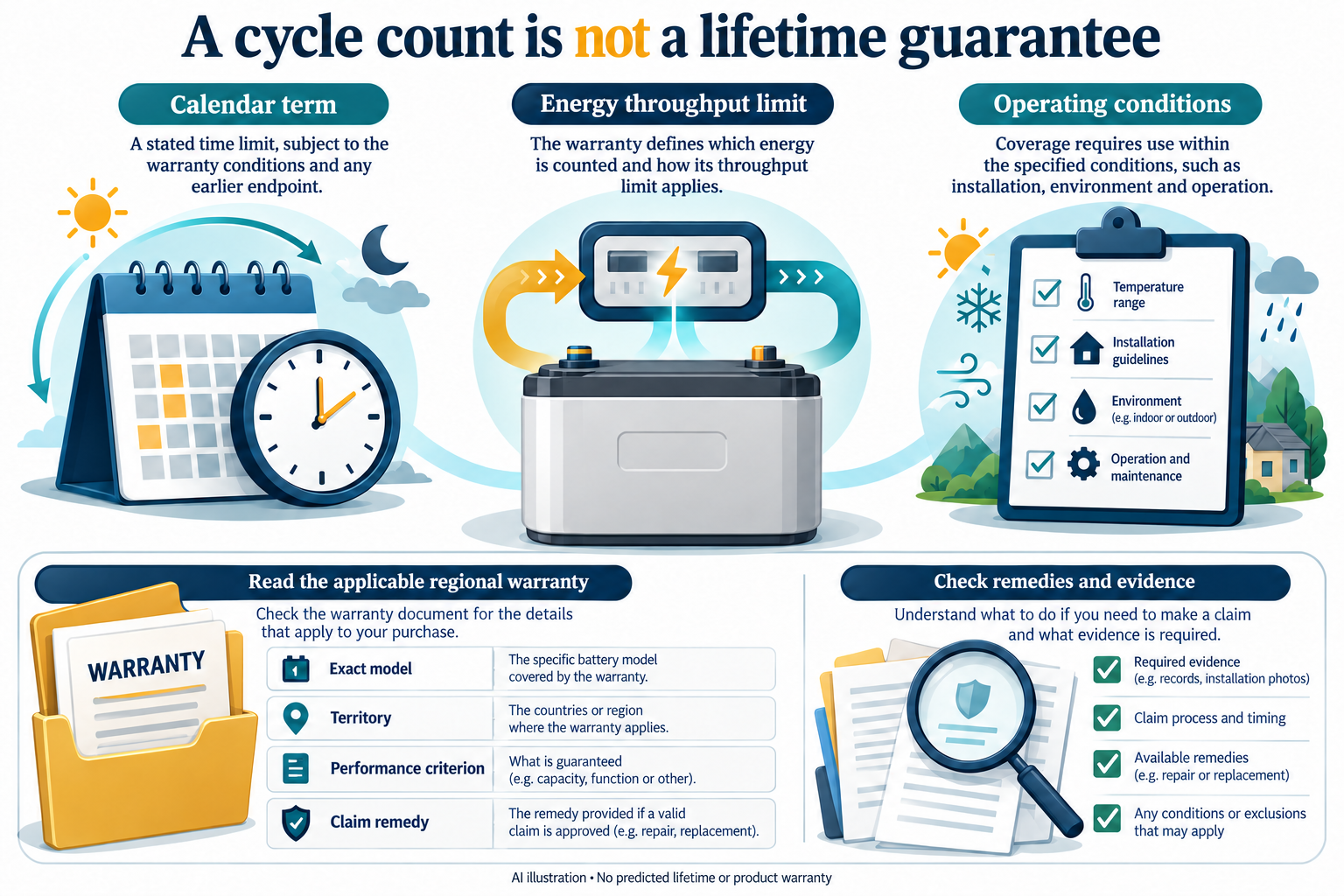
Original companion diagram
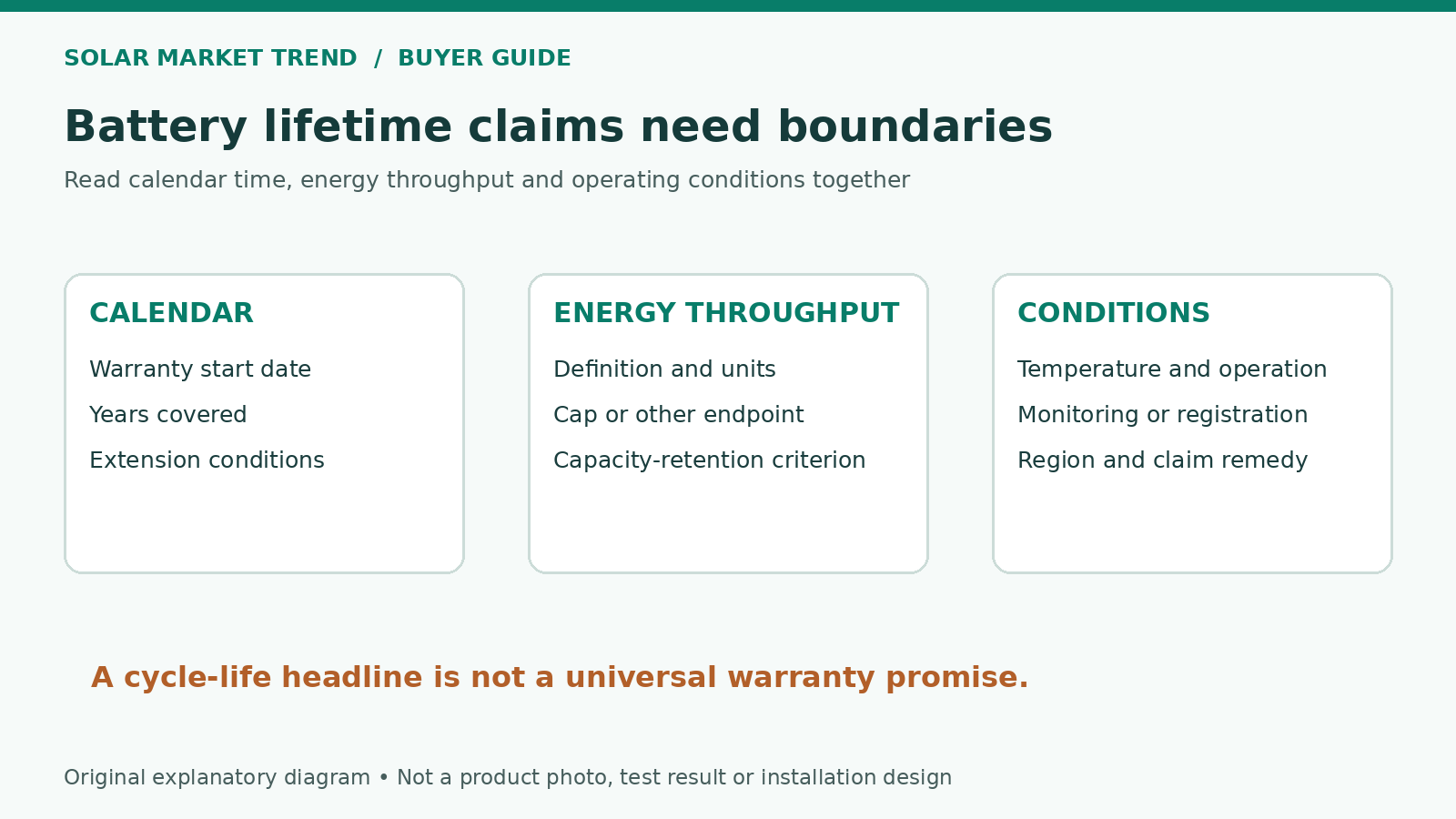
Buy the written promise, not the biggest cycle number
A solar battery quotation can display an impressive cycle count beside a long warranty period. Those figures answer different questions. For a Pakistan household using storage for evening consumption and occasional outages, the useful comparison is the coverage that applies to its exact battery, installation and usage pattern. Ask for the manufacturer warranty document before paying a deposit, then keep the supplier’s additional promises separate. This is a procurement guide, not a prediction that any particular battery will fail on a particular date.
Cycle life needs a test definition
A cycle-life claim is incomplete without discharge depth, retained-capacity endpoint and relevant test conditions. Victron’s current Lithium Smart technical table, for example, lists 2,500 cycles at 80% depth of discharge and 5,000 at 50%, with capacity remaining at least 80% of nominal. These are conditions for that product family, not universal lithium-battery figures or warranty periods. [1]
Do not simply divide an advertised cycle count by 365 and call the result a guaranteed lifespan. NREL’s battery-lifetime research identifies temperature, state-of-charge history, current and cycling patterns as degradation factors; batteries also age during storage. Ask which conditions support the figure printed on your quotation. [2]
Separate defects coverage from performance coverage
Manufacturer documents can promise different things for different periods. BYD’s download-linked South East Asia HVS/HVM warranty provides five-year materials/workmanship coverage and a separate 60%-usable-energy performance promise: seven years, extendable to ten through the stated internet-connection condition, or its throughput limit, whichever arrives first. [3]
This is an overseas-document example, not verified Pakistan coverage. Pakistan is in South Asia, so a South East Asia document alone does not establish entitlement. Obtain written confirmation of the applicable territory, product generation, serial number and issuing entity. A seller’s “ten-year warranty” sticker does not resolve those questions.
Calculate how quickly a throughput cap could arrive
Throughput is cumulative energy, not the number of calendar days the battery operates. BYD’s example document defines it as output energy recorded in the battery control module. Check whether your own warranty counts discharged energy, charged energy or another measurement, and identify the authoritative counter. [3]
Illustration only: a hypothetical 20 MWh discharge-throughput limit equals 20,000 kWh. At an average 8 kWh discharged daily, it would be reached in about 2,500 days, or 6.85 years. This is arithmetic, not a product rating or degradation forecast. Seasonal use, backup reserves and changing loads alter the average. Compare the calculated date with any calendar limit; do not assume both protections last independently.
Check usage conditions and the actual warranty start
Dyness’s published HV Series terms illustrate why appendices matter: they specify registration, a one-full-cycle-per-day warranty basis, model-dependent current conditions and a performance threshold linked to time or throughput. They also state a shorter warranty period for operation without communications. These are HV Series terms hosted on its South Africa site, not confirmed coverage for every Dyness product sold in Pakistan. [4]
For an imported unit, ask for its manufacturing and shipment dates, storage history, commissioning record and the document’s exact start-date formula. Establish whether installation registration or connectivity is required, who completes it, and what evidence the customer receives. Make these deliverables part of the purchase checklist rather than an assumption about what the installer normally does.
Find out what a successful claim actually delivers
Ask the supplier to identify the remedy clause and explain whether an accepted claim means repair, replacement or another remedy. Request a written breakdown of responsibility for diagnosis, removal, freight and reinstallation. Also ask whether replacement coverage continues the original clock or starts again. These are questions to verify, not benefits to assume.
A shorter backup runtime alone is not a controlled capacity test. BYD’s example specifies an energy-measurement procedure and temperature conditions. Have an authorised service provider apply the relevant procedure; do not attempt high-voltage testing yourself. Keep invoices, serial photographs and commissioning records ready for assessment. [3]
The comparison sheet to request before purchase
Put each shortlisted model on one line with its regional warranty version, defects term, performance term, retained-energy threshold, throughput cap, usage restrictions, registration requirements and service contact. Add the applicable test conditions beside every cycle-life claim. Mark unanswered fields “not verified” rather than filling them with dealer assurances.
Choose on documented suitability and a credible claim route, not a brand ranking built from unmatched cycle numbers. A clear warranty with conditions your household can meet is more useful than a larger headline that nobody can explain.