SOLAR BATTERY BUYER GUIDE
Solar Battery DC Fault Protection Why a PV Fuse Is Not Automatically a Battery Fuse
Share on social media
Battery-side protection must match the fault source, not just a DC label. Check interrupting capacity, voltage, operating conditions and the complete protection design before accepting a fuse substitution.
Begin on the battery side of the system
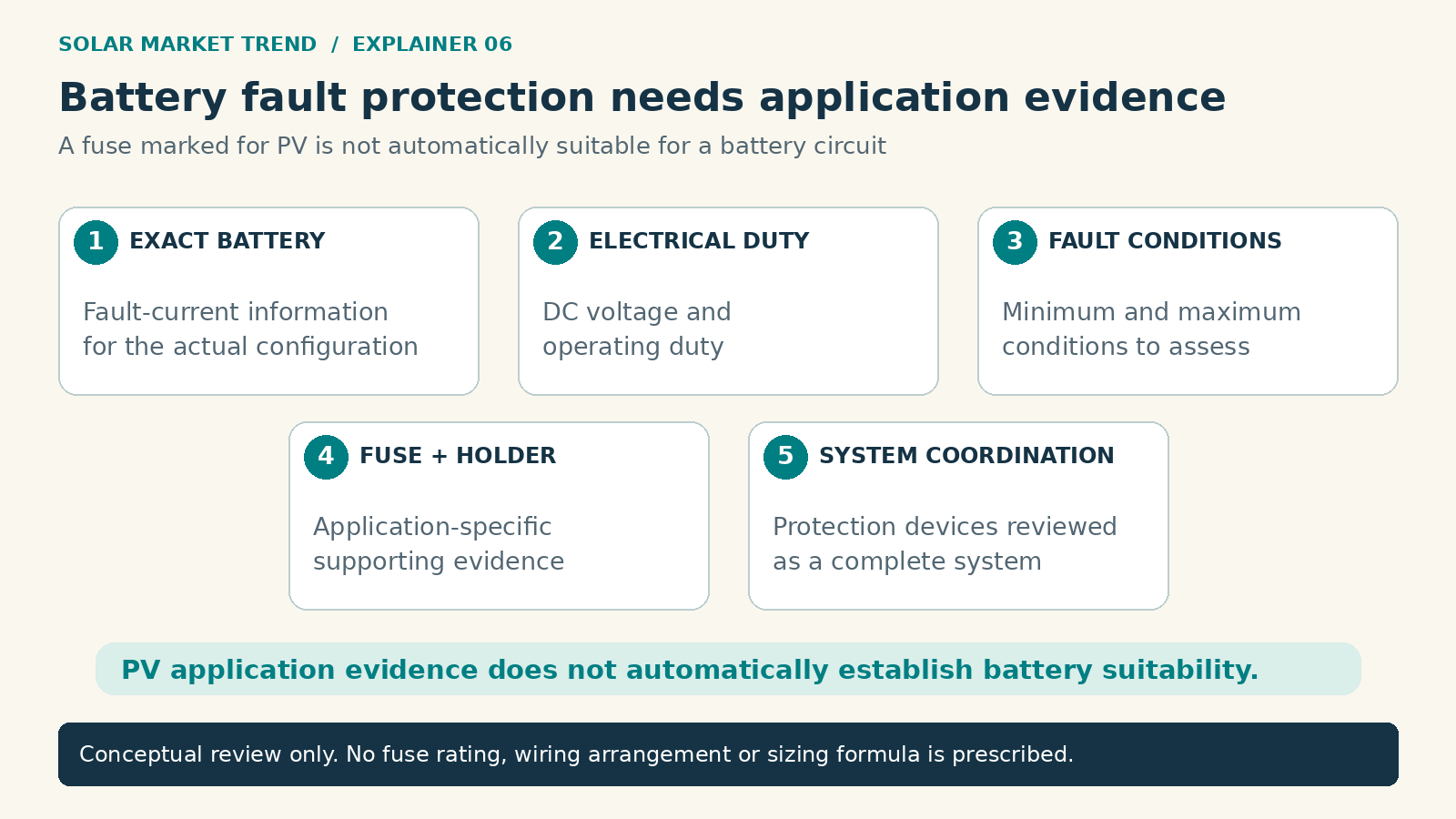
A hybrid solar installation contains different DC circuits. The letters DC on a fuse do not establish that the same fuse suits both a photovoltaic array and a battery bank. Before a Pakistani buyer accepts a substitution, the installer should identify the circuit being protected and the exact part specified for it. Matching the printed amp number is only the beginning of that check.
Mersen’s HP6J documentation, for example, describes a photovoltaic recombiner application designed around the relatively low fault currents of PV arrays. That is a specific design purpose, not an automatic battery endorsement. The correct conclusion is not that every PV-labelled fuse is forbidden in every battery circuit; it is that suitability needs explicit evidence for the actual application. [1]
Carrying current and interrupting a fault are different jobs
Victron’s Wiring Unlimited warns that lithium batteries can deliver very high short-circuit currents, potentially higher than comparable lead-acid systems. It distinguishes continuous current from interrupt rating, also called breaking capacity. The latter concerns how much fault current the protective device can safely interrupt under its rated conditions. An inadequate interrupt rating can result in catastrophic failure. [3]
A chemistry label is not a complete fault-current assessment. Nor can normal inverter consumption establish the battery’s prospective short-circuit current. Request the battery manufacturer’s relevant fault data and the designer’s protection assessment. The fuse’s current rating, DC voltage rating and interrupting capability must all fit the system; one acceptable number does not compensate for a missing one. [3]
A battery-specific family still needs an exact selection
Mersen separately offers NH gBat fuses developed for battery systems, with full-range protection and published application characteristics. This illustrates why the fuse’s intended duty matters. It does not mean that any product carrying a battery-related name will fit every domestic storage system, voltage, holder or protection arrangement. The exact part and its documentation remain necessary. [2]
The same datasheet includes minimum breaking-capacity information as well as high fault-current capability. Buyers should not read only the largest figure in a catalogue. Ask the designer to confirm the required operating range, applicable curves and complete supplied assembly. A product-family headline is a starting point for engineering, not a finished selection. [2]
Fault timing matters, not just fault magnitude
Eaton explains that DC circuit inductance affects how quickly current rises. The associated time constant, commonly expressed as L/R, influences fuse behaviour; the relevant condition is the fault circuit, which may differ from normal operation. Eaton cautions that DC arc interruption and allowable voltage depend on the actual circuit conditions. An AC rating must not be casually reinterpreted as a DC rating. [4]
Its battery discussion also considers internal impedance, state of charge and whether sufficient fault current is available for a selected high-speed fuse to operate correctly. More maximum breaking capacity alone does not answer every protection question. The manufacturer’s application limits and minimum as well as maximum fault conditions need professional assessment. This is not a calculation to improvise from battery energy capacity. [4]
Check the protection system, including its electronic limits
A battery’s electronic protection does not eliminate the need to follow its external fusing instructions. The Victron SuperPack NG manual specifies battery-side fusing and describes separate protection considerations for battery branches and the combined system. It also addresses the interrupting limits of its electronic switching in parallel arrangements. These are model-specific instructions, not values to copy into another brand. [5]
Our practical recommendation is to ask who has checked the complete protection sequence: battery controls, fuse, cables and connected equipment. If a battery or inverter is substituted, that assessment may need revisiting. Do not assume that a fuse which avoids nuisance operation is necessarily providing the intended fault protection. Keep the approved part references with the installation records.
Resolve uncertainty before energising or replacing
A useful quotation names the battery model, fuse and holder, declared DC ratings, protection location and the designer responsible for verifying coordination. Where the proposed part differs from the equipment manual, request the manufacturer-supported basis for that deviation. This guide supplies no fuse sizes because the necessary system data cannot be inferred from a generic solar package advertisement.
Never create a short circuit to test protection, bridge a blown fuse or keep increasing its amp rating until the system runs. A fault or unexplained operation needs qualified investigation under the manufacturer’s safe-isolation procedure. The buying principle is simple: ask for documented battery-side protection, not merely a familiar-looking PV accessory.
Sources and references
- [1] Mersen HP6J photovoltaic fuse datasheet
Checked 2026-10-24
Manufacturer-defined PV recombiner application and low-fault-current design purpose. Example, not a universal prohibition or recommendation.
- [2] Mersen NH gBat battery fuse datasheet
Checked 2026-10-24
Battery-specific full-range fuse family; declared minimum breaking capacity, DC ratings and technical curves. Product examples are not Pakistan stock claims.
- [3] Victron Wiring Unlimited, DC wiring, section 4.6.1
Checked 2026-10-24
Lithium battery prospective fault current; interrupt rating separate from continuous current; current, voltage and interrupt capability must match the application. No generic catalogue numeric ratings reproduced.
- [4] Eaton Bussmann High Speed Fuse Application Guide, pp. 21–23
Checked 2026-10-24
DC fault time constant, battery impedance/state of charge, minimum fault current and limits of high-speed short-circuit-only fuse application. Technical context, not universal residential sizing rules.
- [5] Victron Lithium SuperPack NG Manual, Installation, section 3.5
Checked 2026-10-24
Model-specific fusing directions, separate battery/system protection in parallel arrangements, electronic-switch interrupting limit and need for coordinated protection. No numeric settings recommended.