SOLAR BATTERY BUYER GUIDE
Solar Battery Efficiency: Why Cell, DC and Whole-System Figures Are Not Interchangeable
Share on social media
A percentage becomes useful only when its measurement boundary, operating conditions and included losses are clear.
Start with the measurement boundary
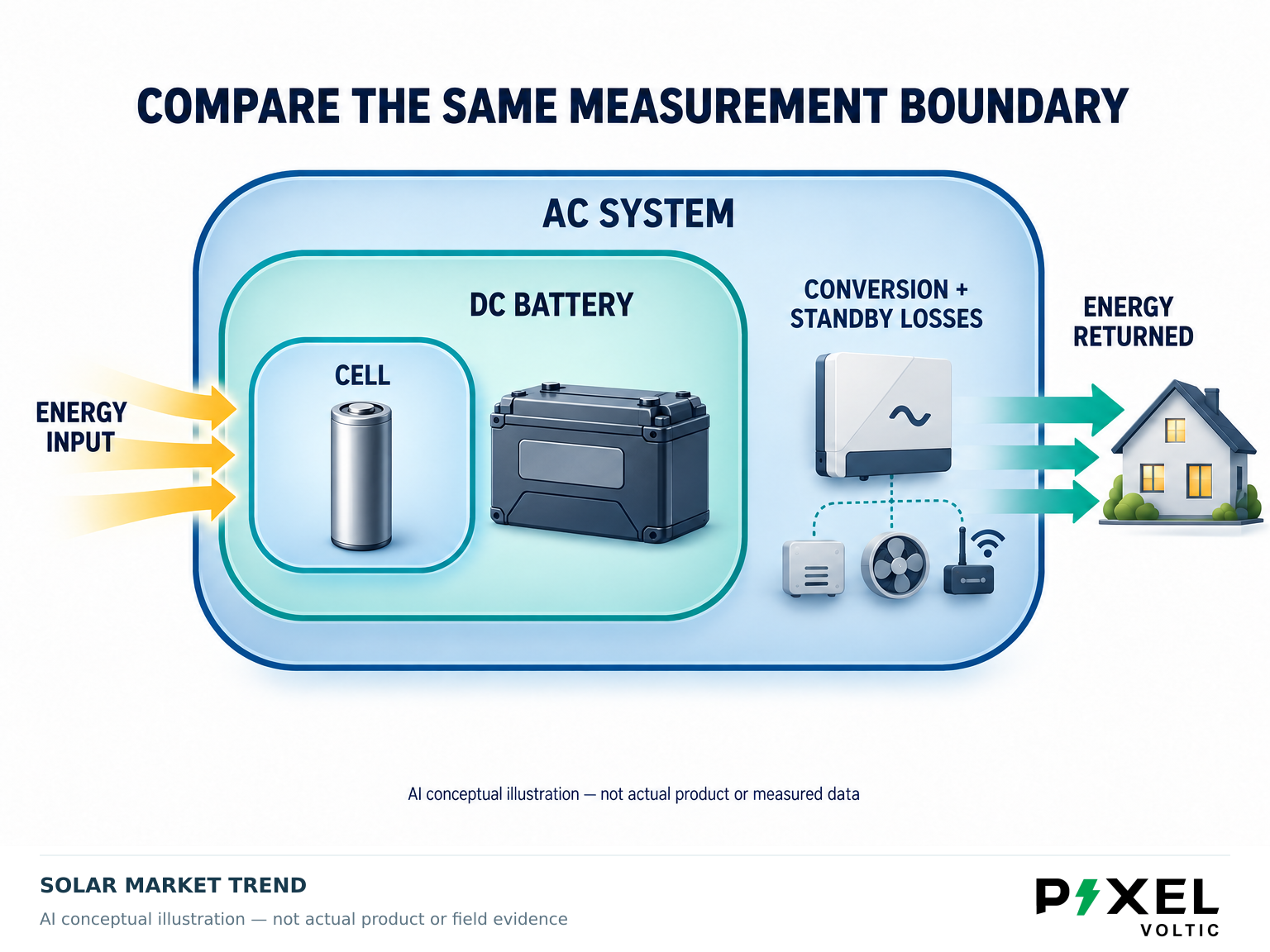
A solar battery brochure can show an impressive efficiency percentage without answering the household question: how much electrical energy returns to the appliances after storage? Before comparing quotations, identify where energy enters and where it leaves the measurement. A cell, a complete battery and an inverter-plus-battery system are not the same test object. An otherwise accurate percentage becomes misleading when its label disappears.
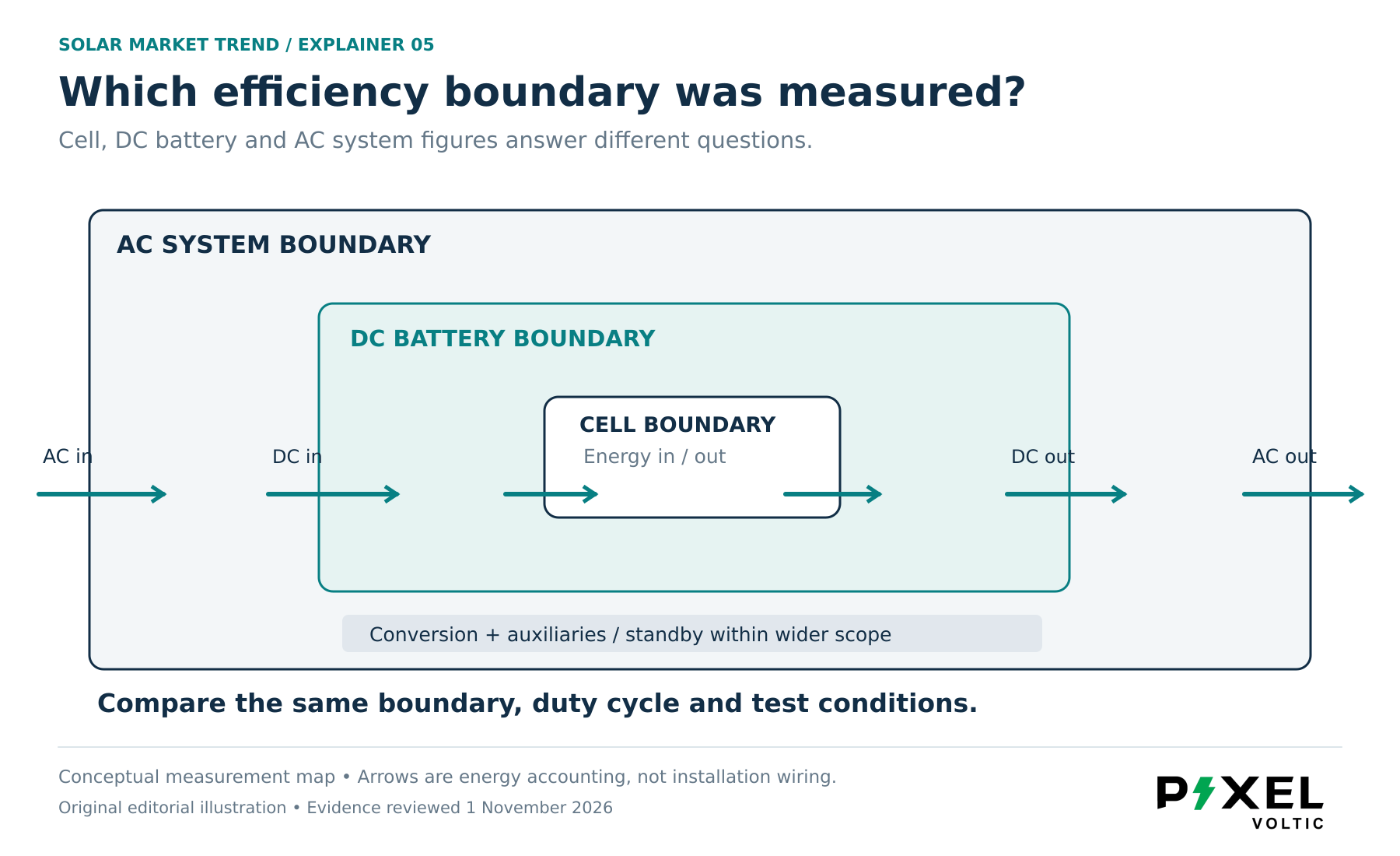
Round-trip energy efficiency compares energy returned with energy supplied across a defined charging and discharging process. It is not a one-way inverter peak efficiency, and it is not the percentage of a battery’s nameplate capacity that a user can access. Those describe different things. The System Advisor Model documentation separately reports battery round-trip efficiency and ancillary-equipment losses, illustrating why the accounting boundary matters. [1]
Three labels that should not be collapsed
A cell result concerns the tested cell, not every component surrounding it. A DC battery result concerns energy at the declared DC measurement points. An AC-to-AC result additionally includes conversion along that declared AC charging and delivery path. A whole-system assessment may go further by including standby consumption and control behaviour over a specified operating profile. Ask exactly what each label includes rather than assuming that all manufacturers use the same boundary. [1][2]
HTW Berlin’s 2026 storage research examines the losses of both the inverter and battery when evaluating energy put into storage and later delivered. Its discussion of charging at higher power and discharging at low power highlights why a component headline cannot stand in for the complete energy path. This is a measurement lesson, not a promise that a German test profile predicts a Pakistani household’s result. [2]
A brand comparison needs matching evidence
BYD’s Battery-Box Premium HVM (US) datasheet lists round-trip efficiency of at least 96%, but its efficiency line does not explicitly label an AC measurement boundary. Its footnote describing DC usable-energy test conditions should not automatically be reassigned to the efficiency line. The fair response is to request the efficiency method, not rank that percentage against a complete AC system’s figure. [3]
Apply the same rule to proposals involving BYD, Pylontech, Dyness or Victron: record the exact battery, inverter, document revision and measurement boundary. This is a documentation checklist, not a claim that these brands share efficiency, availability or test conditions. A missing definition means the comparison is incomplete; it does not prove poor performance.
Real operating patterns change the question
HTW Berlin’s research separates conversion, standby and control-related losses when evaluating storage systems. Its work also explains why low-power operation deserves attention. A household running small evening loads should therefore ask for relevant partial-load evidence, not only the highest efficiency recorded at a favourable operating point. A system-level performance index is useful in its own methodology, but must not be relabelled as cell round-trip efficiency. [4]
Ask for a one-page efficiency statement
Before choosing, request a written statement of the input and output measurement points, tested power, temperature, energy window, duration and included auxiliary consumption. Ask whether any advertised percentage is measured, modelled or simply copied from a component brochure. Keep unlike figures in separate columns. The most useful quotation is not necessarily the one with the largest percentage; it is the one that explains which energy path that percentage actually describes.
Sources and references
- [1] Battery Results — System Advisor Model documentation
National Laboratory of the Rockies / SAM
- [2] Energy Storage Inspection 2026
HTW Berlin
- [3] Battery-Box Premium HVM (US) datasheet V1.4
BYD Lithium Battery Co., Ltd.
- [4] Energy Storage Inspection 2024: The winners are BYD, Energy Depot, Fronius, Kostal and RCT Power
HTW Berlin