SOLAR BATTERY BUYER GUIDE
Solar Battery kW vs kWh: Choosing Power and Backup Duration Separately
Share on social media
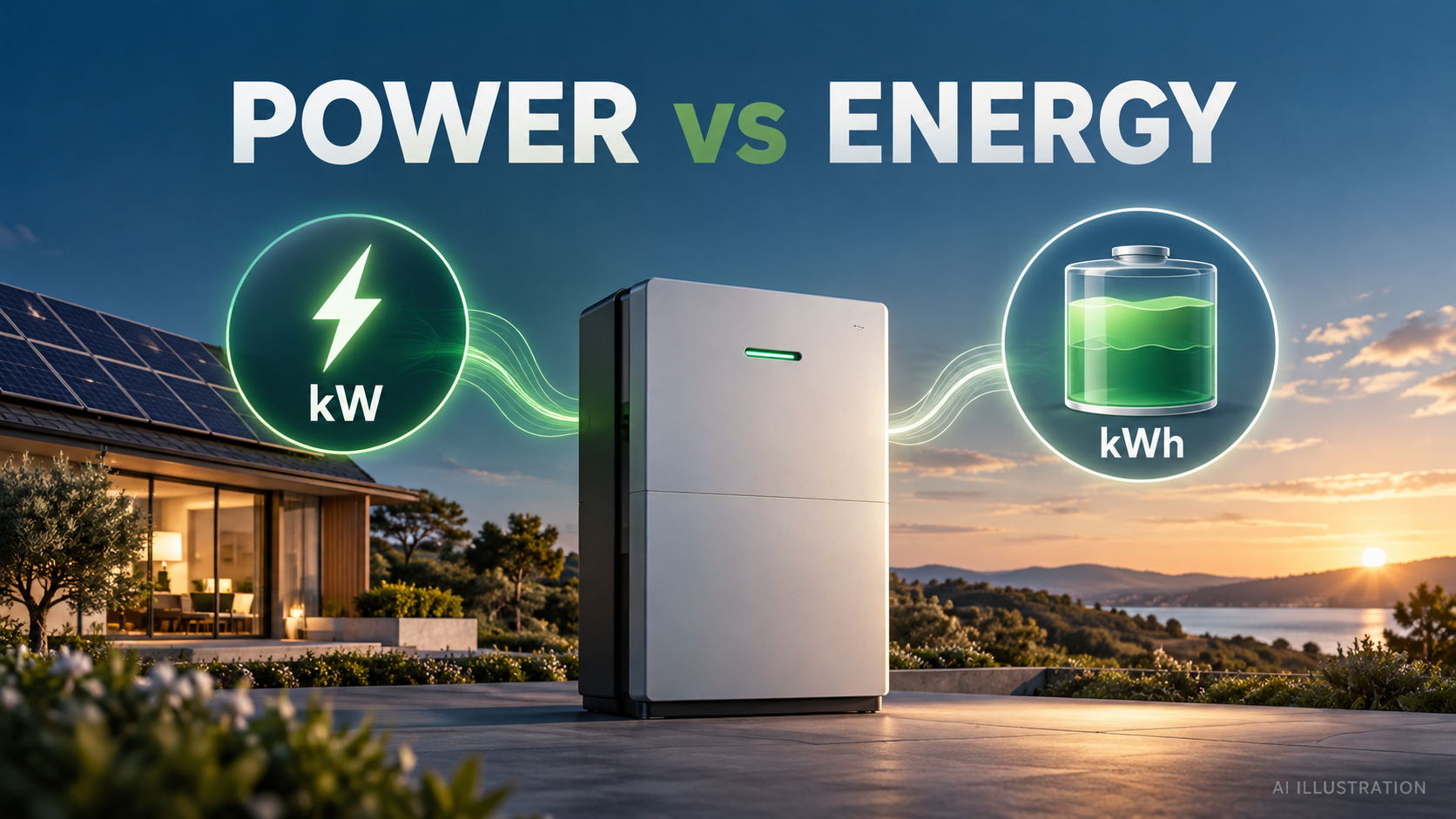
Size a home solar battery for both simultaneous appliance demand and usable backup energy, with a transparent runtime example and model-specific checks.
Two numbers, two different buying decisions
A battery quotation can look generous on capacity and still leave you unable to run the appliances you need during an outage. For a Pakistani home planning backup, ask two separate questions: how much power must the system deliver at once, and how much energy must it supply before charging becomes available?
Kilowatts, or kW, describe power. Kilowatt-hours, or kWh, describe energy. The US Department of Energy makes the same distinction between storage power capacity and energy capacity. A 1 kW load operating for one hour uses 1 kWh. Neither number alone describes a complete backup system. [1]
Start with the loads, not the battery advertisement
Write an essential-load list before choosing equipment. Separate the appliances that must operate together from those you can postpone. Ask an installer to measure or verify running demand and starting demand, particularly for motors and compressors. An average-energy figure cannot establish whether the system will start a particular appliance.
For an illustrative household, selected circuits averaging 0.5 kW over six hours require 3 kWh at the appliances. They may still draw considerably more than 0.5 kW at certain moments. Keep the average demand used for duration separate from the maximum simultaneous demand used for power sizing.
Read nominal and usable energy separately
Pylontech lists its US5000 at 4.8 kWh nominal capacity and 4.56 kWh usable capacity. Those figures describe that model, not every battery sold as a “5 kWh battery.” The same product page specifies normal charge/discharge current separately from short-duration current limits. [2]
Ask whether a quotation states nominal DC energy, usable DC energy or usable AC energy. They are different measurement boundaries. If usable capacity already incorporates a discharge limit, do not deduct that same limit again. A separately chosen backup reserve may still reduce what is available for your planned use.
Use a runtime estimate with visible assumptions
Consider a hypothetical 5.0 kWh nominal battery, starting fully charged, with a selected usable fraction of 90% and an assumed inverter conversion efficiency of 90%. The simplified energy calculation is 5.0 × 0.90 × 0.90 = 4.05 kWh at the AC side. At a constant 0.5 kW load, that gives 8.1 hours before additional deductions.
This is arithmetic, not a product promise. Both percentages are assumptions, not chemistry-wide specifications. Actual backup also depends on starting charge, temperature, ageing, operating cutoffs, standby consumption and changing loads. Victron’s monitoring documentation explains why discharge rate and temperature affect available capacity. Its inverter specifications also distinguish maximum efficiency from zero-load consumption. Use measured system behaviour where possible. [3][4]
Check the inverter and battery power limits together
A bigger energy store does not automatically make the inverter more powerful. Victron’s MultiPlus-II 48/3000/35-32 illustrates another common confusion: its 3000 VA rating accompanies a continuous real-power rating of 2400 W at 25°C, falling to 2200 W at 40°C. Its peak figure is a separate specification. These are model-specific values, not a rule for every 3 kVA inverter. [4]
The battery must also support the required current within its operating conditions. For example, multiplying the US5000’s 48 V nominal voltage by its listed 100 A normal current gives an approximate 4.8 kW DC reference, not guaranteed AC output. Actual voltage, conversion losses and system limits still apply. Short-duration current ratings cannot be treated as continuous capability. [2]
Include recovery between outages
A battery must regain the energy it spends. Ask the installer to check how much charging is available after daytime household consumption, allowing for losses and equipment limits. A large battery paired with insufficient recharge opportunity can start the next outage partly empty. Storage shifts energy through time; it does not create additional solar generation. [1]
All battery chemistries require appropriate protection and competent installation. A lithium label does not remove electrical, fire or handling hazards. Leave equipment selection, protective arrangements and commissioning to qualified personnel, following the specific manuals. [5]
The quotation checklist
Before buying, request these items in writing:
- The essential-load list, simultaneous running demand and verified starting requirements.
- Nominal and usable energy, with the DC or AC measurement boundary identified.
- The starting charge, reserve and efficiency assumptions behind estimated backup hours.
- Continuous battery and inverter limits at expected operating temperatures.
- A realistic recharge assessment before the next planned discharge.
- A commissioning test using your agreed loads.
Choose the combination that meets both power and energy needs. Extra kWh can extend duration, but it cannot by itself correct an undersized inverter or an unsupported battery discharge requirement.
Sources and references
- [1] US Department of Energy: Solar Integration, Solar Energy and Storage Basics
- [2] Pylontech US5000: Official Technical Specifications
- [3] Victron SmartShunt Manual: Operation and Available Battery Capacity
- [4] Victron MultiPlus-II 230V Manual: Technical Specifications
- [5] Victron Lithium NG 51.2 V Manual: Safety Precautions