BATTERY BUYER GUIDE
Solar Battery Charging Current Why Multiple Chargers Need One System Limit
Share on social media
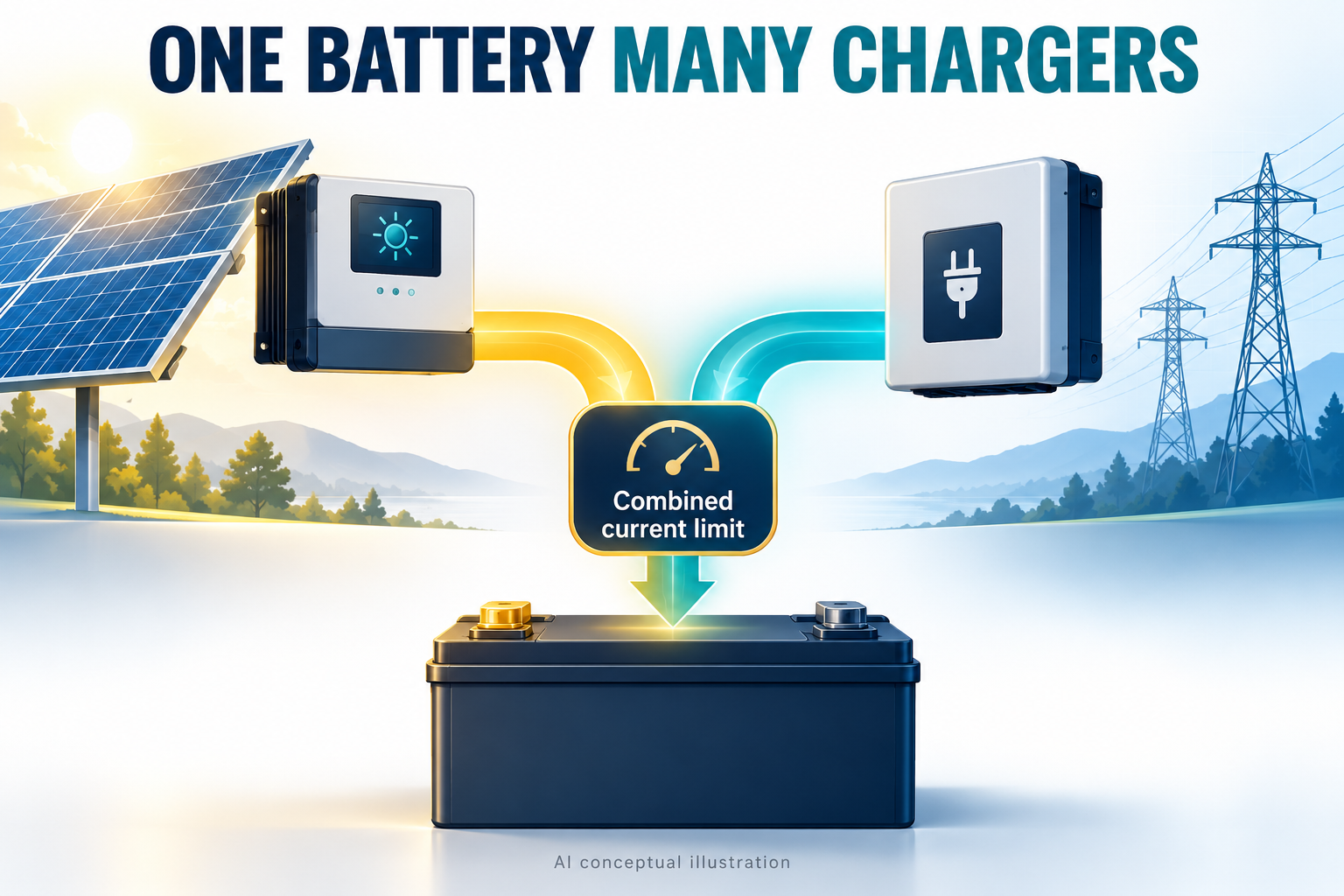
An inverter charger and a separate solar controller can charge the same battery. Check their combined control and battery limits rather than treating each charger setting in isolation.
Start with the complete charging system
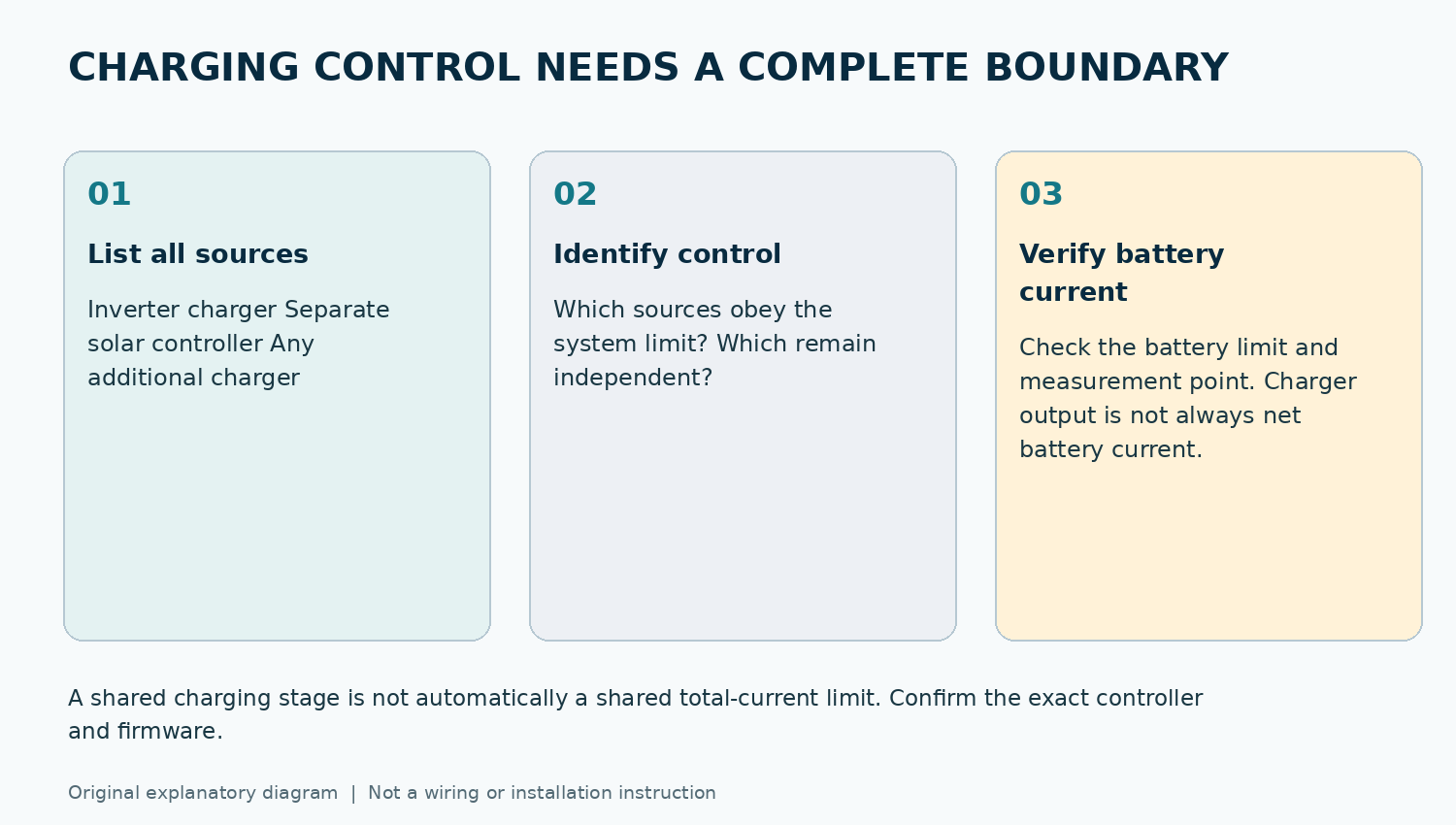
A Pakistani buyer adding a solar charge controller to an existing inverter-battery system should ask a question that is easy to miss: who limits the total battery charging current when both sources operate together? A setting in one charger does not automatically control a second unit. The useful design document is a map of every charging source and its control relationship with the battery.
This guide uses named Victron manuals to illustrate that distinction, not to prescribe settings for Knox, Inverex, Deye or any other platform. Compatibility and control behaviour must be confirmed for the exact inverter, battery, controller and firmware combination. A shared voltage label or communication socket does not establish system-wide coordination.
Synchronising stages is not the same as limiting the sum
Victron’s VE.Smart Networking manual makes an unusually useful distinction. Compatible solar chargers can synchronise their charging stages, moving between stages together, while each still regulates its own output current. The manual states that this network does not provide a network-wide maximum charging-current setting and points to GX/DVCC where that function is needed. [1]
The buying lesson is broader than this one ecosystem: when a seller says several chargers work together, ask exactly what is shared. Shared voltage sensing, temperature sensing, stage timing and a combined current ceiling are different functions. Request the relevant manual section rather than accepting the word synchronized as proof of all four.
A system controller still has a defined boundary
Victron’s DVCC documentation describes a system charging-current limit and use of the lower limit when a connected managed battery requests less current. It also warns that unsupported or unconnected charging sources are outside that control. Device-level current limits remain effective. The same manual explains that DC loads and their measurement can affect the relationship between charger output and net battery current. [2]
These qualifications matter at expansion time. A controller that previously governed every source may no longer do so after a separate charger is added. Ask the installer to identify controlled sources, uncontrolled sources and the measurement point. The answer should be visible in the design record, not inferred from a single app gauge.
Do not use the battery maximum as the everyday target
A battery’s recommended charging rate may differ from its maximum permitted rate. Victron’s Lithium Smart operation manual presents a recommended charging current separately from the maximum in its technical data and requires a charging profile matching the battery chemistry. That is a model-family example, not a universal lithium setting. [3]
For the selected battery, request its recommended and maximum current, applicable temperature limits and any dynamic limit communicated by its BMS. Then ask which limit governs the installed system. Faster charging is not automatically the best operating strategy, and a larger PV array does not authorize exceeding battery or charger instructions.
What an owner can ask to see
Request a commissioning record showing all charging sources, the battery model, software versions and the approved configuration. Ask the technician to demonstrate the combined behaviour under a suitable controlled test, including what happens if communication is lost. The owner should not disconnect communication cables or experiment with protection settings to perform that test.
For an apparent slow-charge complaint, collect timestamps, charging-source status, battery temperature and the limits reported by the system. Compare observations from the same moment; a morning screenshot from one device and an afternoon screenshot from another cannot establish a simultaneous total. A lower current may be intentional control rather than a fault. The goal is a documented, battery-compatible charging arrangement, not the highest number the screen can display.
Sources and references
- [1] Victron VE Smart synchronised charging
Checked 2026-10-25
Stage synchronisation differs from network-wide current limit.
- [2] Victron GX DVCC documentation
Checked 2026-10-25
Controlled-source boundary, lower managed-BMS limit, individual limits and DC load measurement.
- [3] Victron Lithium Smart operation
Checked 2026-10-25
Recommended versus maximum charge current and compatible charging profile; model-specific, no universal settings.