BATTERY BUYER GUIDE
Solar Battery Backup Reserve Why Minimum State of Charge Is Not a Restart Guarantee
Share on social media
A reserve setting, a battery protection cutoff and inverter restart conditions serve different purposes. Ask how your exact system behaves through a long outage and recovery.
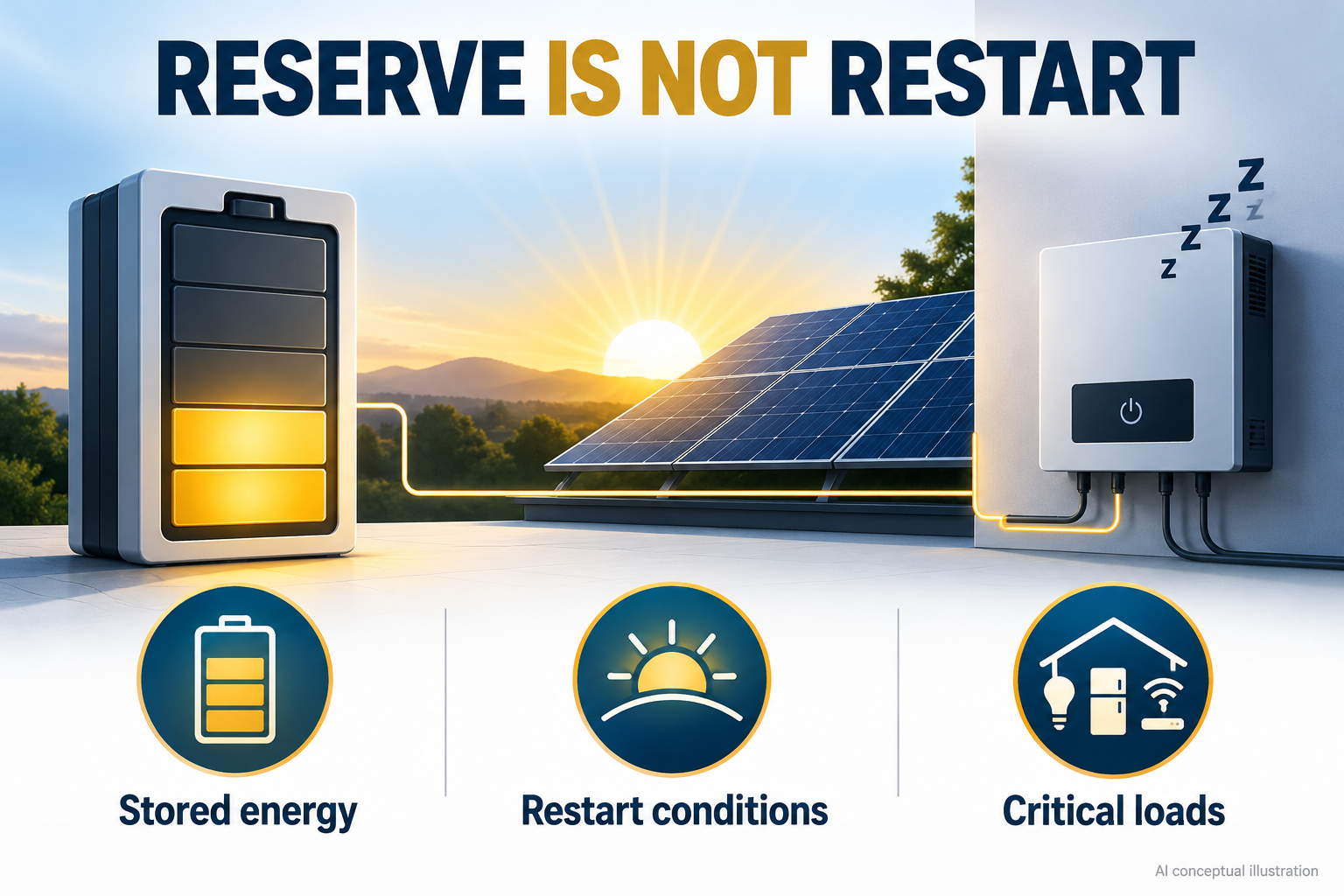
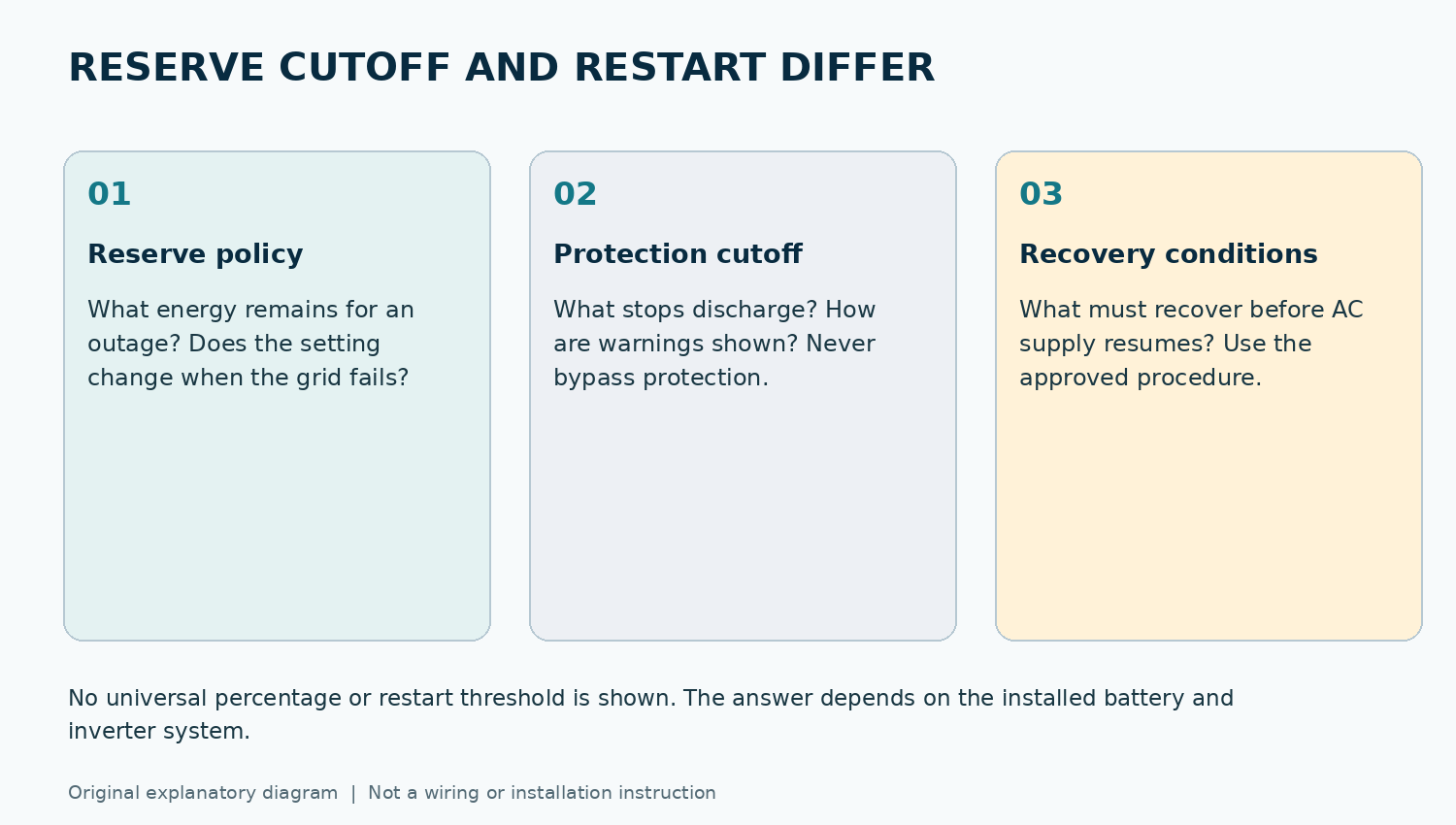
Three questions behind one battery percentage
A battery percentage can be useful, but it cannot answer every backup question. How much energy is reserved for an outage? When will protection stop discharge? What must happen before the inverter can supply loads again? These are three different questions. Pakistani households and businesses should have them answered before relying on a solar-battery system for essential equipment.
A reserve is an operating policy, not a promise of a fixed number of backup hours. The loads connected, the battery’s usable energy and the system’s permitted operating conditions still matter. This article concerns control and recovery, not a prescription for changing battery settings or a substitute for an installer’s site-specific design.
A minimum setting may apply differently during an outage
Victron’s ESS documentation distinguishes behaviour with mains present from behaviour during a mains failure. In its described configuration, a user-defined minimum state of charge limits normal self-consumption while stored capacity can be used during an outage; other protection mechanisms then govern discharge. Its BatteryLife function can also adjust the operating limit. [1]
That example is why an owner should read the exact wording around a setting. A label such as minimum, backup reserve or shutdown may not mean the same thing across products. Ask the installer to state what applies with the grid available, what changes when it fails and which limits cannot be overridden by normal operating preferences.
Protection and recovery are not the same event
Victron’s ESS FAQ describes conditions that can prevent battery supply even when a user expects it: a discharge limit, a managed battery’s command or a pending relay test. It explains that insufficient battery capacity can delay the test and that DC-coupled solar may not immediately supply AC loads in that state. This is a specific system example, not a claim that every hybrid behaves this way. [2]
Sunrise therefore should not be treated as a universal restart guarantee. Ask for the manufacturer’s recovery sequence for the installed topology, including whether grid power, sufficient PV input, battery recovery or an approved manual step is needed. The answer should cover a prolonged outage, not only a brief transfer demonstration with a nearly full battery.
Treat warnings as part of the backup plan
Victron’s Lithium Smart BMS guide distinguishes a low-cell pre-alarm from a low-cell alarm that turns loads off. It notes that support depends on the equipment, including older batteries. This illustrates why a visible percentage alone may not be the warning channel an owner needs. Request the meaning and delivery method of the actual system’s alerts. [3]
The same battery family’s operation manual treats low-cell shutdown as a last protective resort and warns that residual loads after deep discharge can still cause damage. It calls for prompt recovery after a low-cell disconnect. Do not repeatedly force a system back on or bypass its BMS; use the manufacturer’s recovery process through a qualified installer. [4]
Agree on the outage plan before the outage
Write down which circuits are essential, which may be disconnected and who can arrange qualified support. Ask for a demonstration of normal transfer and a documented explanation of low-energy recovery without deliberately exhausting the battery. A reserve policy is useful only when the connected loads and operating priorities are consistent with it.
Keep event times, alarm descriptions and source availability when a shutdown occurs. Describe what was observed rather than immediately declaring the battery faulty. The practical objective is predictable behaviour: a clear reserve policy, understood protection signals and an approved restart procedure. None of these should depend on guessing what one battery icon means.
Sources and references
- [1] Victron ESS controlling depth of discharge
Checked 2026-10-25
Mains-present reserve versus outage protections and dynamic operating limits.
- [2] Victron ESS FAQ
Checked 2026-10-25
Discharge inhibition, relay-test battery requirement and delayed DC-to-AC supply in specific conditions.
- [3] Victron Lithium Smart BMS selection
Checked 2026-10-25
Pre-alarm versus low-cell load-disconnect; model-dependent functionality.
- [4] Victron Lithium Smart operation
Checked 2026-10-25
Low-cell cutoff is last resort; residual discharge and prompt recovery warning.