SOLAR BATTERY BUYER GUIDE
Solar Battery Round-Trip Efficiency: Compare the Same Energy Boundary
Share on social media
A battery efficiency percentage is meaningful only when the energy path, measurement boundary and test conditions are clear. Here is how to compare quotations fairly.
Start with the journey, not the biggest percentage
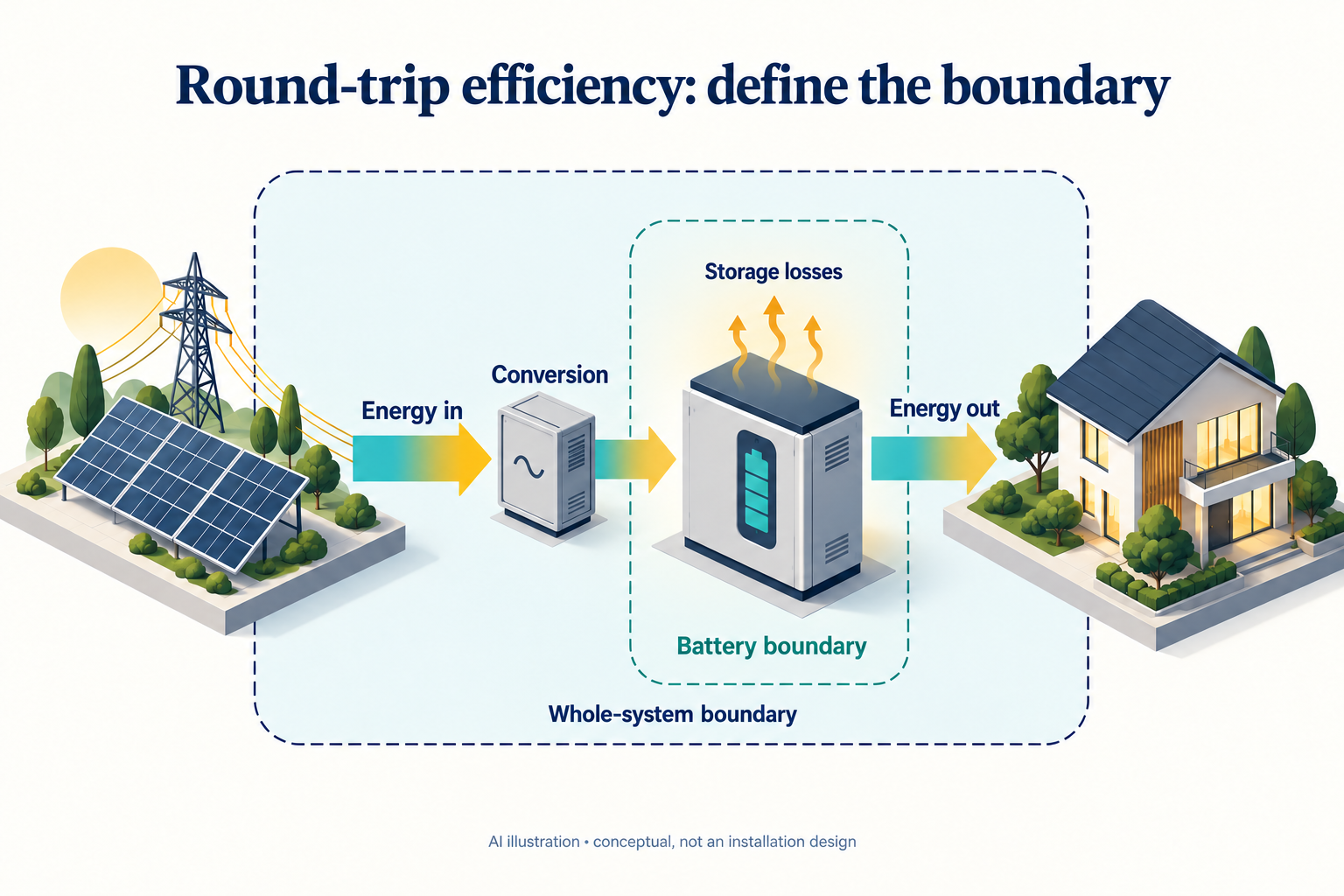
A battery brochure may show an impressive efficiency percentage, but that number is incomplete until the energy path is named. Is it measured at the battery's DC terminals, across an inverter-and-battery system, or from solar input through storage to an AC output? A Pakistani buyer comparing two quotations should ask that question before treating the larger figure as the better product.
Round-trip efficiency is about energy returned relative to energy supplied over a defined cycle. PNNL defines it using discharge and recharge back to the same starting state of charge. [1] The comparison therefore needs a matched starting and ending condition, not a glance at two power readings or an app percentage that changed overnight.
Different boundaries include different losses
A battery-only figure may exclude external conversion and system consumption. The 2016 PNNL/Sandia protocol includes parasitic losses and provides a separate calculation for externally powered auxiliaries. [2] This is methodological context, not a mandatory Pakistan installation rule.
Draw the proposed energy route with the seller: source, conversion equipment, battery, conversion equipment and load. Mark where the input and output meters would sit. Then ask which components are included in the quoted efficiency. A number is not false merely because its boundary is narrower; it becomes misleading when presented as though it describes the complete journey to your appliances.
Two published examples that should not become a ranking
BYD's Battery-Box Premium LVS operating manual lists round-trip efficiency of at least 95% in its technical parameters. Its usable-energy footnote separately specifies DC usable energy under stated test conditions. That layout is not permission to relabel the efficiency figure as a verified whole-home AC result. Ask for the efficiency test boundary and conditions rather than borrowing an adjacent footnote. [3]
Tesla's Australian Powerwall 3 specification is more explicit about its named path: solar to battery to grid round-trip efficiency is listed at 89%. The page associates the value with 25°C, beginning of life and 3.3 kW charge/discharge power, and describes a typical solar-shifting use case. [4]
These are document-reading examples, not a head-to-head test, Pakistan availability statement or purchasing recommendation. Different products, paths and conditions prevent an honest '95 beats 89' conclusion from these figures alone.
Original companion diagram
A small calculation makes the boundary visible
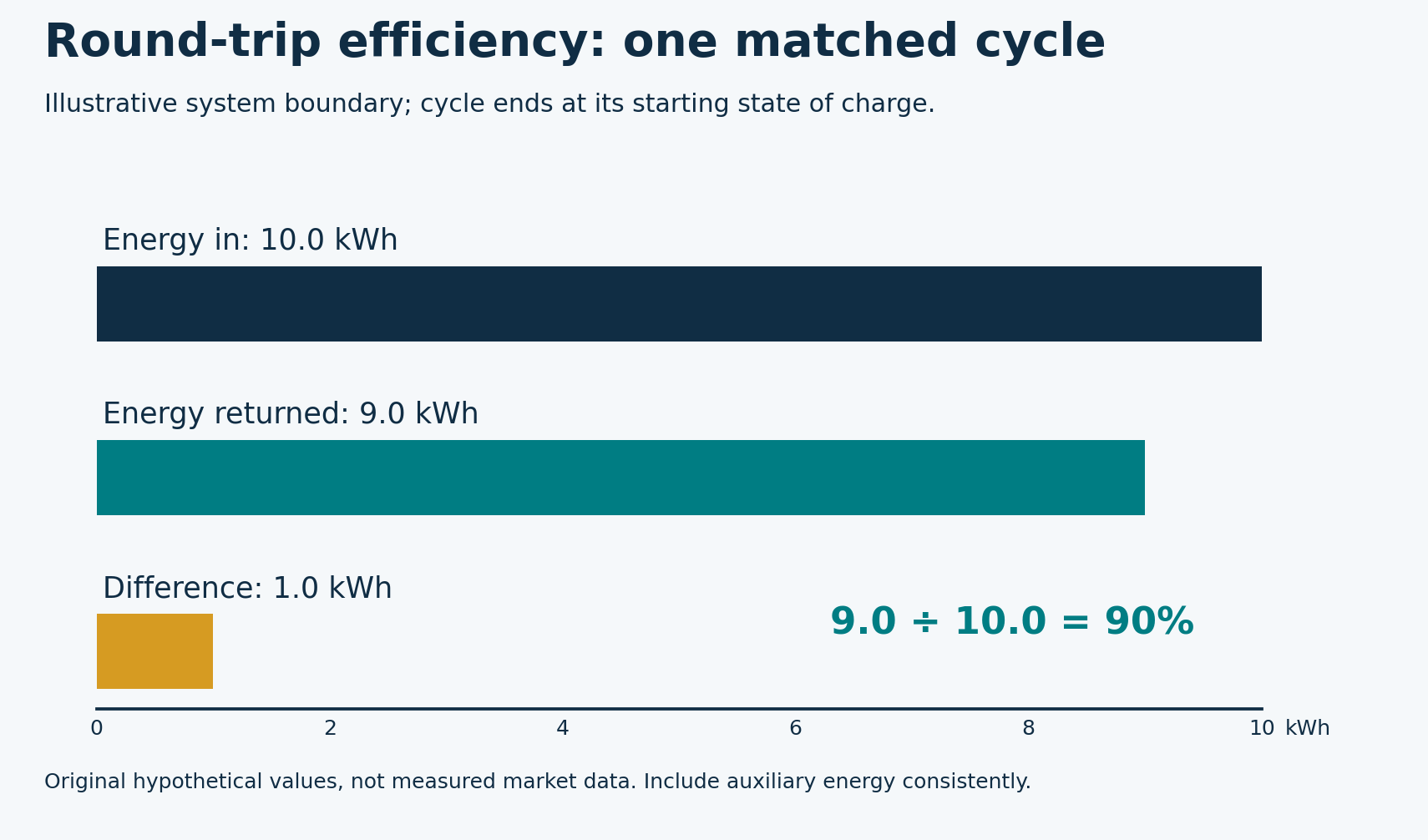
Consider an invented teaching example, not a product claim: 10.0 kWh enters a defined storage-system boundary and 9.0 kWh returns while the cycle finishes at the starting SOC. Round-trip efficiency is 9.0 divided by 10.0, or 90%. The missing 1.0 kWh is the energy difference within that measurement boundary. It is not automatically a fault. [1]
If auxiliary consumption was measured outside that boundary, it must be treated consistently before comparison with a figure that includes it. Do not count household energy supplied directly by the grid or solar as battery discharge. This is why a complete day's solar generation minus a battery reading cannot, on its own, establish storage efficiency. The diagram accompanying this guide is a numerical illustration only, not measured Pakistani market data.
Why the operating pattern matters
The Sandia/PNNL protocol includes tests at different power levels. [2] Ask the supplier which published test best resembles your proposed use, including any long holding period or light-load discharge. Request a relevant report or curve where available. If only one headline value exists, record that limitation.
Do not mix up round-trip efficiency with usable capacity, depth of discharge or the length of the warranty. A battery may have a stated usable-energy quantity without promising that every stored kWh reaches the home after external conversion. Likewise, a warranty is not a promise that your daily operating conditions will match a published efficiency test.
What to put in a comparable quotation
Request the exact battery model and generation, the paired inverter model, the energy path being quoted, and whether auxiliary loads and idle periods are included. Ask for the test temperature, power level, age condition and SOC window when the manufacturer provides them. Keep unknown fields marked unknown rather than filling them with a dealer's verbal estimate.
For an installed system, ask a qualified provider to define a safe measurement plan using consistent meter boundaries and time intervals. Do not bypass protection, open enclosures or force repeated deep cycles to produce a home experiment. Compare the documented result with the applicable specification and test conditions before alleging underperformance.
The practical objective is not the highest isolated percentage. It is a transparent explanation of how much energy the specified system can return under the intended use, with its limits made visible. Sources were checked on 20 October 2026; no independent comparative efficiency testing in Pakistan is claimed here.
Sources and references
- [1] Pacific Northwest National Laboratory: Energy Storage Subsystems and Definitions
- [2] PNNL / Sandia: Protocol for Uniformly Measuring and Expressing the Performance of Energy Storage Systems, April 2016, sections 5.2.1-5.2.2
- [3] BYD: Battery-Box Premium LVS Operating Manual V1.2, Technical Parameters, printed page 44
- [4] Tesla: Powerwall 3 Specifications, Australian installation manual with Backup Gateway 2