SOLAR BATTERY BUYER GUIDE
Solar Battery UN 38.3 Reports Why Transport Testing Is Not Installation Approval
Share on social media
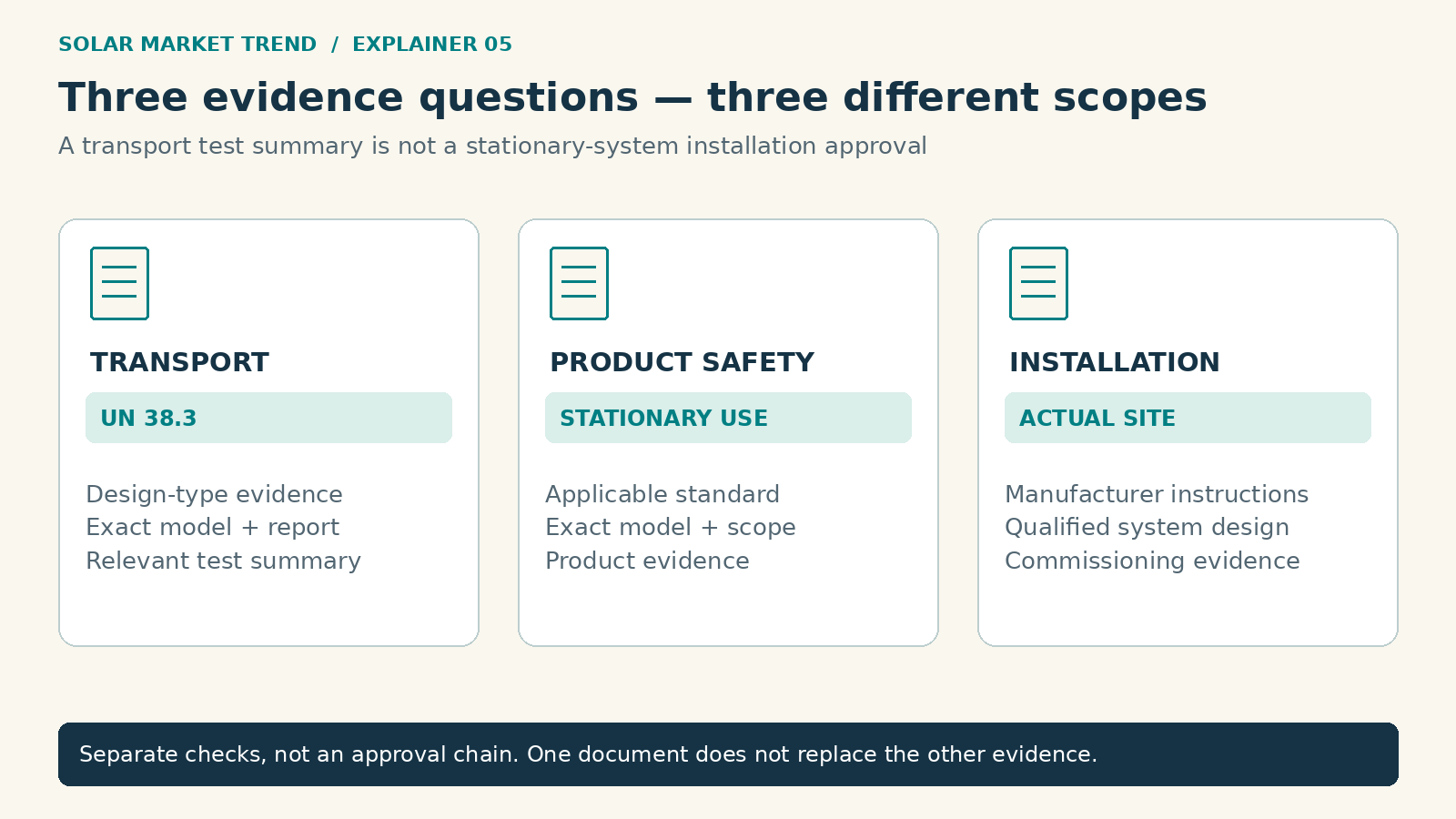
A transport-test document is useful evidence, but it is not a home-storage safety approval. Learn how to match the report to the battery and keep transport, product safety and installation checks separate.

A useful document with a limited job
When a solar-battery quotation says “UN 38.3 certified”, ask what exact document supports that description. IATA explains that the design-type tests address transport events such as vibration and altitude changes, as well as cell or battery integrity. That is a meaningful purpose. It is not the same question as whether the proposed battery, inverter, protection and installation location form a suitable stationary system. [1]
For a Pakistan home or business, treat transport evidence as one part of the purchasing file, not a replacement for the installer’s design. A document can be genuine and still answer the wrong question. The practical aim is to connect each claim to the product and to the decision it actually supports.
Match the identity before admiring the stamp
The PHMSA test-summary guide identifies the information that makes a summary traceable: manufacturer and laboratory details, a unique report identifier, report date, battery description and model, test results, the Manual edition, and the responsible person. Its US regulatory background is not a statement of Pakistan law; the document fields are useful for checking what the evidence describes. [2]
Compare the supplied model identifier with the quotation and battery label. A similar cabinet, brand logo or energy rating is not enough to establish that link. If a summary covers several products, locate the relevant entry rather than assuming the whole range is covered. A missing match is an unresolved documentation question, not proof of either compliance or fraud. [1,2]
Read the result, not just the heading
A historical Victron summary for model BAT512130410 identifies its report and July 2019 date, lists T.1–T.5 as passed, and lists T.6–T.8 as not performed. This is an illustration of why individual entries matter: a headline cannot be read as “every possible test passed”. Not performed does not mean failed or establish why a test was omitted. Applicability must be assessed for the particular cell or battery design and report. This example does not authenticate any battery currently offered for sale. [4]
Do not reject a document simply because it is not printed on a familiar certificate template. PHMSA explains that the summary can take different forms, provided the required information is present. Conversely, attractive formatting does not compensate for missing identifiers or an unexplained mismatch. Keep a readable copy with the purchase record. [2]
Old does not automatically mean expired
IATA’s 2026 guidance says the summary has no defined validity period if the battery type has not changed in a way that requires retesting. It also identifies potentially material design changes, including changes to protective devices and cell arrangements. The sensible question is therefore not merely “Is this year printed on it?” but “Does it still cover this exact supplied design?” [1]
Where the supplied generation differs, request a documented explanation linking it to the tested type before relying on the older evidence. Do not invent a universal expiry date, and do not assume a changed model suffix is harmless. An unresolved identity or revision issue belongs on the supplier-document checklist, not in a marketing promise.
Keep stationary safety and site design separate
IEC 62619:2022 addresses safe operation of secondary lithium cells and batteries in industrial applications, including stationary energy storage. Its public scope is different from transport testing. A seller claiming this standard should provide evidence whose model and scope can be checked separately; mentioning UN 38.3 does not establish IEC 62619 conformity. Only the IEC public scope was reviewed here, not the paid test clauses. [3]
Nor does a product-test claim settle every installation decision. The manufacturer’s manual remains essential. For example, Victron’s Lithium Smart instructions restrict battery work to qualified personnel, warn that terminals remain live, prohibit dismantling, and say not to use a damaged battery. A transport document cannot cancel those precautions or substitute for the correct model’s instructions. [5]
The purchase file to ask for
Our recommendation is a three-part file: a traceable transport summary; separately identified product-safety evidence; and a model-specific installation and commissioning record from the qualified installer. Record any unresolved questions before accepting a broad “fully certified” claim. The three parts should refer to the same supplied equipment, but they serve different purposes.
Do not open a battery to investigate a paperwork discrepancy or attempt to recreate the transport tests. If the delivered unit is damaged, keep it out of service and follow the manufacturer’s qualified-service process. This article is a document-reading guide, not shipping authorisation, a site approval or a claim that any brand is risk-free. [5]
Sources and references
- [1] IATA Battery Guidance Document, revised for 2026, pp. 8–9 and 19–21
Checked 2026-10-24
Transport design-type purpose; test-summary availability; model linkage; design changes; no fixed validity period absent changes requiring retesting. Guidance only, not a Pakistan legal determination.
- [2] PHMSA Lithium Battery Test Summaries, revised July 2024, pp. 2–4
Checked 2026-10-24
Test-summary identification fields and flexible document format. US compliance guidance used for document-reading context, not asserted as Pakistan law.
- [3] IEC 62619:2022 official public scope
Checked 2026-10-24
Safe-operation scope for industrial secondary lithium batteries including stationary applications; public scope only, full paid standard not inspected.
- [4] Victron BAT512130410 UN 38.3 declaration and test summary, July 2019
Checked 2026-10-24
Historical model-specific example listing report number, date, model and individual performed/not-performed tests. Not a recommendation or verification of a current offered battery.
- [5] Victron Lithium Smart Battery Manual, Safety precautions
Checked 2026-10-24
Qualified personnel; terminals remain live; damaged batteries must not be used; do not dismantle; handling and model-specific BMS requirements.