SOLAR ACCESSORY BUYER GUIDE
Solar Changeover Switches Why Automatic Does Not Mean Any Source Can Be Connected
Share on social media
An automatic changeover is a switching system, not a universal permission to connect grid, generator and inverter outputs. Compare transfer mode, complete equipment ratings and the neutral arrangement before buying.
Start with the job, not the label
A Pakistani home or shop comparing a solar changeover box should first ask which two sources it is designed to select, which circuits it supplies and what happens when either source is unsuitable. The word automatic describes how transfer is initiated and controlled. It does not establish that every generator, grid connection or inverter output can safely be joined to the same box. A seller’s front-panel photograph is not a complete system design.
Schneider Electric distinguishes manually operated, remotely operated and automatic transfer switching equipment. In the automatic form, sensing and control logic are part of the transfer function; a remotely operated switch is not necessarily self-acting. The useful purchasing question is therefore not merely whether a motor or electronic display is fitted, but what the complete equipment actually monitors and controls. [1]
Separate automatic control from transition method
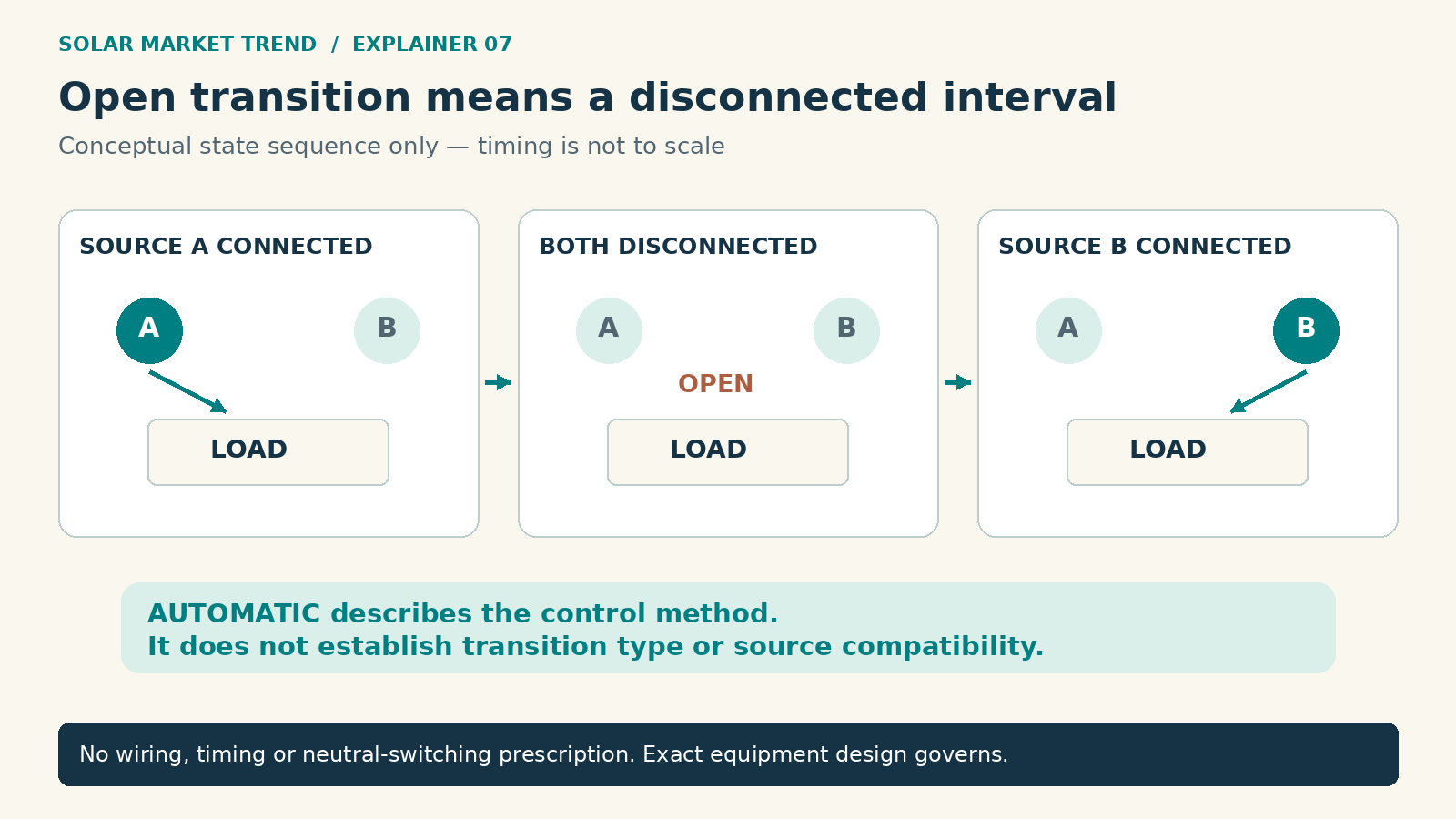
Eaton describes open transition as disconnecting one supply before connecting the other. Closed transition connects the second before disconnecting the first. Those are fundamentally different source relationships, even though either product may be described as automatic. A closed-transition arrangement is not a casual upgrade to a household solar changeover: its suitability requires an engineered source and system assessment. Do not assume two independent outputs may be paralleled because their nominal voltages look similar. [2]
A transfer sequence also depends on source availability and acceptance conditions, not simply on whether one lamp is illuminated. Eaton’s explanation includes checking the alternative supply against voltage and frequency tolerances. Ask the installer to document the intended response to source loss and return, including any delays and the loads affected. An ATS label alone is not evidence of uninterrupted operation. [2]
Buy a documented assembly, not a collection of impressive parts
The public scope of IEC 60947-6-1:2026 explicitly excludes configurations that have not been manufacturer type tested or marked as a complete transfer switch under that document. This matters when a sales description relies on the individual ratings of two switching devices but provides little evidence for the assembled transfer equipment. A component certificate and a complete assembly assessment answer different questions. [3]
Request the exact manufacturer, model, wiring documentation and declared standard/edition for the supplied assembly. The IEC summary reviewed here is not the full paid standard, and this article does not certify compliance or establish which rules apply at a particular Pakistani site. A qualified designer must check the relevant local requirements and the manufacturer’s permitted application. [1,3]
An amp number is only one part of the comparison
A current number on a selector handle does not describe every duty. Socomec’s transfer-switch catalogue separately lists thermal current, operational current under different utilization categories, short-time withstand and conditional short-circuit characteristics with associated protection. These are separate entries because carrying load and surviving the applicable fault conditions are not the same assessment. [5]
For a quotation comparison, ask for the rating at the intended voltage and load duty, plus the required upstream protection and its coordination evidence. Do not copy a fuse or breaker choice from a different catalogue column, enclosure or model. A complete offer should identify what is supplied, what must be added and who is responsible for verifying the combination. [5]
Leave the neutral decision to the system design
ASCO’s technical FAQ describes solid, switched and overlapping neutral arrangements. Their existence is a warning against the shortcut that one pole count or neutral treatment is always right for solar backup. The decision belongs with the actual source earthing arrangements, inverter instructions and protective-device design. The cited manufacturer examples explain categories; they do not prescribe a connection for your premises. [4] A listed design category is not necessarily covered by every standard: the IEC 2026 public scope expressly excludes overlapping-neutral TSE. [3]
Ask for a single-line diagram and a written explanation of the selected neutral arrangement before accepting the installation. Do not bridge terminals, bypass interlocks or alter neutral connections to make an inconvenient transfer appear to work. Such changes require qualified assessment, not experimentation based on a product photograph. [1,4]
A useful handover is evidence you can keep
Our editorial buying checklist is straightforward: keep the equipment identification, source/load description, complete assembly documentation, protection schedule and commissioning record together. Ask the installer to demonstrate the agreed normal and backup behaviour safely, including return to the preferred source, rather than only showing that a handle moves.
Choose the documented function your installation needs. This guide is about evaluating changeover equipment, not a wiring procedure or a recommendation to add an ATS to every solar system. It makes no claim about local stock, prices or brand quality. The correct result may be a different specified device—or no additional changeover at all—after the existing inverter architecture has been reviewed.
Sources and references
- [1] Schneider Electric — TransferPacT user guide, Overview
Checked 2026-10-24
Distinction between manual, remote and automatic transfer equipment; product-specific application study and qualified personnel. Undated current online manual.
- [2] Eaton — Fundamentals of automatic transfer switches
Checked 2026-10-24
Open versus closed transition and source acceptance sequence. Undated technical context, not Pakistan installation approval.
- [3] IEC — IEC 60947-6-1:2026 public scope and edition information
Checked 2026-10-24
2026 scope includes manual, remote and automatic TSE and excludes configurations not type tested/marked as a complete transfer switch. Public summary only; paid standard not reviewed.
- [4] Schneider Electric / ASCO — Neutral configurations for transfer switches
Checked 2026-10-24
Solid, switched and overlapping neutral arrangements are different; FAQ modified 9 June 2025. US manufacturer context, not a local wiring prescription.
- [5] Socomec — Enclosed transfer switches, catalogue technical characteristics
Checked 2026-10-24
Page 4 distinguishes thermal current, utilization-category operational current, conditional short-circuit ratings and associated protection. Internally labelled General Catalogue 2025; URL timestamp is not a new-product claim.