SOLAR INVERTER HEAT GUIDE
Solar Inverter Heat in Pakistan Understanding Thermal Derating
Share on social media
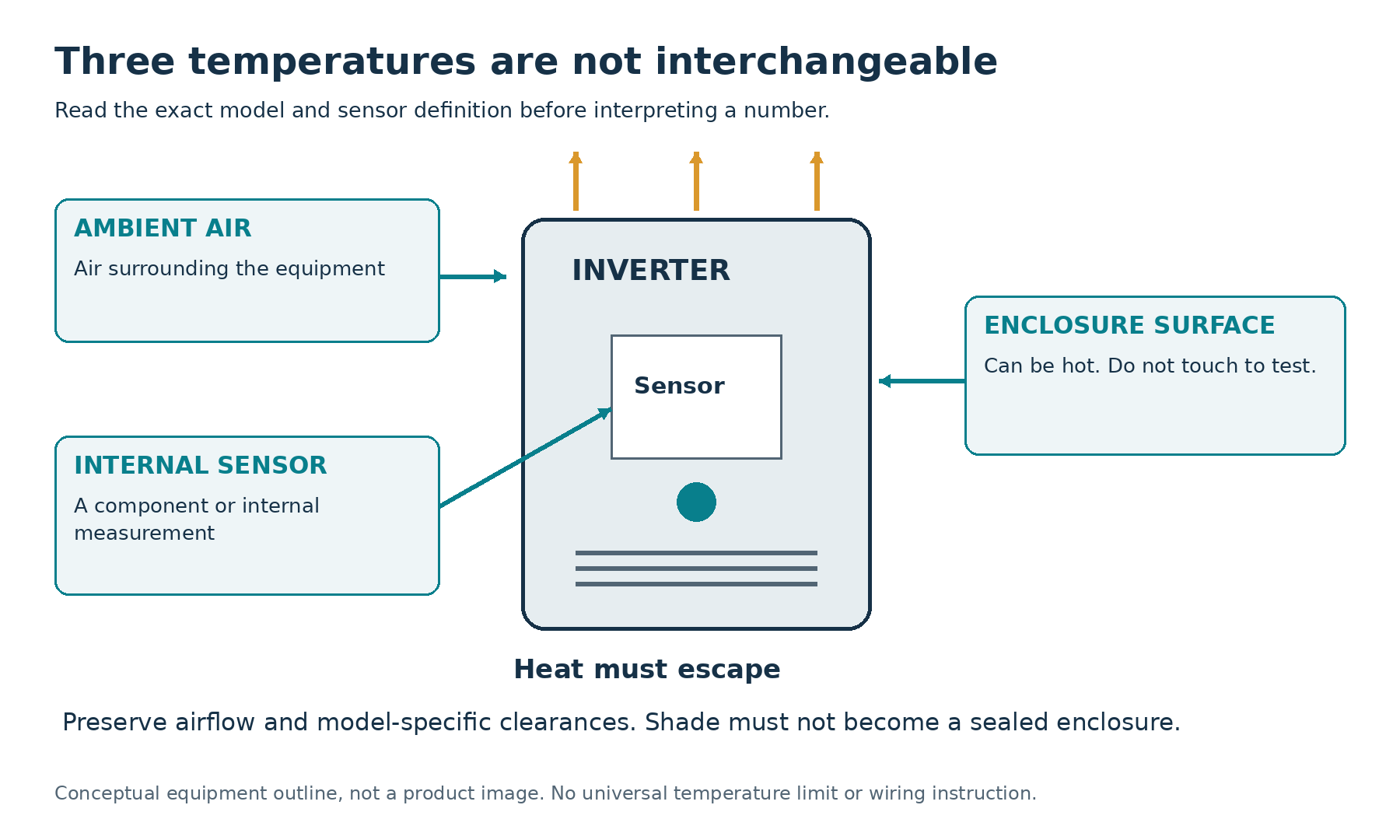
A solar inverter can reduce output to protect itself from excessive heat. That behaviour is called thermal derating. It is not automatically proof of a defective inverter, and a hot-looking number in an app does not establish the cause of a generation shortfall. For Pakistani buyers, the practical goal is a correctly selected installation location, a documented model-specific heat assessment and a clear service response if thermal warnings occur.
This guide separates the inverter's cooling requirements from generic claims about brands. The manufacturer sources were checked on 16 October 2026. They explain engineering principles and particular products, not comparative failure rates or measured losses across Pakistan.
What thermal derating actually means
SMA explains that an inverter reduces power when monitored components approach their permissible temperature. Output may recover after temperatures fall; more severe conditions can trigger shutdown. The protection is intended to keep components within their limits. A rating on the front of the unit does not mean it can deliver that power under every installation condition. [1]
Ask for the exact model's derating curve, not just its maximum operating temperature. The curve's conditions matter. SMA's technical note shows that DC operating voltage and ambient temperature can affect the result. Do not copy a threshold from another model, an overseas installation or a different generation of the same brand. [1]
Ambient temperature is not component temperature
An app may show an internal sensor rather than the air temperature around the inverter. A Solis North America support note explicitly distinguishes these measurements. It was updated on 9 June 2022 and excludes future production models from its stated scope. Its numerical examples therefore must not become universal limits for modern Solis products sold in Pakistan. [2]
Before comparing two installations, ask what each displayed temperature represents. Record the model, sensor label, time and associated warning, if any. A screenshot without that context is weak evidence. Do not touch the enclosure to decide whether it is safe; hot surfaces require the precautions in the relevant manual.
For a service discussion, a useful question is: “Does this record show thermal power limiting for this exact model, or only a temperature reading?” Ask for the answer against the manufacturer's documented alarm or operating-state definition, rather than a social-media rule of thumb.
A weatherproof enclosure still needs heat to escape
Protection against dust or water ingress is not permission to install an inverter in a sealed, unventilated cupboard. Fronius's Symo GEN24 3–5 kW manual requires adequate heat removal in enclosed installations and notes that dust on cooling surfaces can impair thermal performance even though the enclosure is dust-proof. These are product-specific instructions, not a universal cabinet design. [3]
The same manual advises avoiding direct sunlight and unsuitable corrosive environments. The decision about a location should therefore cover more than whether rain reaches it. Have the installer assess ventilation, solar exposure, dust, service access and the mounting surface together. A visually tidy enclosure can still be a poor technical choice. [3]
Shade must not become an airflow obstruction
Huawei's Japan-market SUN2000-4.95KTL-NHL2 manual, Issue 07 dated 30 March 2026, calls for a well-ventilated installation and warns that direct sun may cause temperature-related power reduction. It recommends a sheltered location or an awning. This example supports checking exposure, not fitting the same cover to every inverter. [4]
If a supplier proposes a protective cover, ask for a drawing that preserves the manufacturer's clearances and service access. Do not wrap the inverter, block openings or improvise a tightly fitting box. Any new structure should be reviewed by the installer against the actual manual and site conditions.
SMA's installation guidance also cautions against arranging multiple inverters so that one takes in another's warm exhaust. The direction of airflow and the placement of neighbouring equipment belong in the installation plan. Passive and active cooling designs should be assessed on their documented requirements, not ranked solely by whether they have a fan. [5]
Make the handover practical
Before accepting a new installation, ask for a short location record containing:
- The exact model and the manual revision used for installation.
- Photographs showing the completed position and surrounding clearances.
- The applicable operating conditions and derating documentation.
- Any ventilation or shading measures included in the quotation.
- The permitted owner checks and the maintenance work reserved for technicians.
- The installer or service contact responsible for investigating repeated warnings.
These are purchasing and handover recommendations, not claims that a particular installation currently has a fault. They also make future alterations easier to review. For example, adding storage shelves beside an inverter should trigger a clearance check rather than silently changing its operating environment.
Investigate recurring warnings rather than overriding them
If the inverter repeatedly reports a temperature-related alarm or power limit, preserve the timestamps and screenshots and contact the qualified installer. Ask them to compare the location and equipment condition with the applicable manual. Do not disable protection, open the enclosure, alter fan wiring or repeatedly restart the unit to force higher output.
Keep maintenance access safe. A provider should specify what they will inspect and whether the manufacturer's service procedure requires isolation and waiting time. Owners should not infer that switching off one control makes all internal parts safe. Huawei's maintenance instructions explicitly require a controlled power-off procedure and observance of the discharge warning. [4]
A good outcome is a documented explanation and a suitable remedy, not merely a lower number in an app. There is no defensible brand-wide “safe internal temperature” supplied by this article, and no promised percentage gain from a fan or cover. Choose the installation and service evidence that fits the exact product.
Sources
- [1] SMA Sunny Boy and Sunny Tripower Temperature Derating technical information version 1.5
Version 1.5; publication date not printed in inspected text. Illustrative model curves are not universal thresholds.
- [2] Solis North America Inverter Temperature De-rating
2022-06-09. Regional support note excludes future production units; no numeric thresholds extrapolated.
- [3] Fronius Symo GEN24 3–5 kW Plus and Plus SC operating instructions
Undated live manual. Exact product scope; no universal enclosure or clearance design inferred.
- [4] Huawei SUN2000-4.95KTL-NHL2 User Manual Issue 07
Issue 2026-03-30; page released 2026-04-02. Model-specific example; availability in Pakistan not asserted.
- [5] SMA Installation site and heat dissipation
Undated live guidance. Engineering guidance, not a comparative reliability study.