SOLAR INVERTER BUYER GUIDE
Solar Inverter Input Current Why Maximum Operating Current and Short Circuit Current Are Different Limits
Share on social media
Two figures measured in amps answer different questions. Read the usable-current limit, the permitted array short-circuit current and the exact input boundary before matching modern modules to an inverter.
Amps need a label and a boundary
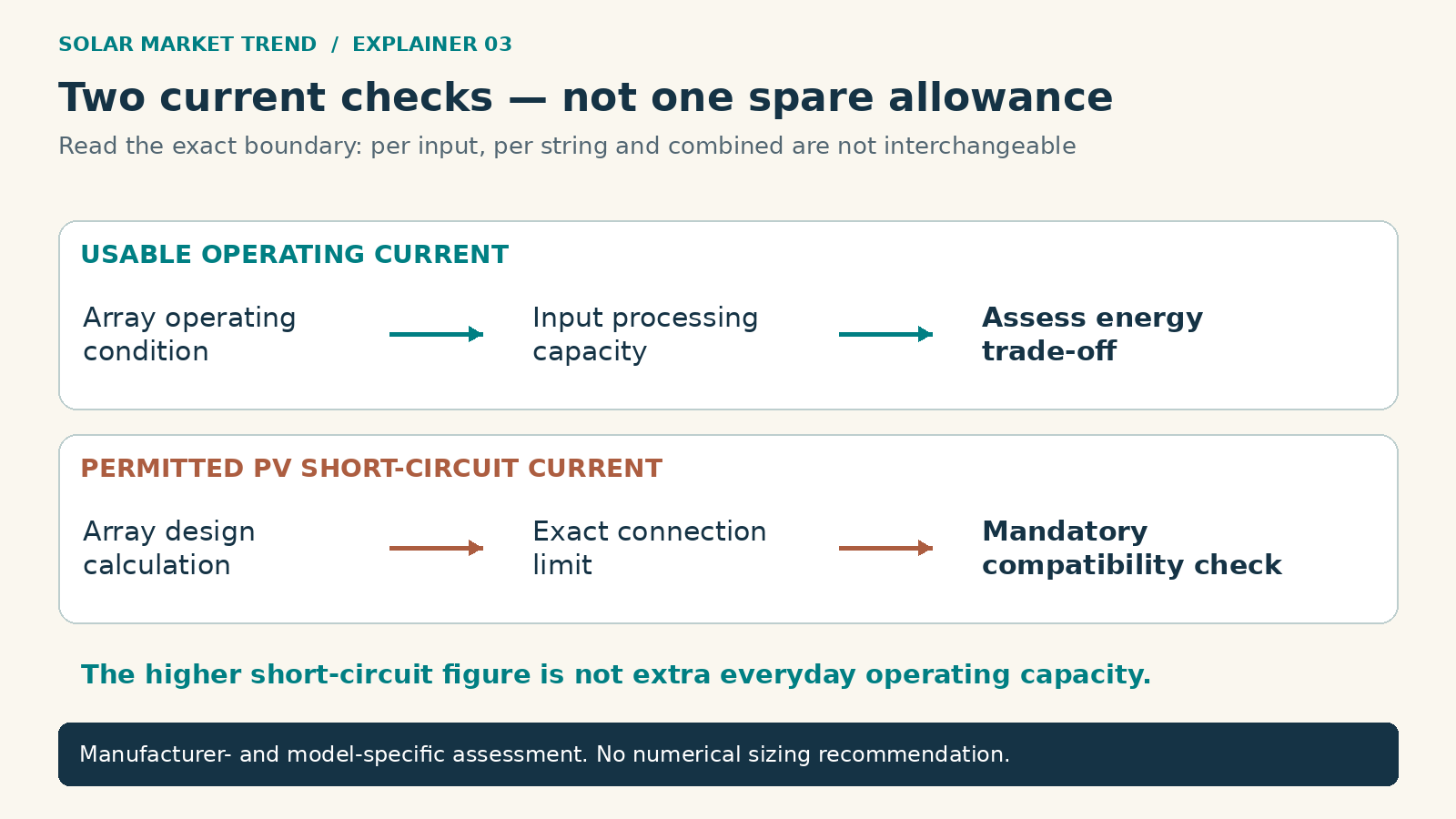
A quotation that says an inverter accepts “high-current panels” is not a compatibility calculation. Ask which current, at which input, under which conditions. The usable operating-current figure describes what the inverter can process; the permitted PV short-circuit-current figure constrains the array that may be connected. Treating the second number as extra everyday operating capacity confuses two separate checks. SMA explicitly distinguishes them in its manufacturer declaration. [1]
For a Pakistani buyer comparing systems, the useful deliverable is a short, auditable matching sheet, not the largest amp figure in a brochure. It should name the module variant, inverter model and manual revision, then identify every relevant current limit. This is a purchasing checklist, not permission to alter live DC wiring.
Permission must belong to the exact inverter
SMA says that, for the models listed in its March 2023 declaration, the array’s maximum-power-point current may exceed the inverter’s usable input-current capability without invalidating the stated warranty position. It separately requires the calculated array short-circuit current, including site-related adjustments, to remain below the inverter limit. That is a manufacturer-specific statement with a model list—not a blanket exemption for all brands or every inverter sold under a similar name. [1]
Do not accept a screenshot of another model’s approval as evidence for the unit being purchased. Ask the designer to identify the applicable document and explain any exception in writing. If the manufacturer’s position is unclear, resolve that before procurement rather than relying on a demonstration that the inverter starts successfully.
Usable current may depend on voltage
The Sunny Tripower CORE2 STP 110-60 online manual gives a concrete example: usable current per input is 22 A below 600 V and 26 A above 600 V, while the separate maximum short-circuit current is 40 A per input. It lists 12 independent MPP inputs and two strings per MPP input. These figures illustrate why one headline number is insufficient; they are not settings or design allowances for another product. [2,5]
Keep the manufacturer’s boundary wording intact. A limit per input is not automatically a limit per connector, per string or for the whole machine. Nor should a buyer silently interpolate a condition at an exact boundary that the displayed table does not specify. Request the complete design clarification where the proposed operating range makes that detail relevant. [2]
The larger number does not guarantee better harvesting
Solis explains in its December 2022 technical article that insufficient MPPT current capacity can limit current during operation and reduce generation. Its discussion also considers the continuous-current capability of the DC hardware path. This is older technical context, not evidence of a new October 2026 product release or of Pakistan stock availability. [3]
The practical comparison is the expected energy effect for the proposed arrangement, not simply whether two inverters share the same AC kilowatt rating. Ask for assumptions and a reproducible design result. A claimed negligible loss in a different climate or array layout is not a measured outcome for your roof.
Read the smaller-print restrictions too
Fronius’s Symo Advanced 15.0-3-M table separates individual MPP input currents from a combined maximum and adds a per-string restriction with AFCI enabled. Spare capacity on one input does not establish acceptability elsewhere. [4]
Request a drawing that maps the proposed strings to named inputs and a checklist covering the applicable voltage, current and equipment restrictions. Require the installer to reconcile the drawing with the exact delivered model rather than copying a previous customer’s configuration.
A decision buyers can verify
Before accepting the system, retain the relevant datasheets, matching calculation, input allocation and any manufacturer clarification with the invoice. Mark unresolved assumptions explicitly. A current-limited design may be an intentional trade-off where the manufacturer permits it; exceeding a safety-related connection limit is not the same trade-off. [1,3]
This guide does not select a string arrangement, establish local regulatory compliance or authorize a test short circuit. A qualified designer must apply the complete manuals and applicable requirements. The buyer’s role is to insist that “compatible” is supported by the correct limits and traceable documents. [4]
Sources and references
- [1] SMA manufacturer declaration — MPP current of the PV array, 11 March 2023
Checked 2026-10-24
Distinction between usable input current and permitted array short-circuit current; limited scope of model-specific permission.
- [2] SMA Sunny Tripower CORE2 STP 110-60 online manual — DC input
Checked 2026-10-24
Voltage-dependent usable current, separate short-circuit current, input count and string grouping.
- [3] Solis Seminar 50 — How do inverters adapt to high-power PV modules, 26 December 2022
Checked 2026-10-24
Current limiting can affect generation; current capability and continuous hardware suitability need consideration.
- [4] Fronius Symo Advanced operating instructions — technical data
Checked 2026-10-24
Different MPP input limits, combined limit and per-string restriction with activated AFCI; qualified installation.
- [5] SMA Sunny Tripower CORE2 online manual — document validity
Checked 2026-10-24
Example is STP 110-60, with and without AFCI, from firmware 1.1.xx.R.