SOLAR INVERTER SURGE GUIDE
Solar Inverter Surge Ratings: Why Starting a Motor Is Different from Running It
Share on social media
A practical guide to motor-starting demand, surge duration, battery limits and the commissioning evidence Pakistani solar buyers should request.
1. The pump that runs may still refuse to start
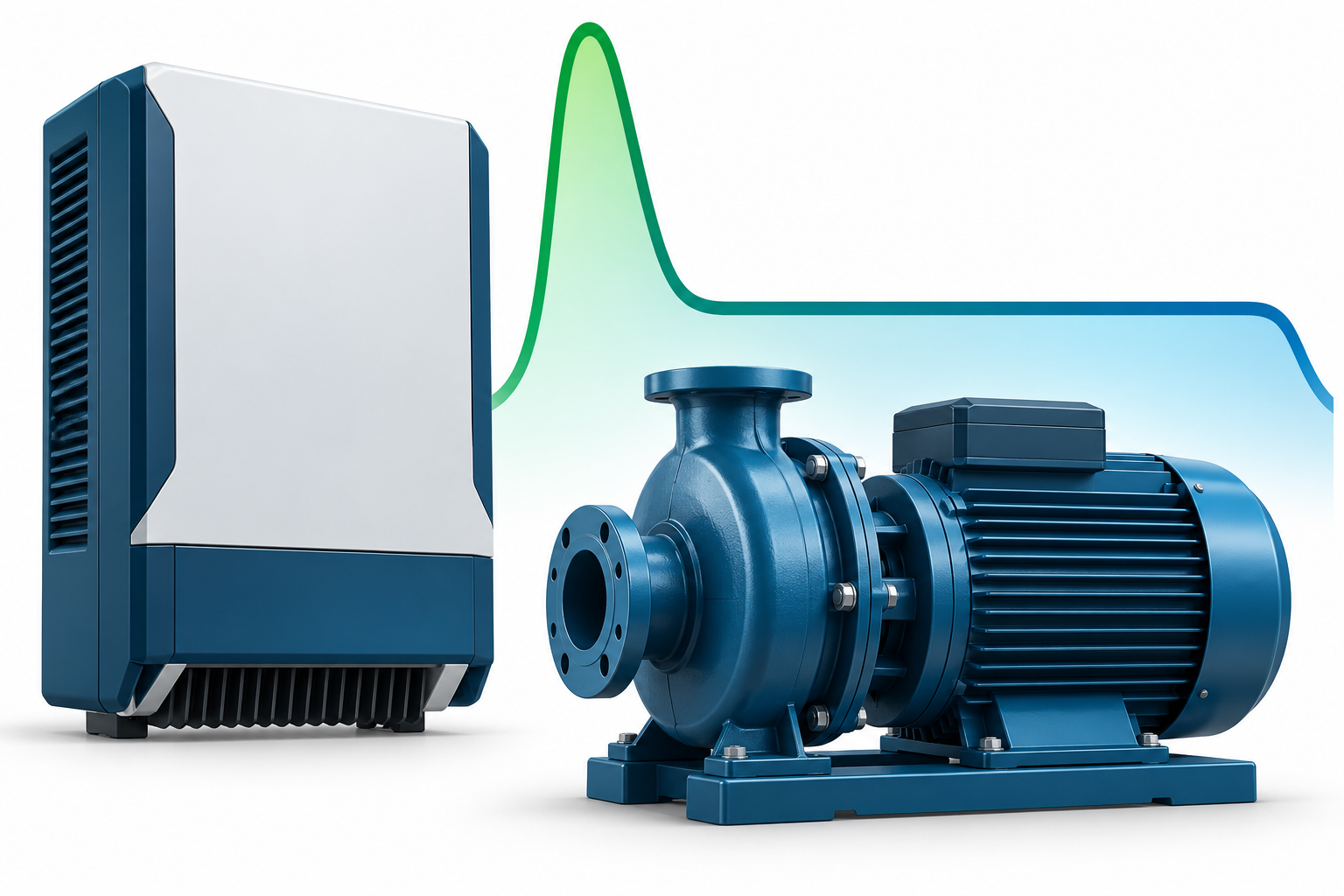
A water pump may start on utility power yet trip a solar inverter during an outage. For a Pakistani household buying backup, a running-load demonstration leaves an important question unanswered: can the stationary motor start with the other agreed loads connected?
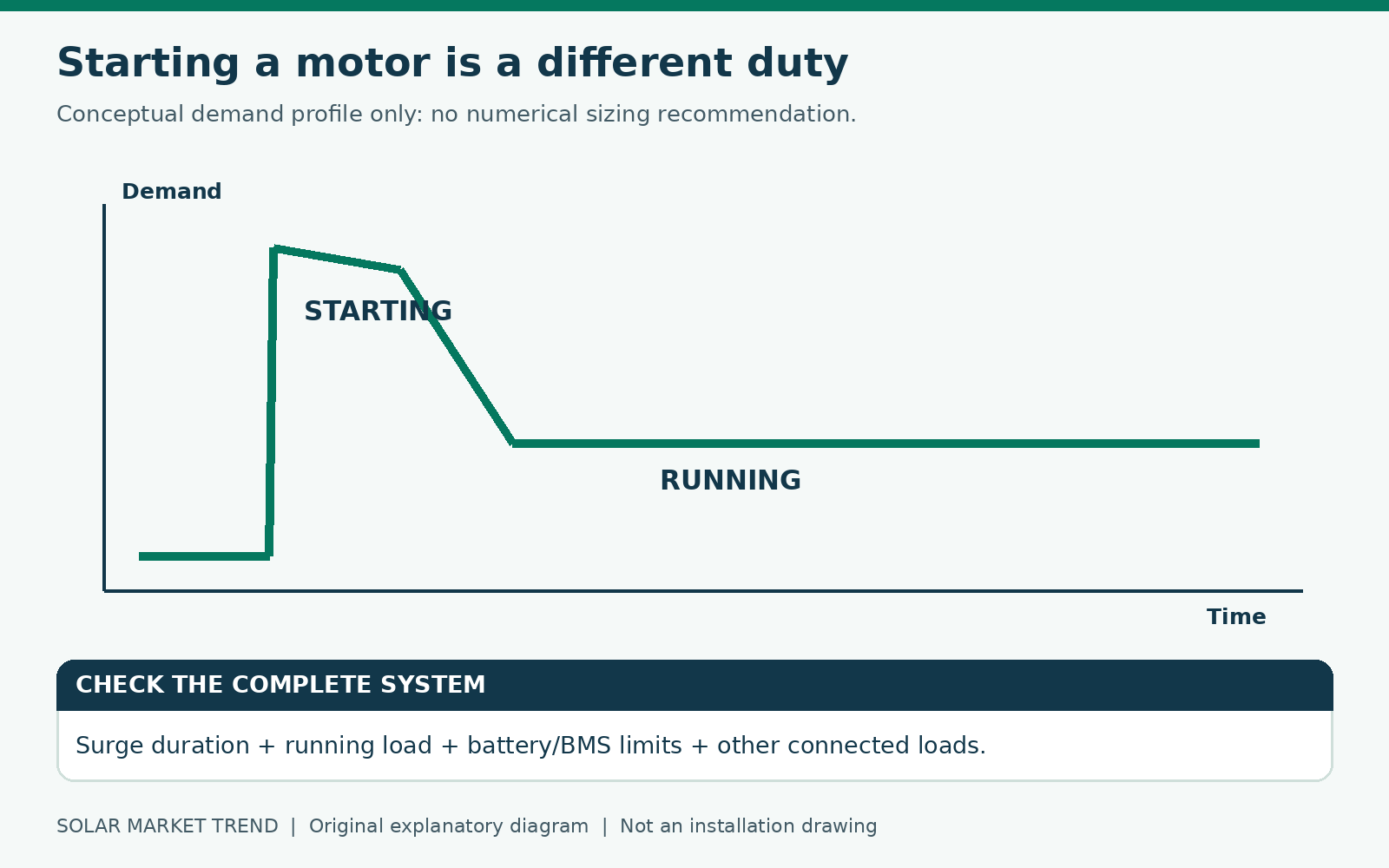
ABB's motor-starting guide identifies starting method, load torque and inertia as separate selection factors. Direct-on-line starting applies full supply voltage and can create high starting current and voltage dips. The demand during acceleration therefore deserves its own assessment; the motor's ordinary running figure is insufficient. [1]
Ask the supplier to identify the exact motor and its starter, rather than promise that every pump below a certain horsepower will work.
2. A surge rating needs an output mode and a stopwatch
A useful surge specification states how much output is available, for how long, and in which operating mode. For example, Deye's published SUN-3/3.6/5/6K-SG04LP1-EU product table lists off-grid peak power at twice rated power for 10 seconds. Its grid-to-load passthrough current appears separately. These are different specifications, and neither should be substituted for the other. [2]
That example does not establish that any particular pump will start. Request the applicable overload curve and confirmation covering the precise model revision, operating conditions and motor demand.
Also check the distinction between temporary output capability and surge protection against electrical transients. The same Deye table separately lists Type II AC/DC surge protection. That protection entry does not increase motor-starting capacity. [2]
3. Understand what an unsuccessful start can look like
An inverter may limit its output before it shuts down. Victron's Inverter Smart manual explains that a motor or pump's starting current can exceed its overcurrent threshold; the output voltage then falls as current is limited. Continued overload leads to shutdown and a delayed restart. Its documented retry behaviour belongs to that product family, not every hybrid inverter. [3]
For the buyer, the important implication is that a brief hum, a restart or flickering lights is not a successful motor-start test. Record the displayed fault and ask the installer to diagnose it. The same manual distinguishes low-battery-voltage and temperature protection from overload, so an interruption alone does not identify the cause. [3]
Do not repeatedly force a stalled appliance to start or ask anyone to bypass protection to make a demonstration pass.
Original companion diagram
4. The battery must support the same event
Evaluate the battery and its management system alongside the inverter. Victron's Lithium NG 12.8 V battery manual, for example, requires a BMS and specifies operating conditions and discharge-current restrictions, including temperature-related reductions. These instructions are specific to that battery family; another lithium battery may have materially different limits. [4]
Our purchasing recommendation is to request both the permitted continuous discharge current and any separately documented short-duration allowance for the proposed battery bank. Ask the installer to reconcile those limits with the inverter's starting demand and the site's expected temperature and state of charge.
A large stored-energy figure is not sufficient evidence for this check. The quotation should identify the battery model, quantity, compatible BMS arrangement and manufacturer-supported limits, rather than treating every battery with a similar capacity label as interchangeable.
5. Ask for measurements that capture the start
An ordinary running-current reading can miss the event under investigation. Fluke explains that dedicated, triggered inrush measurement synchronises capture with motor starting. Its example instruments calculate a starting-current measurement over a defined sampling window. That is more meaningful than reading a display after the motor has settled. [5]
Ask a qualified technician to document the instrument, capture method, starting current and operating conditions. For a difficult application, request an appropriately recorded current-and-voltage trace covering acceleration, not merely an isolated peak value. This is our recommended evidence package, not a universal test standard.
Have the installer compare the captured event with the inverter's time-dependent limits. Do not open a distribution board or expose live conductors to collect these readings yourself.
6. Soft starting is an engineering option, not a universal fix
ABB describes softstarters as controlling the voltage ramp to reduce starting-current peaks, while variable-frequency drives control frequency and voltage for the motor application. Selection still depends on the load and operating requirements. These are distinct approaches, not interchangeable add-ons. [1]
If a seller proposes either solution, request written compatibility for the motor, inverter and intended duty. Ask who will commission it and support the combined system. Avoid accepting a generic accessory as proof that the original inverter selection is adequate.
7. Put the acceptance conditions in the quotation
Before paying, request a written schedule covering: the exact motor and starter; other loads permitted during starting; the inverter model and off-grid overload specification; battery/BMS limits; and the agreed commissioning record.
Our suggested acceptance test is a manufacturer-compliant demonstration of the actual application on backup, witnessed and recorded by the installer. Agree the battery condition and background loads beforehand. Any repeated-start sequence must respect the appliance manufacturer's restrictions. A demonstration performed while utility power remains available should not be presented as proof of battery-only starting performance.
For a household pump, shop compressor or workshop motor, a documented match is more useful than a confident horsepower claim. Buy the tested operating arrangement, with its limits clearly stated.
Sources and references
- [1] ABB: Motor Starting Solutions, Rev. A, September 2025
- [2] Deye: SUN-3/3.6/5/6K-SG04LP1-EU technical specifications
- [3] Victron Energy: Inverter Smart Manual, protections and automatic restarts
- [4] Victron Energy: Lithium NG 12.8 V battery manual, operation
- [5] Fluke: How and why to measure inrush current