SOLAR INVERTER BUYER GUIDE
Solar Inverters at Altitude Why Installation Height Can Change the Allowed Ratings
Share on social media
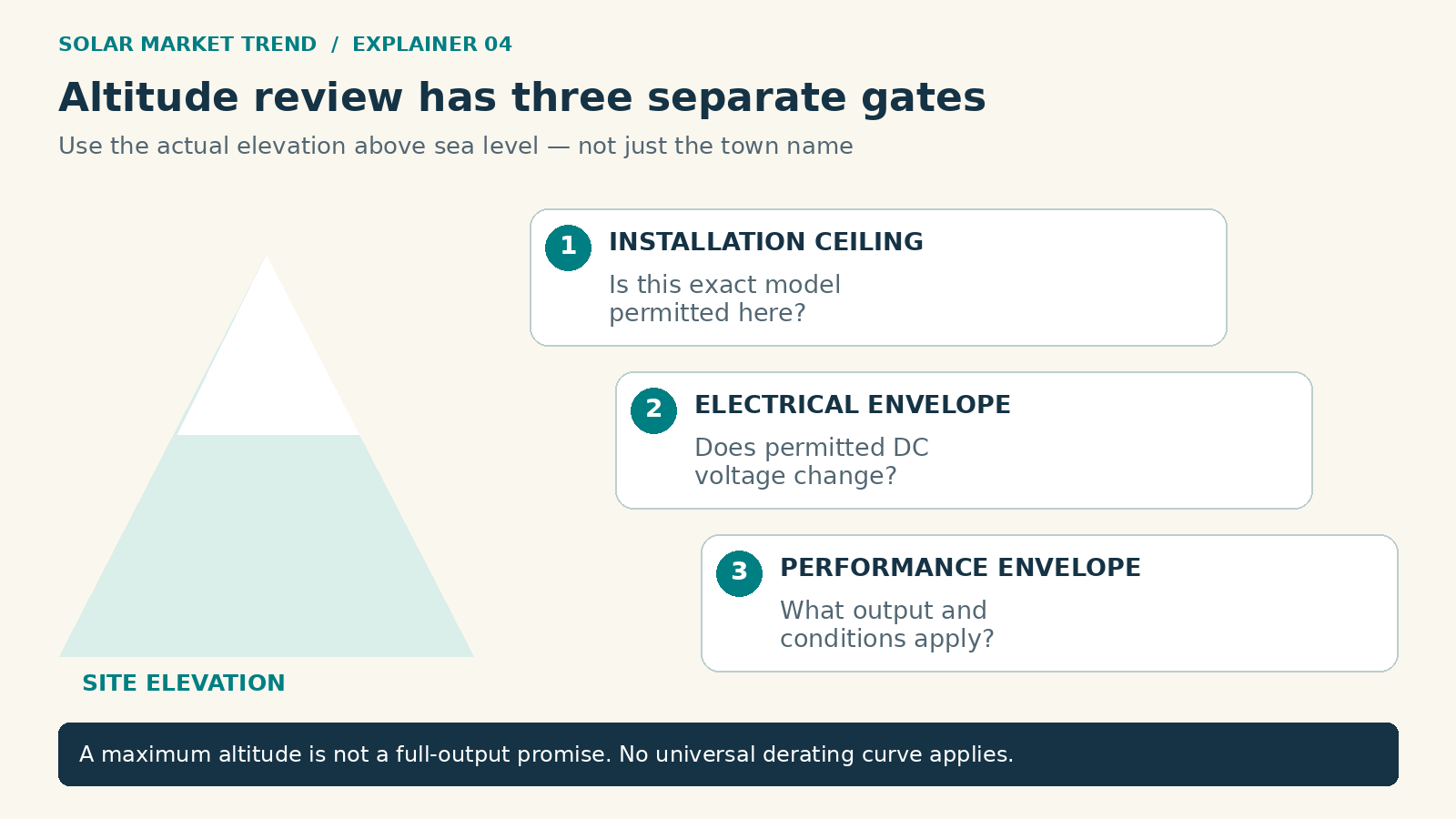
A maximum installation altitude is not a promise of full output at every height. Elevation can affect permitted DC voltage, cooling conditions and model eligibility, so the exact manual must travel with the quotation.
Start with the site, not a country-wide assumption
An inverter selected for one address should not automatically be transferred to a higher-elevation project. For a Pakistani buyer planning a mountain-area home or business, the first question is the actual installation elevation above sea level. The town name, roof height above the street and a generic “works in Pakistan” assurance are not interchangeable pieces of design evidence.
Ask the designer to record the site elevation and its source alongside the exact model and manual revision. This turns altitude from a forgotten environmental footnote into a procurement question that can be checked before the equipment arrives. It does not imply that every elevated site needs a larger inverter.
Altitude affects more than a power percentage
SMA’s technical information for Sunny Central CP XT inverters separates two effects of lower air density: reduced electrical insulation capability and reduced cooling capability. Its design guidance therefore considers both maximum permissible DC voltage and AC power, with particular order options for high-altitude applications. These are instructions for that central-inverter family, not a universal derating curve for domestic hybrids. [1]
The distinction matters when comparing quotations. “It will only produce a little less” does not answer whether the proposed DC voltage remains permissible. Likewise, a temperature specification does not by itself establish the altitude limit. The complete operating envelope must cover the actual site and equipment. [1]
An example where voltage changes with elevation
Fronius’s Symo Advanced manual reduces permitted string voltage across altitude bands and prohibits installation above 3400 m. Its stated maximum changes from 1000 V at 0–2000 m to 850 V at 3001–3400 m. This product-specific example is not a general Pakistan string-sizing table. [2]
Have the designer retain the relevant manual page in the project record. If a supplier proposes a substitute model, repeat the review rather than assuming that a similar enclosure, power label or brand name preserves the same conditions.
Maximum altitude and full performance are different claims
Huawei’s published Thailand-region specifications for the SUN2000-12/15/17/20/25KTL-M5 family state an operating-altitude range of 0–4000 m, with derating above 2000 m. The maximum height and the onset of derating are therefore different figures. That page does not supply a universal percentage loss for each additional metre, and we do not invent one. It is technical context, not confirmation of a Pakistan variant or current local availability. [3]
As another deliberately different example, the SMA Sunny Boy Storage 2.5 battery-inverter manual lists a maximum operating altitude of 3000 m. It should not be treated as equivalent to a PV string inverter, but it reminds buyers that a storage system can contain several devices whose environmental limits need separate checks. [4]
Put four answers in the proposal
Ask for four written answers: Is the precise model permitted at the site elevation? Does its permissible DC voltage change there? What power or current capability applies under the stated environmental conditions? Do any special product options or manufacturer confirmations apply? These questions are an editorial checklist drawn from the differing manufacturer examples, not a substitute for their engineering instructions. [1,2,3,4]
A useful proposal should distinguish verified answers from pending ones. It should identify who will resolve a missing curve or ambiguous regional specification and what document will close the question. Avoid accepting a guessed straight-line reduction merely because the sales sheet contains one threshold and one maximum height. Keep the response attached to the same quotation so later substitutions remain visible.
Do not repair a design gap with a setting change
If altitude compatibility remains unresolved, pause equipment selection or the affected design decision until a qualified professional has the applicable manufacturer guidance. Do not assume a fan, an output limit or a software adjustment creates approval to operate beyond a documented installation ceiling.
Keep the final environmental assessment with the handover pack and use it again when equipment is replaced. These sources explain product-specific technical constraints; they do not establish Pakistan regulatory approval, warranty coverage for an unidentified regional variant or measured annual energy loss. The defensible purchase is the one whose documented ratings fit the real site—not the one with the highest isolated number.
Sources and references
- [1] SMA technical information — Installation at high altitudes, CP-Hoehenaufst-TI-en-12
Checked 2026-10-24
Reduced air density affects insulation and cooling; CP XT design requires voltage and power checks, sometimes special order options.
- [2] Fronius Symo Advanced operating instructions — altitude-dependent string voltage
Checked 2026-10-24
1000/950/900/850 V altitude bands and prohibition above 3400 m, applicable to this product family.
- [3] Huawei Thailand — SUN2000-12/15/17/20/25KTL-M5 specifications
Checked 2026-10-24
Published regional specification allows 0–4000 m with derating above 2000 m; not a Pakistan availability claim.
- [4] SMA Sunny Boy Storage 2.5 online manual — technical data
Checked 2026-10-24
Battery-inverter example lists maximum operating altitude 3000 m; product-specific scope differs from PV inverter examples.