SOLAR PANEL BUYER GUIDE
Solar Panel Bypass Diodes Why They Do Not Make a Roof Shade-Proof
Share on social media
Bypass diodes reduce some effects of shading, but their presence does not remove the need for a roof shade survey, sensible layout and professional fault investigation.
Protection is not permission to ignore shade
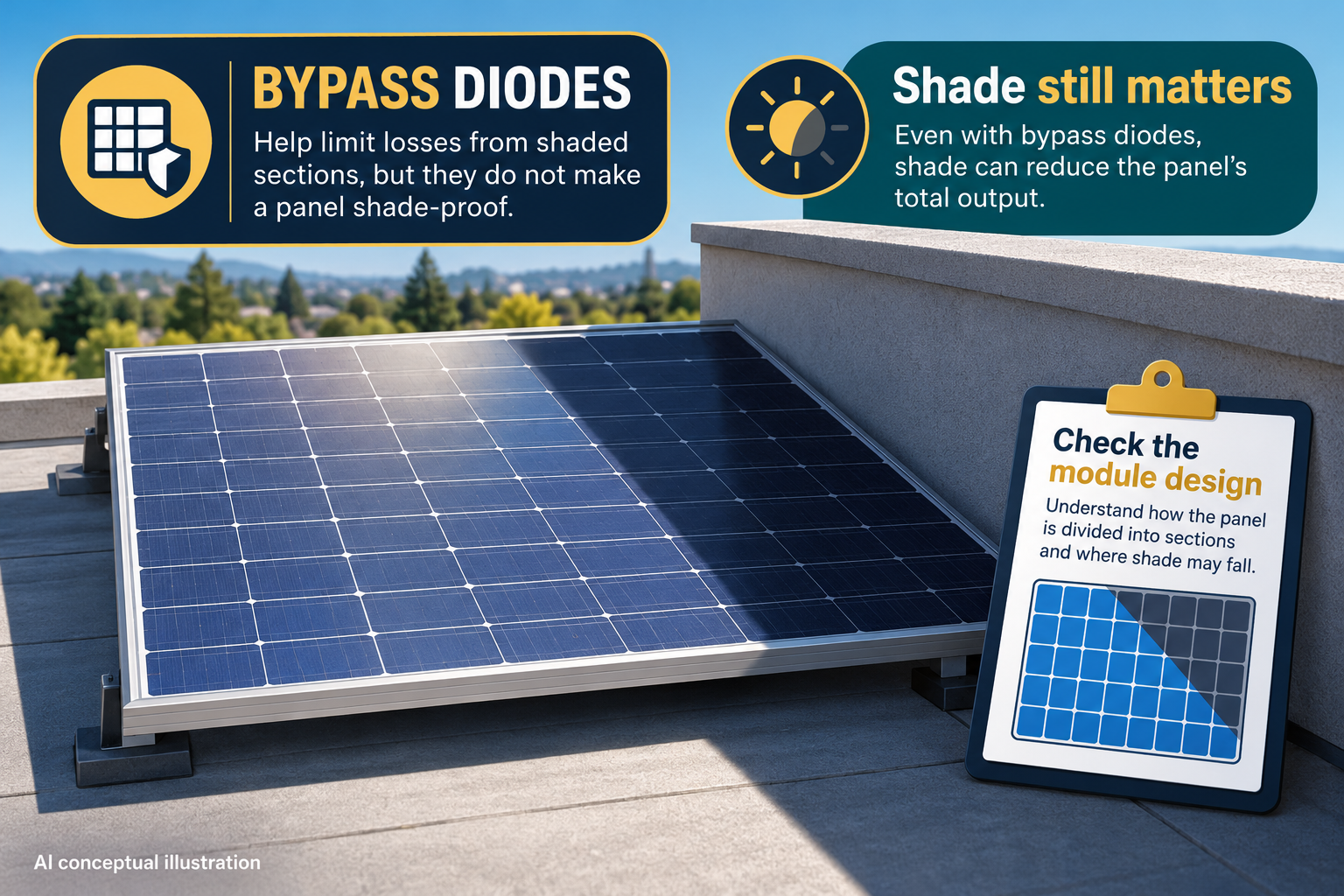
A solar quotation may mention bypass diodes as reassurance when a water tank, parapet or neighbouring structure shades the proposed array. The useful question is not simply whether diodes are present. It is whether the installer has assessed the actual shadow and selected an appropriate layout. JinkoSolar explicitly warns that shadows can still affect performance and operational safety even when its modules contain bypass diodes. A diode-equipped panel is therefore not automatically suitable for a permanently shaded position. JinkoSolar installation manual
What the diode actually bypasses
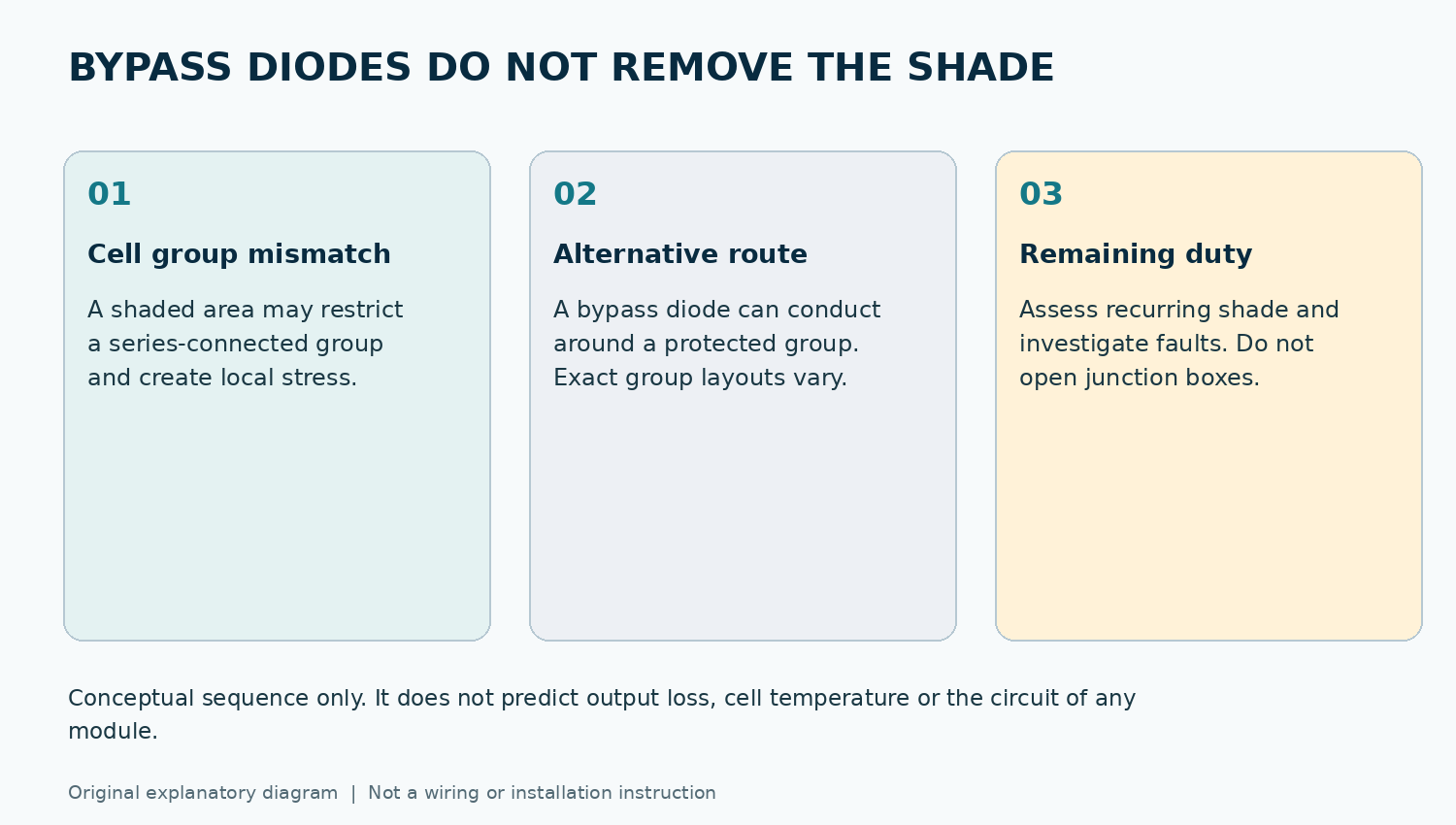
Solar cells connected in series share a current path. A shaded cell produces less current than its illuminated neighbours and, under some operating conditions, can be driven into reverse bias: instead of contributing useful electrical output, it dissipates power. A bypass diode provides an alternative route around a group of cells when the electrical conditions make it conduct. It does not illuminate the shaded area or restore that group’s missing contribution. Penn State engineering explanation
The grouping matters. Penn State illustrates a conventional module with three protected cell groups; that is an example circuit, not a universal map of modern panels. Ask for the exact module’s cell-interconnection information rather than assuming every visible row corresponds to one diode. A narrow shadow across several groups can behave differently from a shadow confined to one group.
Why hot spots can still occur
A bypass diode protects a group rather than independently controlling every small region of every cell. Original research published by Germany’s Institute for Solar Energy Research Hamelin examined partial shading in two modules using a hot-spot endurance test. Both full-cell and half-cell designs could develop substantial local heating despite their bypass architecture. The study supports a limited but important conclusion: the presence of bypass diodes alone is not proof that damaging local heating is impossible. It is not a failure prediction for every current module or every shaded roof. ISFH research summary
Request a shade assessment not a slogan
For a Pakistan rooftop purchase, request a marked roof plan showing the array, obstructions and maintenance access. Ask the installer to identify which modules receive shade, at what times, and how the assessment accounts for changes through the year. Photographs should carry a date and time; one clear midday photograph cannot document every operating condition.
Turn that survey into an explicit design decision. Can a module be moved away from the obstruction? Has the proposed orientation been checked against its internal cell layout? If the installer accepts remaining shade, ask for the reasoning and energy-model assumptions in writing. These are practical purchasing questions, not a promise that any single arrangement eliminates hot spots.
Keep fault checks outside the junction box
JinkoSolar distinguishes bypass diodes from overcurrent protection and tells owners not to open module junction boxes themselves. Suspected diode faults therefore belong with the installer or manufacturer’s service channel, not a rooftop experiment. Do not unplug live connectors or deliberately cover cells to test a claim. JinkoSolar electrical and maintenance guidance
A useful owner record includes dated photographs of recurring shade, the affected module locations and monitoring observations. From a safe accessible position, report visible damage or new obstructions. Have the service provider determine whether inspection, electrical testing or other diagnostic work is appropriate; a production dip by itself does not identify a failed diode.
The buying decision
Choose evidence over a shade-proof label. Keep the exact model datasheet, applicable installation manual, shade assessment and service contact with the purchase record. Ask the seller to explain any claim that a particular cell design tolerates your obstruction. Diodes are one component of module protection, not a replacement for correct placement or maintenance. The strongest proposal acknowledges the remaining uncertainty and explains how recurring shade will be avoided, monitored or investigated.
Sources and references
- [1] JinkoSolar Photovoltaic Modules — Installation and Instruction Manual V10
Checked 2026-10-25
Inspected full official 40-page PDF on 2026-10-25; relevant printed pp.11,26,30–31: shade remains a performance/safety concern; bypass diodes are not overcurrent protection; no owner junction-box opening. Regional manual used for manufacturer principles, not Pakistan-specific installation rules.
- [2] Penn State AE 868 — Wiring within a PV Module and the Shading Effect
Checked 2026-10-25
Inspected complete university-authored engineering lesson and figure descriptions on 2026-10-25; series-cell mismatch, reverse bias, grouped bypass diodes and shading-pattern dependence. Its 60-cell architecture is explicitly an example.
- [3] ISFH — Three Bypass Diodes Architecture at the Limit
Checked 2026-10-25
Inspected institute-hosted original research abstract on 2026-10-25; Witteck et al., IEEE Journal of Photovoltaics (2020), DOI 10.1109/JPHOTOV.2020.3021348. Controlled tests of two modules show partial-shade heating despite bypass diodes; no extrapolated brand ranking.