SOLAR PANEL BUYER GUIDE
Solar Panel Delivery Why Pallet Format and Unloading Plans Matter
Share on social media
A solar delivery needs more than a clear space beside the truck. Check packaging format, handling responsibility, storage readiness and product identity before panels arrive.
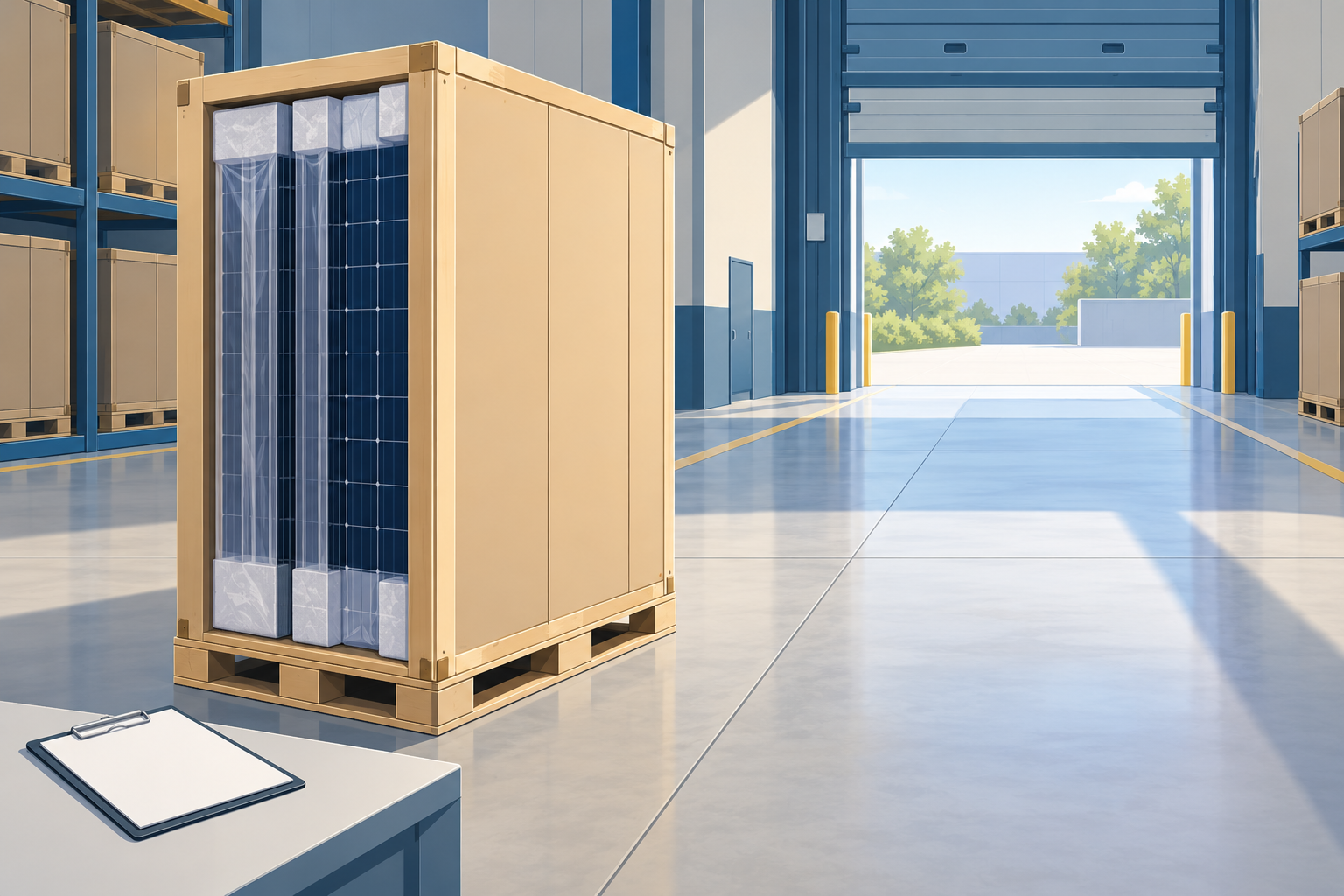
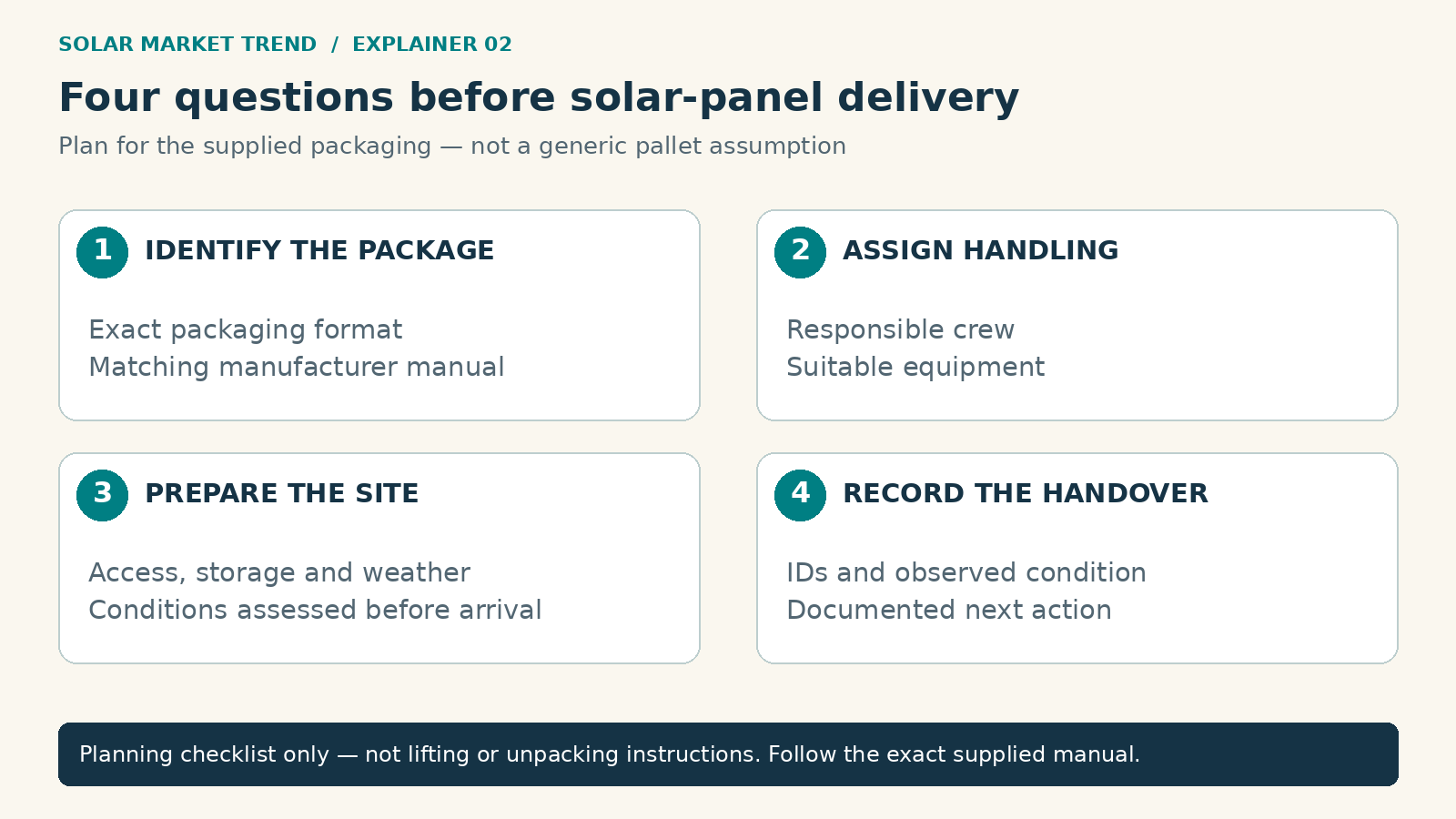
Plan the handover before the vehicle arrives
A solar-panel quotation can identify the wattage and price precisely while leaving delivery surprisingly vague. For a home, shop or project site in Pakistan, ask what arrives: a complete factory pallet, a partly filled package or individually repacked modules. The receiving arrangement should fit that consignment, not an assumption based on the last delivery. This is a buyer’s planning guide, not an unloading procedure.
There is a technical reason to take logistics seriously. IEA PVPS identifies packaging, transport and installation among the possible origins of cell cracks, many of which are not visible by eye. Preventing avoidable handling stress is therefore worthwhile even when the outside of the consignment looks tidy. This does not establish a defect rate for Pakistani shipments. [4]
Pallet orientation changes the question
Canadian Solar’s April 2024 manual gives different stacking conditions for landscape-oriented and portrait-oriented module packaging; it does not offer one limit for every package. Its restrictions also refer to particular bracing arrangements. The example shows why the module model alone is not enough to plan storage. The packaging format and supplied supports matter too. [2]
Our recommendation is to obtain the applicable packing and handling document before dispatch, with photographs or identifiers confirming the actual format. Ask the supplier to resolve any mismatch between the document and the consignment. Do not convert a limit for a complete package into permission to stack loose panels, or assume that an arrangement suitable inside a vehicle is suitable at the receiving site.
Make unloading responsibility explicit
LONGi’s published guidance calls for trained personnel and suitable handling equipment. It separately addresses stable pallets, secure cargo and protection against impact or packaging deformation, and prohibits stacking damaged or deformed pallets. These requirements make unloading a planned activity rather than a favour that whoever happens to be present can perform. [1]
Before confirming delivery, agree who supplies the equipment and trained crew, who checks access, where the consignment will be placed, and what happens if the site is not ready. Ask the responsible contractor to verify that the selected equipment and route suit the actual load. This article provides no lifting configuration, forklift dimensions or crane instructions; those must come from the applicable documents and competent personnel.
Storage is a site condition, not spare floor space
Trina Solar’s August 2024 Vertex manual addresses ground stability, drainage, moisture protection, packaging condition and access to the storage area. It recommends appropriate warehouse storage for longer periods and warns against ground conditions that can allow packages to tilt or collapse. A location that appears empty is not automatically suitable for a heavy, tall consignment. [3]
For quotation and scheduling purposes, identify the storage location and expected waiting period before installation. Ask who will inspect stored packages and respond if rain, construction work or a changed layout affects the area. If the original plan becomes unsuitable, arrange a reviewed alternative rather than repeatedly moving the same consignment around the site without a handling plan.
Unpacking must match the supplied format
The Trina manual uses different unpacking methods for specified packaging formats. Before unpacking it calls for checking product type, power bin, serial information and quantities against the package records, and prohibits improvised unpacking methods. The important buyer lesson is to confirm that the crew has the correct instructions and required support equipment before packaging restraints are removed. [3]
A partially used delivery needs a plan as well. Ask how remaining modules will be secured and stored under the applicable manufacturer instructions, and who retains responsibility until installation. Do not let the delivery schedule pressure untrained people into opening a package merely to make it easier to move. A revised appointment is preferable to an undocumented workaround.
Keep identity and exceptions with the delivery record
We recommend retaining the order, package identifiers, module serial list where supplied, receipt photographs, observed exceptions and the agreed next action together. Record “packaging damaged” separately from a diagnosis about the module inside. Canadian Solar’s manual identifies module barcodes and nameplates as product-identification information; preserving that link makes later supplier queries more specific. [2]
These manufacturer documents are scoped examples, including older 2024 manuals, not universal instructions for every product now on sale. Obtain the current applicable version for the delivered model and package. Owners should not attempt electrical tests or handle broken modules to settle a delivery dispute; use qualified personnel. A well-planned delivery leaves a traceable, safely stored consignment and clear responsibility—not merely a signed receipt. [2]
Sources and references
- [1] LONGi — PV Module User Manual, DGBG 1.0 file dated 260409, sections 10.2–10.4
Checked 2026-10-24
Packaging-specific stacking and trained handling; suitable equipment, secure cargo and avoidance of damaged pallets, shock and deformation.
- [2] Canadian Solar — Installation Manual of Photovoltaic Modules, EN v2.1, April 2024, sections 2 and 4
Checked 2026-10-24
Different stacking restrictions for packaging orientations; product identification and safety precautions. Older documented example, not current instructions for every supplied model.
- [3] Trina Solar — Vertex Series User Manual UM-M-0002/Ver. L, August 2024, sections 4–5
Checked 2026-10-24
Storage-site stability, drainage and packaging condition; packing-list checks and packaging-specific unpacking methods. Older primary manual used as a scoped example.
- [4] IEA PVPS Task 13 — Quantification of Technical Risks in PV Power Systems, 2021, cell-crack fact sheet
Checked 2026-10-24
Packaging, transport and installation are potential sources of cell cracks, many of which are not visible by eye; no Pakistan defect rate inferred.