SOLAR PANEL BUYER GUIDE
Solar Panel Drainage Holes: Why a Clear Frame Path Matters
Share on social media
A small factory opening has a specific job. Learn what a buyer should ask about drainage, mounting and inspection without attempting frame modifications.
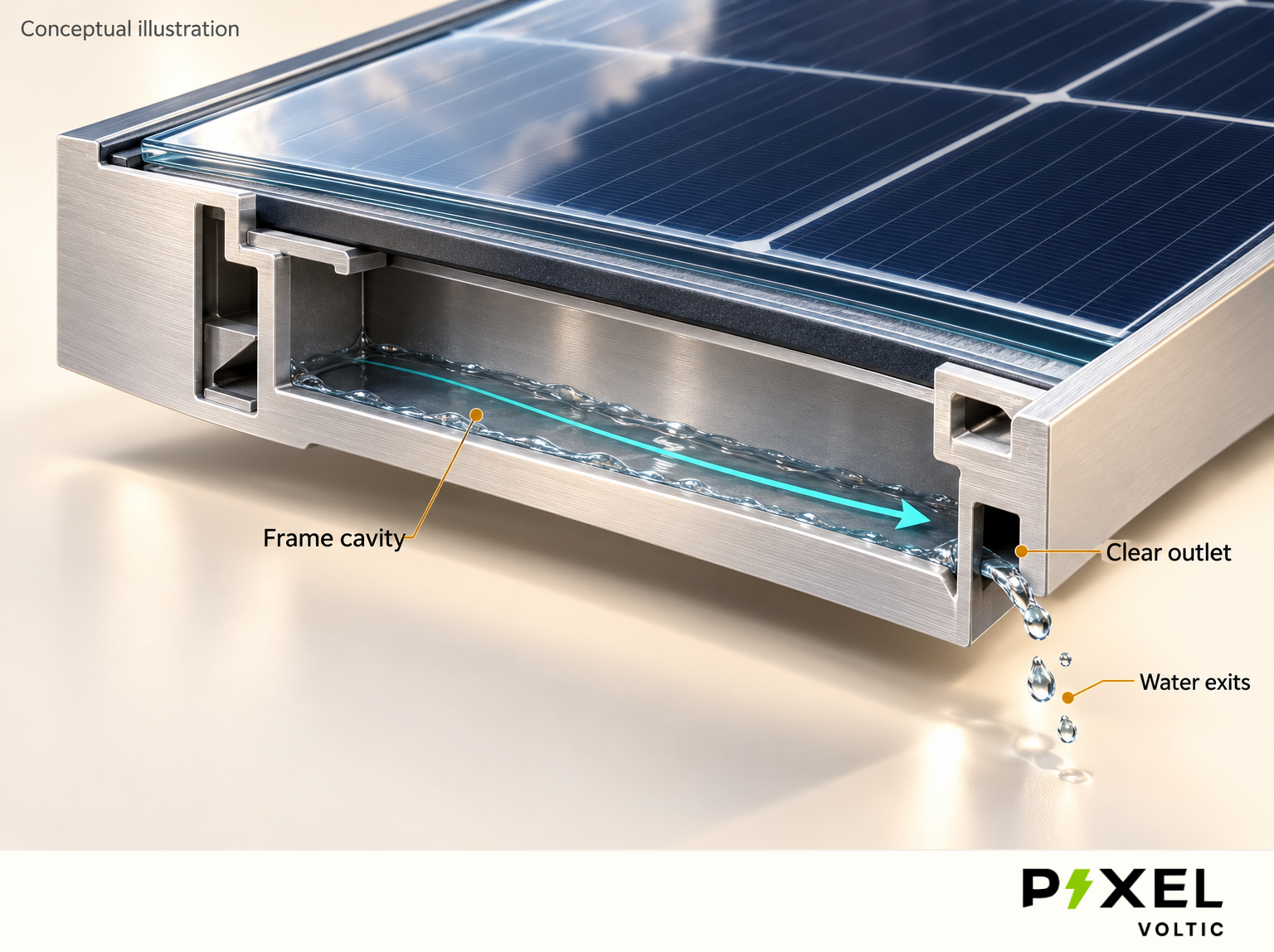
The small opening that deserves a handover check
When reviewing a solar installation in Pakistan, the obvious questions concern panel capacity, roof space and the inverter. A less visible detail is whether the module frame retains its intended drainage path after installation. The useful buyer question is not how many holes a panel has, but whether its manufacturer’s specified openings remain unobstructed in the completed arrangement.
REC’s installation manual explains that its frame drainage openings allow moisture and water to leave. It says they must remain open, must not be used for mounting, and must not be covered by the mounting structure. Their shape and dimensions can vary with product and frame design. [1]
Distinguish drainage from mounting and grounding
A frame can contain openings with different purposes. LONGi’s V19 drawings separately identify mounting holes, grounding holes and drain holes. Its installation guidance also prohibits clamps from blocking drainage openings. This matters because a convenient-looking opening is not automatically an approved place for a fastener or accessory. [2]
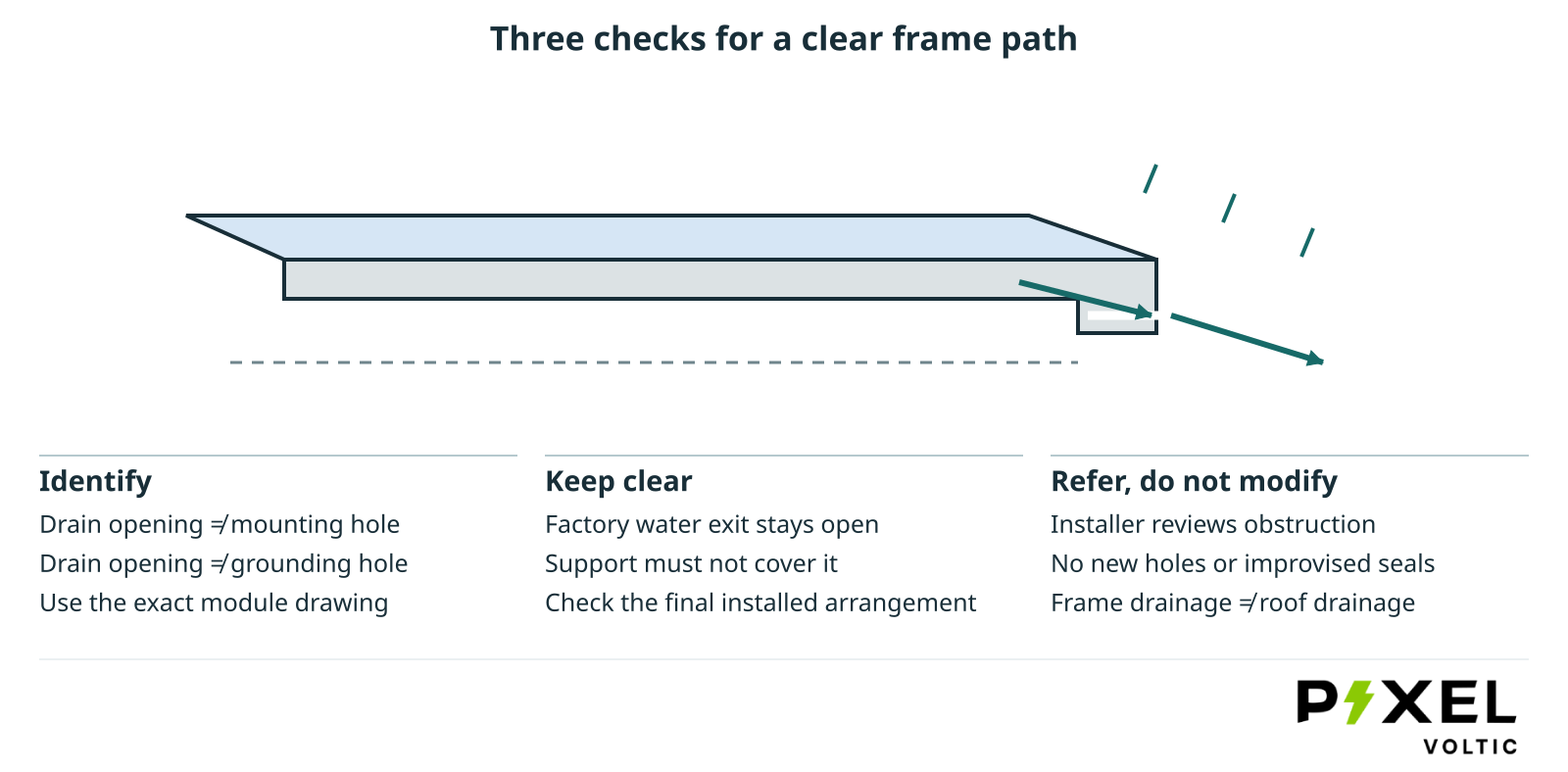
Ask the installer to identify these features on the drawing for your exact module, not on a generic internet photograph. The required evidence is modest: the relevant drawing, the proposed support arrangement and a clear explanation of how the water outlet remains free. A photograph from another product family cannot settle whether your own frame is correctly supported.
Review the whole path, not only the visible hole
Canadian Solar’s July 2026 manual requires drain holes to remain unblocked. It separately links adequate rear ventilation clearance with the dissipation of condensation and moisture. The two requirements are related to managing moisture but are not interchangeable: an open frame outlet does not establish that the rest of the installation has the required clearance. [3]
Our suggested review follows the path outward. Can water leave the designated opening? Is the mounting arrangement obstructing that exit? Has a later accessory introduced a new obstruction? Have the module and mounting instructions both been checked? These are questions for the designer or installer; this guide does not prescribe a universal gap, tilt angle or clamp position.
Do not turn an inspection issue into a modification
An apparent blockage is not permission to drill another outlet. JinkoSolar’s global manual prohibits unauthorised frame drilling and warns of corrosion or other adverse effects. That warning supports a conservative response: have a qualified installer resolve the obstruction using the equipment’s approved arrangement, rather than alter the module to suit an improvised support. [4]
The same reasoning applies to an attractive-looking sealant repair or an accessory sold as a drainage improvement. Request manufacturer confirmation of suitability for the specific module before accepting a change. Do not treat every gap as a defect to be sealed, or every opening as a place to attach something. Neither appearance nor a salesperson’s demonstration replaces the applicable instructions.
Ask for evidence that remains useful after installation
Before handover, request dated photographs of representative frame exits and of any awkward support intersections, taken by the installation team from safe working positions. Have them record which module and mounting documents were followed. Where a concern was identified, retain a before-and-after record and the written explanation of the approved correction.
Build drainage into the maintenance conversation rather than inventing a separate DIY routine. Ask who will inspect the array, which observations require attention, and how rooftop access will be managed. Photographs of persistent staining or accumulated debris can help explain a concern, but they do not establish its cause. Leave close inspection and any corrective work to qualified personnel.
What drainage can—and cannot—tell a buyer
An unobstructed factory outlet is a compliance detail, not a guaranteed energy-yield improvement or a test of panel quality. The cited manuals do not supply a universal percentage loss from a blocked hole, a standard cleaning interval for every Pakistani roof, or permission to redesign the frame. Avoid quotations that turn this small feature into an unsupported performance promise.
Finally, keep frame drainage separate from roof drainage and electrical sealing. A clear module opening cannot prove that the roof drains properly or that connectors are dry and correctly protected. The sound purchasing decision is to require each issue to be addressed on its own terms, with a documented installation and a safe service plan. These examples concern the cited module families; your equipment’s instructions govern the final design.
Sources and references
- [1] REC Solar Panels Installation Manual, UL 61730, Rev. 15, November 2022—Drainage Holes, p. 19
REC Group
Manufacturer-hosted PDF (filename ends rev_l) internally states Rev. 15, November 2022. Page 19 explains drainage purpose and restrictions for its listed TwinPeak/N-Peak modules.
- [2] Installation Manual for LONGi Solar PV Modules, V19, §§3.1, 5.2.2
LONGi
Separates hole functions and prohibits drain blockage by clamps; model-specific requirements retained.
- [3] Installation Manual—PV Modules, v3.3, July 2026, Installation Requirements and Reliable Ventilation
CSI Solar / Canadian Solar
States drain holes must remain unblocked and rear clearance permits moisture dissipation; no universal dimensions reproduced.
- [4] Global Installation Manual, 14 August 2024, §2.1
JinkoSolar
Warns against unauthorised drilling of the module frame because of corrosion and other adverse effects.