SOLAR PANEL BUYER GUIDE
Solar Panel Fire Classifications Why a Module Rating Is Not a Roof Safety Approval
Share on social media
A fire-related label is useful only when its test system, certified product and installation conditions are clear. Learn to ask for evidence covering the module, mounting assembly and roof rather than a reassuring letter alone.
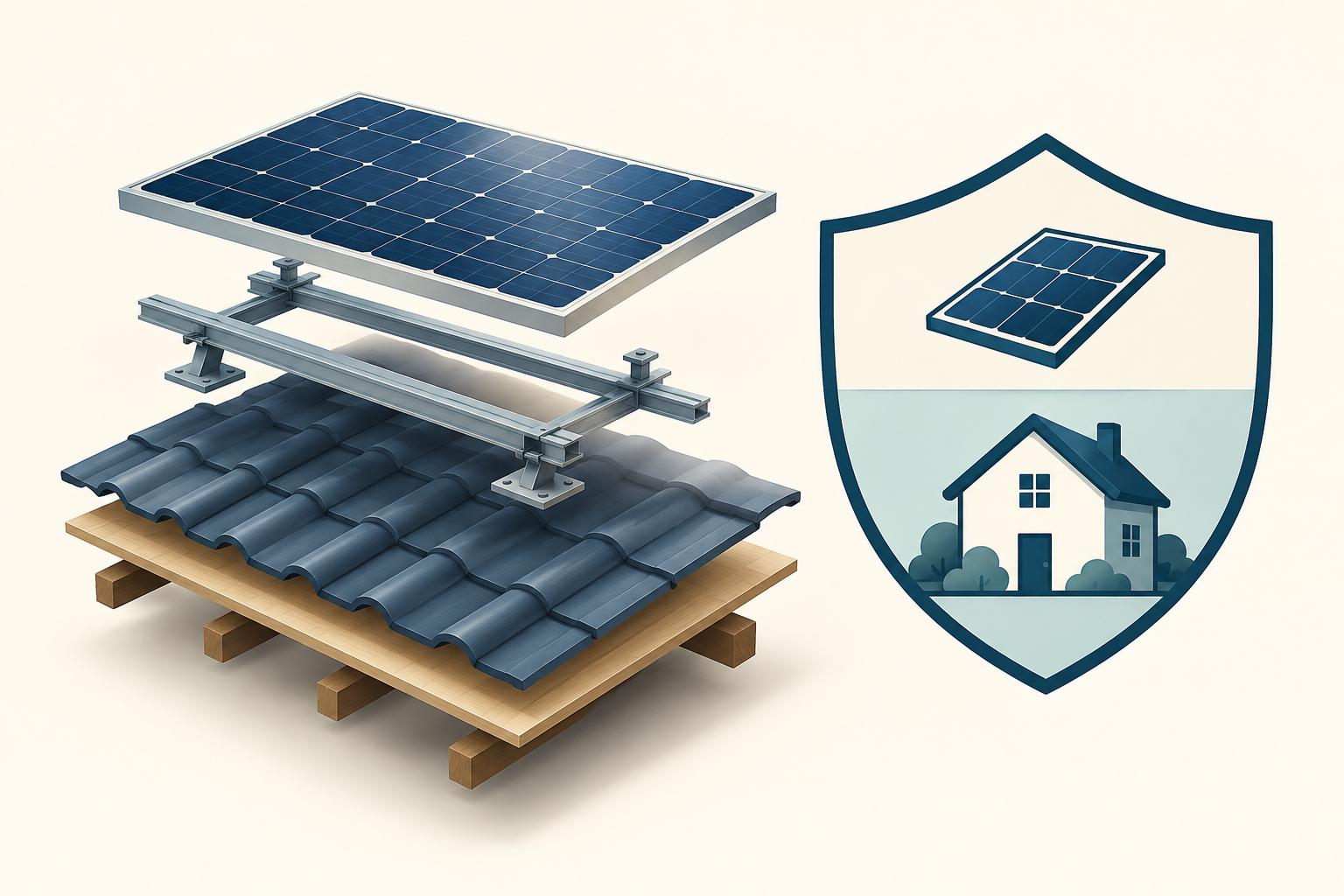
Ask what has actually been classified
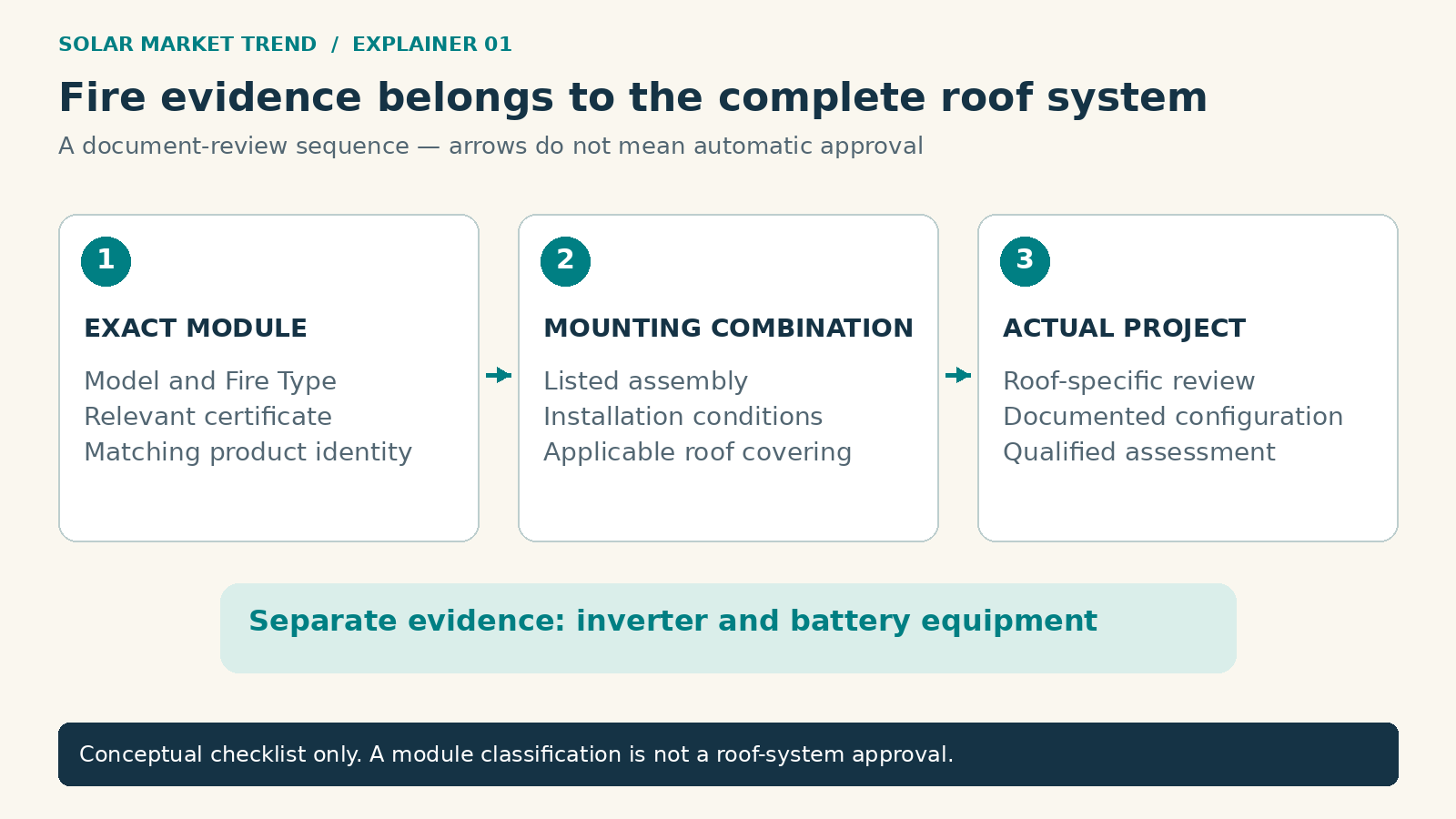
A Pakistani buyer comparing rooftop quotations may encounter phrases such as fire-rated panel, Class A or a numbered Fire Type. Do not treat them as interchangeable promises. The useful buying question is narrower: which product or assembly was assessed, under which standard, and in what installed configuration? This guide explains the evidence trail, not a fire-safety approval for any particular roof.
SolarAPP+, a US solar-permitting platform, explicitly distinguishes a module’s numeric Fire Type from the A, B or C Fire Class of a module-and-racking assembly. Its documentation guide also asks for the exact module model, certification agency and supporting instructions or certificates. A sales-sheet badge without those identifiers leaves the meaning unresolved. [1]
A module is one part of the evidence chain
UL’s public scope for UL 2703 describes mounting and related devices for specific manufacturer/model-designated PV modules. It addresses attributes including mechanical strength, bonding paths, materials and fire classification. This is more precise than saying that a rack is universally approved for every panel that physically fits. Check the actual combination and the attributes included in its evaluation. [2]
The scope also excludes equipment such as inverters and batteries. That matters when a quotation uses one certification mark to reassure the buyer about an entire solar package. Evidence for the roof-mounted assembly cannot, by itself, establish the safety or suitability of separate electrical equipment. Keep the documents for those components distinct. [2]
Read the installation conditions, not only the letter
UL’s 2016 application guide explains external-fire classification as a property of specified PV modules combined with a rack and installed according to that system’s instructions. It also separates the fire, mechanical and bonding attributes of a listing. This older guide is useful explanatory context; it is not a substitute for the current certificate, current instructions or applicable local requirements. [3]
Our practical recommendation is to request a short configuration schedule with the quotation: module model, mounting-system model, roof covering, and the installation conditions referenced by the supplier’s fire evidence. Have the designer identify any required accessories and permitted geometry in the actual documents. Do not invent a universal clearance, roof pitch or barrier material from an unrelated installation photograph.
Roof-integrated products need a different conversation
A conventional rack-mounted module sits above the building envelope. A building-integrated photovoltaic product can itself serve as roofing or another part of that envelope. UL Solutions describes BIPV assessment as covering both PV functions and building-related characteristics, including weather protection, wind resistance, impact and fire. Its UL 7103 discussion illustrates why a roofing product needs more than an ordinary module brochure. [4]
For a solar carport, canopy or roof replacement, ask the project professional to identify the assembly category before comparing certificates. Treating every overhead panel as the same installation can obscure the question of which product is providing weather protection and what evidence supports that use. This is a procurement check, not permission to improvise a roof assembly.
Build a reviewable file before accepting the claim
We recommend keeping the supplier’s exact claim, dated quotation, module label photograph, matching certificate and mounting instructions in one project folder. Ask the installer to mark the relevant certificate entry rather than send an unexplained collection of logos. If a module or rack is substituted, request a fresh compatibility review instead of assuming that the previous combination still applies.
A useful written answer states what is verified, what is conditional and what is still missing. “Certificate supplied; roof compatibility not yet reviewed” is more informative than “fireproof.” A classification tied to a test configuration should not be rewritten as a guarantee that the installation cannot ignite or suffer damage. Fire-risk review belongs with qualified professionals, including assessment of the building itself.
Pakistan buying conclusion and evidence limits
The sources here explain US certification terminology and evaluation boundaries. They do not establish which foreign standard, classification or approval process is legally mandatory for a particular Pakistani property. The project team must verify applicable local requirements and any insurer or building-owner conditions separately. No current Pakistan fire-incident rate or brand safety ranking is claimed.
The buying decision is therefore not simply to choose the strongest-sounding badge. Choose an offer whose evidence can be traced from the exact module to the mounting assembly and the intended roof, with unresolved items clearly identified before installation. A complete, relevant evidence trail is more useful than an isolated label.
Sources and references
- [1] SolarAPP+ — What module and racking information should an installer have available for an inspection?
Checked 2026-10-24
Numeric module Fire Type differs from A/B/C system Fire Class; model, label, manual and certification evidence need to match. US permitting context, not Pakistan law.
- [2] UL Standards & Engagement — UL 2703 public scope, revision shown 28 April 2026
Checked 2026-10-24
Public scope covers specific module/mounting combinations and separate bonding, mechanical and fire attributes; exclusions prevent interpreting a listing as approval of every system component. Full paid standard not accessed.
- [3] UL — Alternative Energy Equipment and Systems Marking and Application Guide, 2016, pp. 12–13
Checked 2026-10-24
Historical explanatory guide: external fire classification concerns specified module/rack combinations installed to instructions; individual listing attributes must be checked. Not relied on for current code requirements.
- [4] UL Solutions — Building Integrated Photovoltaic System Testing and Certification
Checked 2026-10-24
BIPV functions as PV equipment and building-envelope material; evaluation also includes weather protection, wind, impact and fire. US certification examples are not asserted as Pakistani requirements.