SOLAR FLASH-TEST REPORT GUIDE
Solar Panel Flash-Test Reports: Reading Measured Power Without Confusing It with Roof Output
Share on social media
A Pakistan buyer’s guide to checking flash-test identities, electrical readings, test conditions and uncertainty without mistaking a factory wattage for rooftop generation.
What does a flash-test report actually establish?
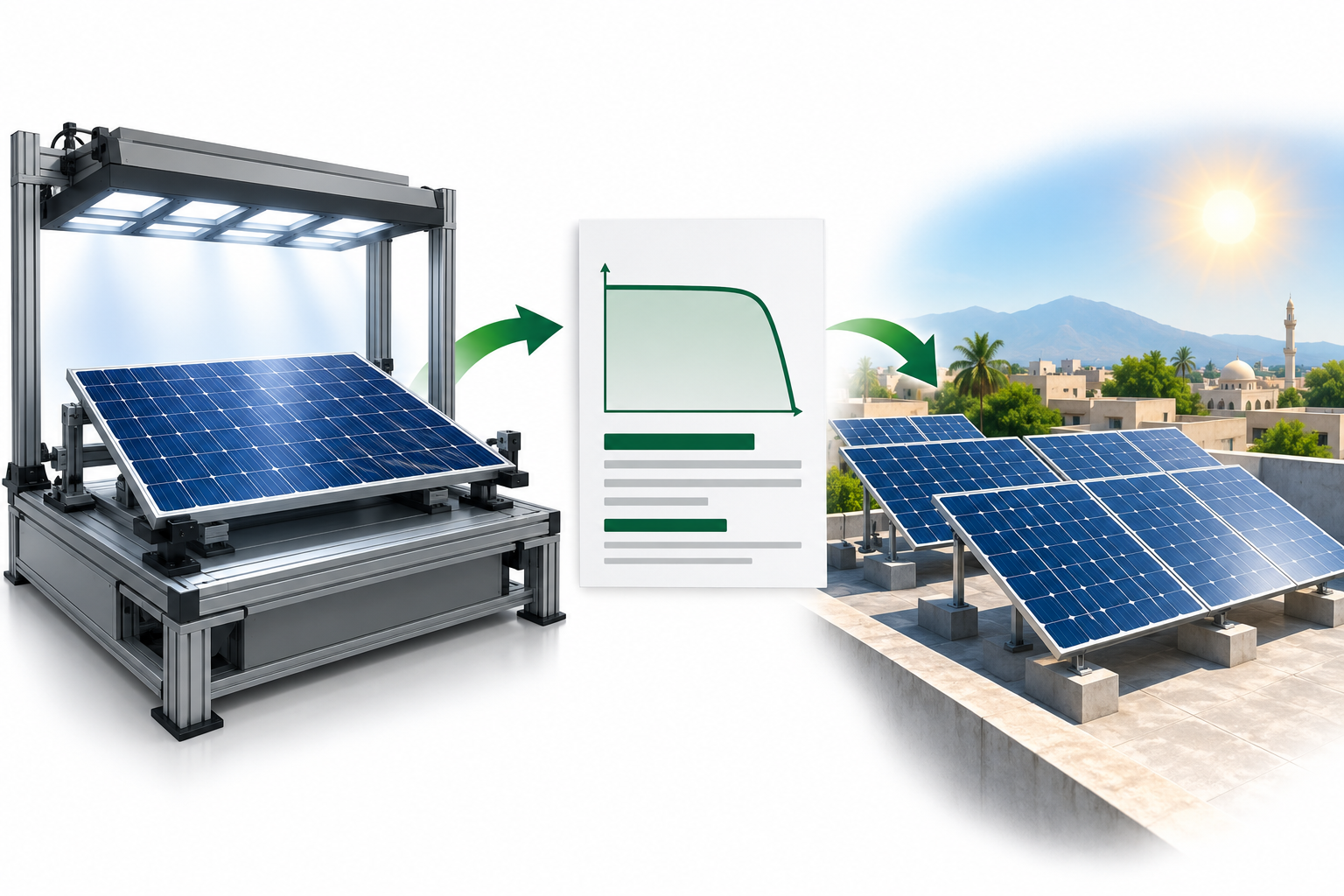
A seller gives you a spreadsheet showing a panel measured slightly above its labelled wattage. That can be useful procurement evidence, but first identify what was measured. A flash tester uses simulated light to measure the module’s current-voltage behaviour; laboratory systems can also use continuous illumination. NLR’s module-measurement service explicitly distinguishes these methods. [1]
IEC TR 60904-14 addresses production-line maximum-power measurements and reporting at standard test conditions, including errors and uncertainty. Its purpose is consistent measurement, not a prediction for a particular roof. [2] For a buyer in Pakistan, the useful question is therefore: does this record credibly describe the delivered module under identified test conditions? Keep that question separate from how much electricity the installed system will produce.
Does this record belong to the panels being delivered?
Before comparing watts, reconcile the report against the physical module labels and delivery documents. Our recommended receiving checklist is the exact model suffix, individual serial number, labelled power class, test date, report issuer and an identifiable report or data-file reference. Ask for the original complete file, rather than a cropped screenshot containing only the best-looking rows.
Mark missing serials, duplicates and unexplained model changes for clarification before acceptance. A report for a different pallet is not evidence about yours. Also identify who performed the measurement: a manufacturer’s production record, a seller’s retest and an independent laboratory result have different provenance. Describe each accurately. A spreadsheet does not become independently verified merely because a dealer forwards it.
Which electrical numbers should you compare?
Read Pmax or Pmp as maximum DC power at the stated conditions. Vmp and Imp are the voltage and current at that operating point; their product should approximately match Pmax, allowing for displayed rounding. As a deliberately invented arithmetic example, 40.0 V multiplied by 13.8 A equals 552 W. It is not a result for any product.
Voc means open-circuit voltage and Isc means short-circuit current. Multiplying those two does not give usable maximum power because they describe different operating points. IEC 60904-1 covers the measurement of the current-voltage curve itself. [3] Compare a measured value against the corresponding model’s declared rating and tolerance, using the same reporting conditions, rather than against another seller’s largest number.
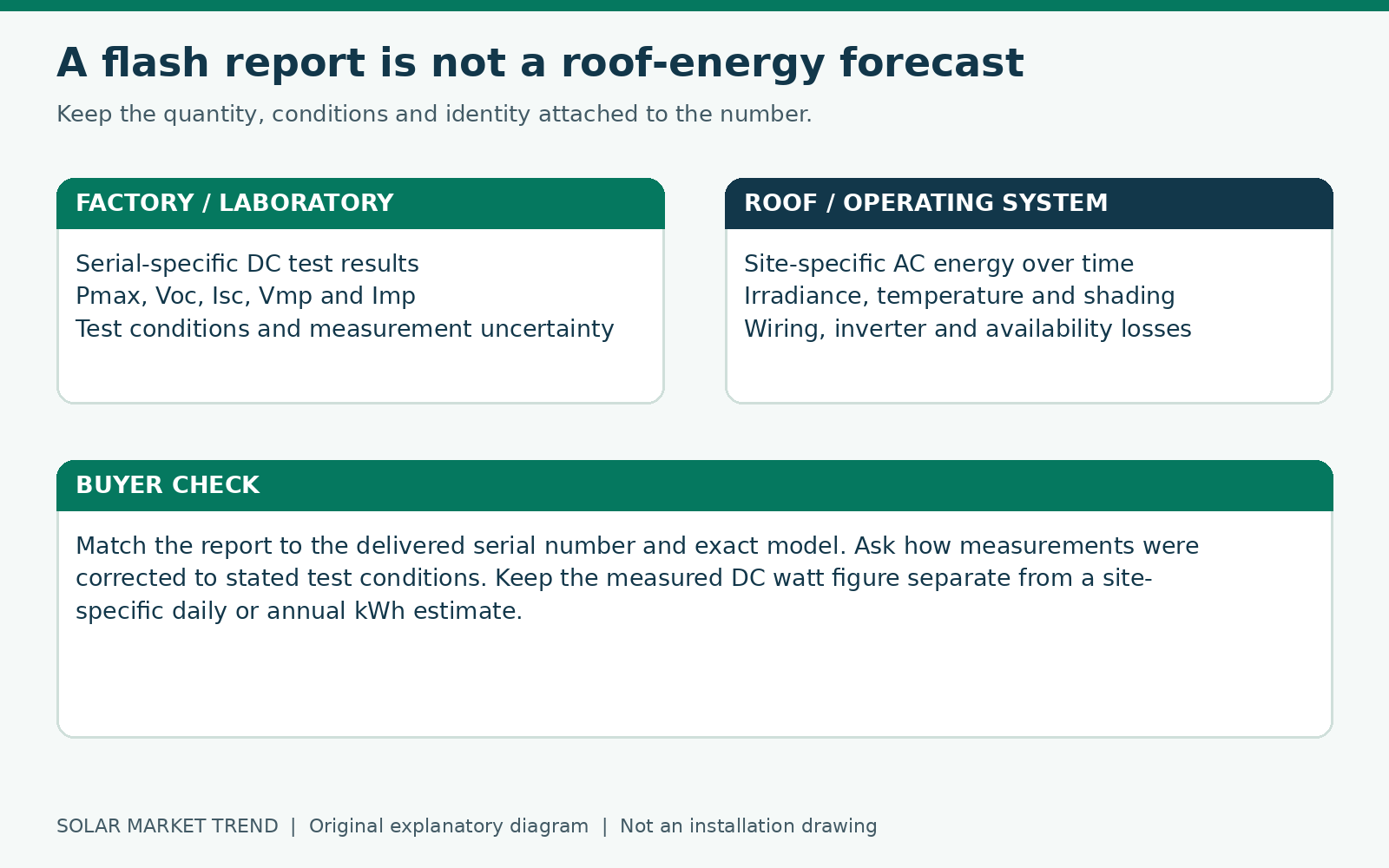
Original companion diagram
Were the light and temperature conditions comparable?
The familiar STC reference combines irradiance of 1,000 W/m², cell temperature of 25°C and an air-mass-1.5 spectrum. Cell temperature is not the same as the weather app’s ambient temperature. NLR’s SAM documentation defines this reference for array DC nameplate capacity. [4]
Ask whether the report presents measurements at those conditions or values corrected to them. Request the method and simulator classification. IEC 60904-9 classifies simulators using spectral match, spatial uniformity and stability over time; the classification concerns the light source, rather than being an all-purpose accuracy guarantee. [5] For bifacial modules, ask what front and rear illumination the reported power represents. IEC publishes additional bifacial measurement requirements, so do not silently compare differently illuminated tests. [6]
Is a small wattage difference meaningful?
A display with several decimal places does not establish equivalent accuracy. NLR identifies temperature uncertainty and light-source non-uniformity as major contributors to module-calibration uncertainty. [1] Fraunhofer ISE’s accredited CalLab publicly reports Pmpp measurement uncertainties of ±1.1% for monofacial and ±1.4% for bifacial modules. Those figures describe that laboratory’s capability, not the unknown factory or shop that issued your report. [7]
Ask for the uncertainty applicable to the actual result, calibration traceability and any preconditioning used. A 550 W versus 552 W comparison may not support a confident ranking without that information. Likewise, uncertainty is not automatic permission to accept any shortfall. Agree the comparison and acceptance procedure in advance, and seek a competent laboratory’s interpretation when the difference matters.
Why will the inverter show something different?
A factory module result is DC power at a specified reference point. An inverter display may show AC power after conversion, or another system quantity. SAM separates DC array power, AC inverter power and accumulated energy in kWh. A momentary watt reading and a day’s energy total answer different questions. [8]
Real-system modelling also accounts for temperature, wiring, connections, soiling and availability. PVWatts treats inverter conversion and cell-temperature effects separately from its other system-loss inputs. Its default percentages are modelling assumptions, not measured losses for your installation. [9] Ask the installer for a site-specific energy estimate with explicit inputs. Adding the flash-test watts across a pallet cannot, by itself, establish the roof’s daily kWh or the household’s usable electricity.
What should you request before paying the balance?
Keep a compact acceptance pack: the serial-matched test file, applicable datasheet, issuer and method details, relevant uncertainty information, and a written explanation of any discrepancy. Preserve the original files so later comparisons use the same evidence. These are practical purchasing recommendations, not a claim that every supplier must use an identical document format.
If a field reading disappoints, first ask the installer to identify the measured quantity and operating conditions. Do not declare a panel under-rated by comparing hot-roof AC output directly with factory STC DC power. Equally, do not accept an unexplained shortfall solely because a spreadsheet says “pass.” A useful flash report supports a traceable measurement claim; a credible roof-output forecast needs its own evidence.
Sources and references
- [1] NLR: Module Measurements
- [2] IEC TR 60904-14:2020: Production-line maximum-power measurement and reporting
- [3] IEC 60904-1:2020: Measurement of photovoltaic current-voltage characteristics
- [4] NLR System Advisor Model Help: PVWatts System Design
- [5] IEC 60904-9:2020: Classification of solar simulator characteristics
- [6] IEC TS 60904-1-2:2024+AMD1:2026: Bifacial PV measurement
- [7] Fraunhofer ISE: CalLab PV Modules
- [8] NLR System Advisor Model Help: PVWatts Results
- [9] NLR PVWatts: System Losses