SOLAR PANEL HAIL TEST GUIDE
Solar Panel Hail Tests What Hail Resistant Does and Does Not Prove
Share on social media
Read hail-test claims through the actual module identity, impact conditions and reported outcomes rather than treating a certificate, a large ice ball or intact glass as a universal guarantee.
Ask for the tested conditions rather than a hail proof label
A video of ice hitting a solar panel can be impressive, but it is not a complete procurement record. Before treating a module as hail resistant, ask which product was tested, under which conditions and with what result. The useful outcome is a defined level of evidence, not a promise that the panel will survive every future storm.
For buyers in Pakistan, international testing can inform product selection, but foreign storm maps and losses cannot establish the hazard at a Pakistani address. This guide does not assign a hail-risk category to any city or rank brands. Its purpose is to make the supplier's claim specific enough to assess.
Baseline qualification is not the same as severe hail assessment
The US Department of Energy describes a commonly used baseline test involving 25 mm ice balls at 23 m/s and recommends evidence beyond minimum qualification where hail exposure warrants it. [1] That is a defined laboratory challenge, not unlimited resistance.
IEC TS 63397 has a separate purpose: its public scope addresses increased hail stresses beyond those covered by the IEC 61215 series. [2] Ask whether the offered evidence is baseline qualification, testing to that technical specification or a laboratory's proprietary protocol. Record the exact edition and test scope. A supplier should not present these different routes as though their names alone guarantee identical severity or identical pass criteria.
Ice ball diameter is only one input
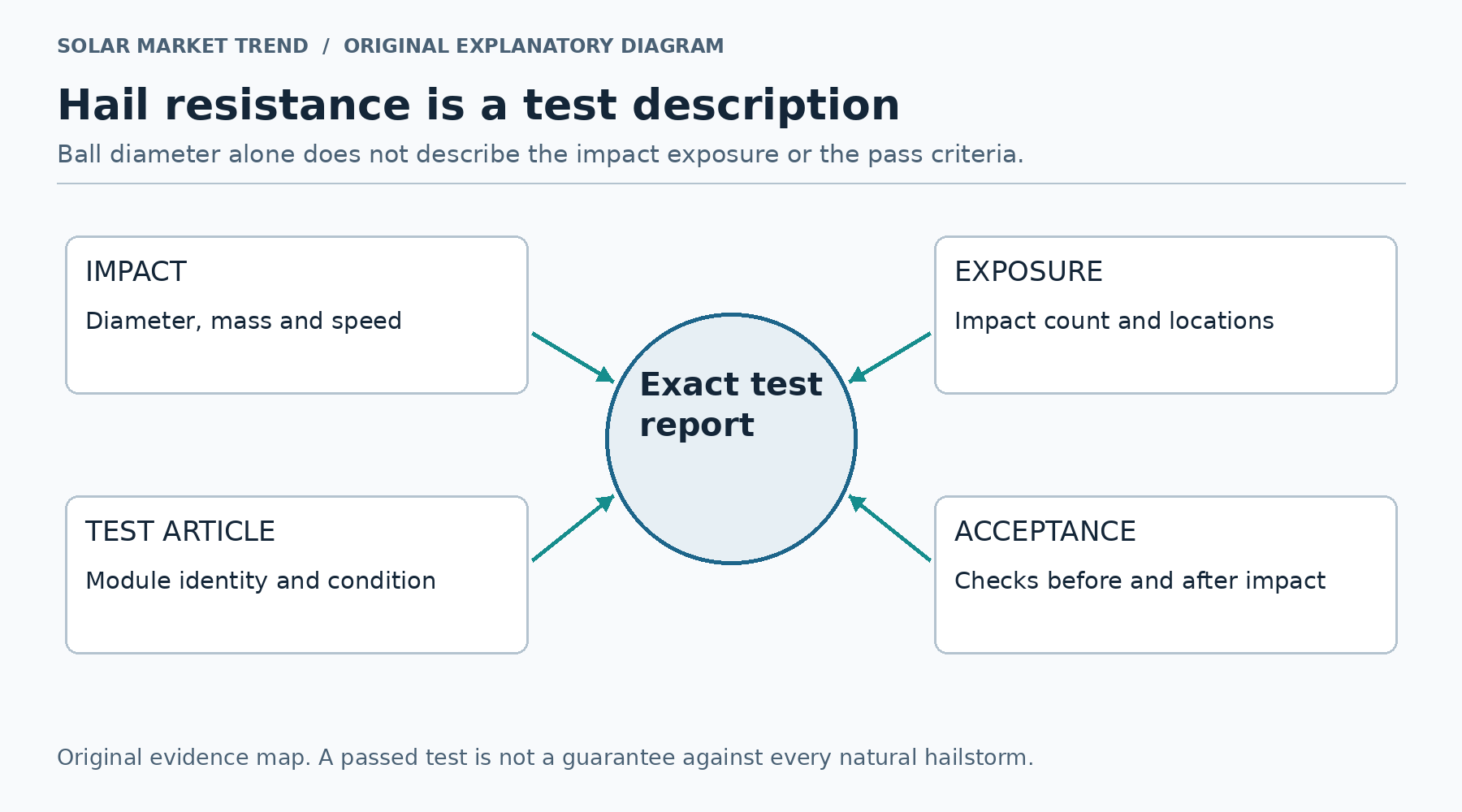
To interpret an impact, request the ice-ball diameter and mass, launch or impact speed, impact angle, target locations, number of strikes and sample count. Keep those details attached to the report. A photograph of a large ice ball does not establish the measured speed or what happened to the samples afterwards.
The basic physics explains why this matters: kinetic energy is one-half mass multiplied by speed squared. As an illustrative comparison, the same mass moving at twice the speed has four times the kinetic energy. That is not a damage prediction, and equivalent energy does not make different test arrangements equivalent. RETC's own programme distinguishes test cases using diameter, mass, speed and energy together. [3]
Check which outcome the test actually measured
A report may focus on glass breakage, power change, cell damage, insulation or behaviour after further stress. Do not turn one measured outcome into a claim about all the others. RETC describes a programme that characterises samples before and after impacts, then includes thermal cycling and hot-spot testing. [3]
Kiwa PVEL's currently published Hail-TTF procedure, by contrast, describes stepped ice-ball sizes and visual-inspection characterisation for that specific test. [4] These examples show why the full protocol matters. Ask what was measured, at which stages, against what acceptance rule, and whether the advertised result refers to one sample, all tested samples or a selected best result.
Match the report to the product being purchased
Our recommended buying record includes the complete model code, module dimensions, relevant construction or bill-of-materials identifier, laboratory name, report number and date. Ask the supplier to explain how the tested sample identity maps to the shipment offered. Treat a result for a related model as supporting context until that relationship is documented.
Kiwa PVEL's material distinguishes hail test results by module design and test sequence. [4] The editorial implication is not that a brand with a certificate is automatically better or worse. It is that an organisation-wide badge cannot replace evidence for the actual product. Where the detailed report is unavailable, state that limitation rather than filling the gap with a sales demonstration.
Avoid both reassurance and alarm based only on appearance
An intact-looking surface is not a complete damage assessment, but a finding of cell cracks should not be converted into a universal forecast of rapid failure either. A 2024 NREL conference study followed hail-exposed modules on fixed mounts in Golden, Colorado. It reported an initial power difference between more- and less-damaged samples, but did not observe a higher subsequent degradation rate in the damaged group over six further years. [5]
That small, specific study is not a guarantee for another module, storm or installation. It does show the value of distinguishing immediate damage from later behaviour. Base repair decisions on qualified inspection and the actual system evidence, not on either extreme generalisation.
Make resilience a design discussion not a rooftop improvisation
The Department of Energy discusses the trade-off between hail exposure, module angle, energy production and wind loading. [1] This does not justify changing a fixed roof array's angle, fitting improvised covers or adding supports without review. Ask the designer how the selected equipment and layout address the site's assessed risks together.
Before purchase, also ask who will inspect a suspected hail event and how the event and condition will be documented. Keep before-event photographs and commissioning records with the system file. These are practical evidence-management suggestions, not an insurance coverage statement; any cover, exclusions and claims requirements need confirmation from the actual policy provider.
Use a safe response after a suspected damaging event
Do not climb onto a damaged or wet roof, touch broken modules or disconnect solar connectors to investigate. Trina's instructions warn that illuminated modules generate electricity and that contact with damaged glass can create an electric-shock hazard. [6] Arrange assessment by qualified personnel and follow the installation's documented emergency procedure from a safe location.
When reviewing the findings, separate visible breakage, electrical safety, measured performance and the proposed remedy. Ask for the reasoning behind replacement, further testing or continued operation. The best buying question remains the same before and after a storm: what evidence supports this exact conclusion? A clear answer is more valuable than the undefined word hail-proof.
Sources and references
- [1] US Department of Energy Hail Damage Mitigation for PV Systems
Public technical guidance accessed 22 October 2026 · Checked 2026-10-22
Baseline ice-ball diameter and velocity; recommendation for stronger evidence in severe exposure; tilt and wind trade-offs.
US-oriented guidance, not Pakistan hail-risk mapping. No local probability or policy coverage inferred.
- [2] IEC TS 63397 Qualifying Guidelines for Increased Hail Resistance
IEC TS 63397:2022 published 14 December 2022 with July 2023 corrigendum · Checked 2026-10-22
Public scope explicitly addresses hail stresses beyond the IEC 61215 series.
Public scope only. Full paid procedure and acceptance criteria were not accessed.
- [3] RETC Hail Durability Test Program
Public programme description accessed 22 October 2026; displayed day/month September 14 without clear year · Checked 2026-10-22
Protocol differentiates diameter, mass, velocity and energy; characterisation, thermal cycling and hot-spot stages.
Laboratory description of its own programme, not an independent finding for an offered module. No vendor ranking implied.
- [4] Kiwa PVEL Hail Stress Sequence and Hail TTF Procedure
Current public procedure accessed 22 October 2026 · Checked 2026-10-22
Current Hail-TTF section distinguishes module designs and stepped sizes, and states visual-only characterisation for its Hail-TTF samples.
The page contains broader HSS context and a specific Hail-TTF procedure. Do not generalise its visual-only statement to all PVEL programmes or historical reports.
- [5] Johnston et al Photovoltaic Module Performance for Six Years After Hail Damage
2024 IEEE PVSC paper; DOI 10.1109/PVSC57443.2024.10748885 · Checked 2026-10-22
Official laboratory abstract reports initial power differences but no observed increase in subsequent degradation rate over six further years for the studied fixed-mounted modules.
Abstract and bibliographic record reviewed, not full paywalled paper. Small site-specific comparison in Colorado, not a Pakistan risk estimate or universal guarantee.
- [6] Trina Solar Vertex Series User Manual
UM-M-0002 Version L August 2024 · Checked 2026-10-22
Illuminated modules generate electricity; damaged glass can present shock hazard; installation and service require professional skills.
Manufacturer safety instructions for listed products; no detailed shutdown or repair procedure prescribed in this article.