SOLAR PANEL BUYER GUIDE
Solar Panel Insulation Tests: Why a Megohmmeter Result Needs a Test Plan
Share on social media
An insulation-resistance number is useful only when the tested circuit, equipment limits and conditions are clear. Here is what a buyer should request from the professional report.
1. Ask what was actually tested
A contractor says your solar panels have “passed the megger test.” Before accepting that statement, ask which circuit was tested and what the result establishes. An insulation-resistance test investigates electrical insulation; it is not a measurement of module wattage or a guarantee of future energy production.
Fluke describes ground faults as unintended connections between current-carrying conductors and grounded metalwork, and distinguishes persistent faults from intermittent ones. Damaged wiring can be involved, not just a defective panel. [1] For a Pakistan rooftop owner, the first useful document is therefore a circuit identification: the string, cable section or equipment boundary represented by the reading.
2. The method must fit the installed equipment
There is no responsible universal test setting to copy from a social-media video. The professional must reconcile the applicable test procedure with the actual module and system documentation.
SMA's Sunny Tripower ground-fault instructions identify the work as a qualified-person task, require suitable test arrangements and limit the test voltage by the modules' maximum system voltage. Those instructions apply to that product family; they are not a stand-alone procedure for every installation. [2] Ask the contractor to identify the manual, relevant revision, instrument and acceptance basis in the report. A larger displayed test voltage is not automatically stronger evidence of quality.
3. Protect connected electronics before testing
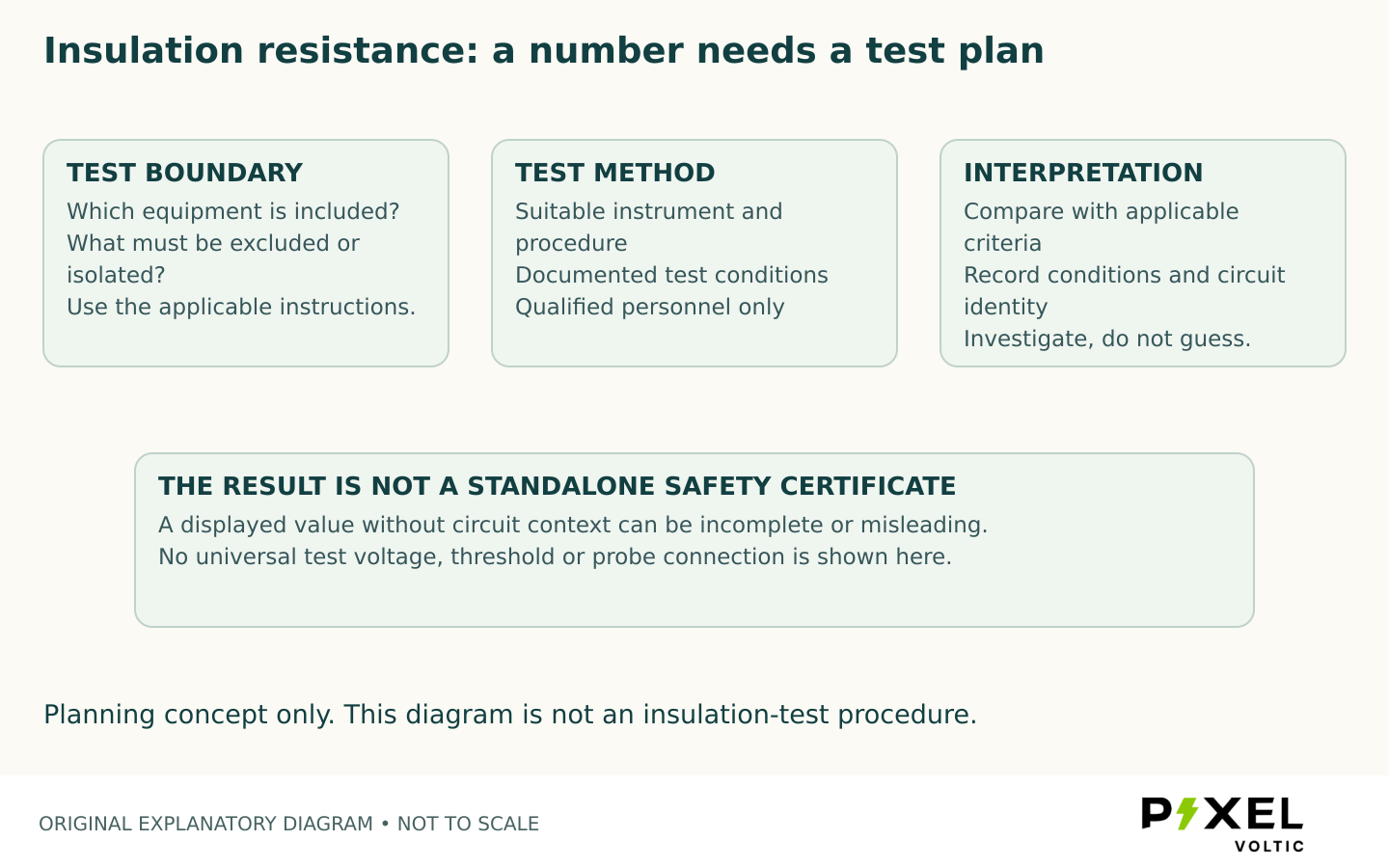
The test boundary matters because a high-voltage insulation test is not harmless to every connected device. Fluke says professionals should confirm with the module manufacturer that testing through its modules is permitted, and must isolate circuits from inverters and module-level power electronics before this testing. [1] Delta separately warns that connected inverters and surge-protection devices may be damaged by an inappropriate test arrangement. [3]
The buyer's role is to ask how these requirements were addressed, not to disconnect equipment. “The inverter was switched off” is an incomplete answer unless the professional explains the electrical isolation and protected test boundary.
4. Record weather and investigate intermittent faults
A dry-afternoon result may not explain an alarm that appears after rain. Delta notes that temperature and moisture affect insulation-resistance measurements; Fluke describes intermittent faults that appear under particular conditions. [3] [1] This does not mean every rainy-day alarm proves water has entered a panel.
Keep the time of the alarm, weather observations and any safely obtained photographs. Ask whether the contractor correlated those records with the inspection and test results. Do not spray water onto equipment or repeatedly restart the system to recreate the fault. The next investigation should be planned by the responsible professional, with its limitations stated.
5. Request a report that another technician can use
For commissioning or a paid fault investigation, request:
- An array map or circuit reference identifying the tested section. - The instrument model, identification and relevant calibration record. - The selected method, test settings and recorded result with units. - The relevant equipment limits and acceptance criterion. - Environmental conditions and any excluded or inaccessible circuits. - A clear distinction between observation, suspected cause and confirmed defect.
These are practical procurement questions, not a replacement for the standard selected by the professional. If only part of the installation was tested, the report should not describe the entire roof as cleared. Retain the original report alongside the installation drawings.
6. Close the fault, not just the alarm
Ask what was repaired, how it was checked afterwards and who authorised return to service. SMA's instructions distinguish fault investigation from reconnecting strings after the fault has been eliminated. [2] A cleared screen or a single unexplained number is not a useful repair record.
Do not open a combiner box, unplug PV connectors, touch array frames during a suspected ground fault or attempt this test yourself. Sunlit PV circuits require specialist precautions. When comparing service quotations in Pakistan, prefer a defined diagnostic scope and documented conclusion over a cheap “megger pass” with no circuit identification, method or accountable sign-off.
Sources and references
- [1] How to find and repair ground faults in solar PV systems
Fluke
Manufacturer application note, especially pages 1 and 6. Used for fault types, causes, module permission and isolation from power electronics; not its US regulatory statements, PPE prescriptions or test steps.
- [2] Sunny Tripower STPTL-30: Checking the PV System for Ground Faults
SMA Solar Technology
Qualified-person scope, equipment-dependent test-voltage ceiling, suitable test arrangement and fault-clearance requirement. No numerical settings or DIY sequence reproduced.
- [3] Measurement of Isolation Resistance
Delta Electronics support
Solivia support guidance on isolating electronics/SPDs and environmental influence. Its numerical table and Australian regulatory applicability are not generalised.