SOLAR PANEL BUYER GUIDE
Solar Panel Junction Boxes: Why a Cracked Lid Is Not a Cosmetic Defect
Share on social media
The box behind a panel protects electrical connections. Damage deserves a documented manufacturer-led decision, even if the module still produces power.
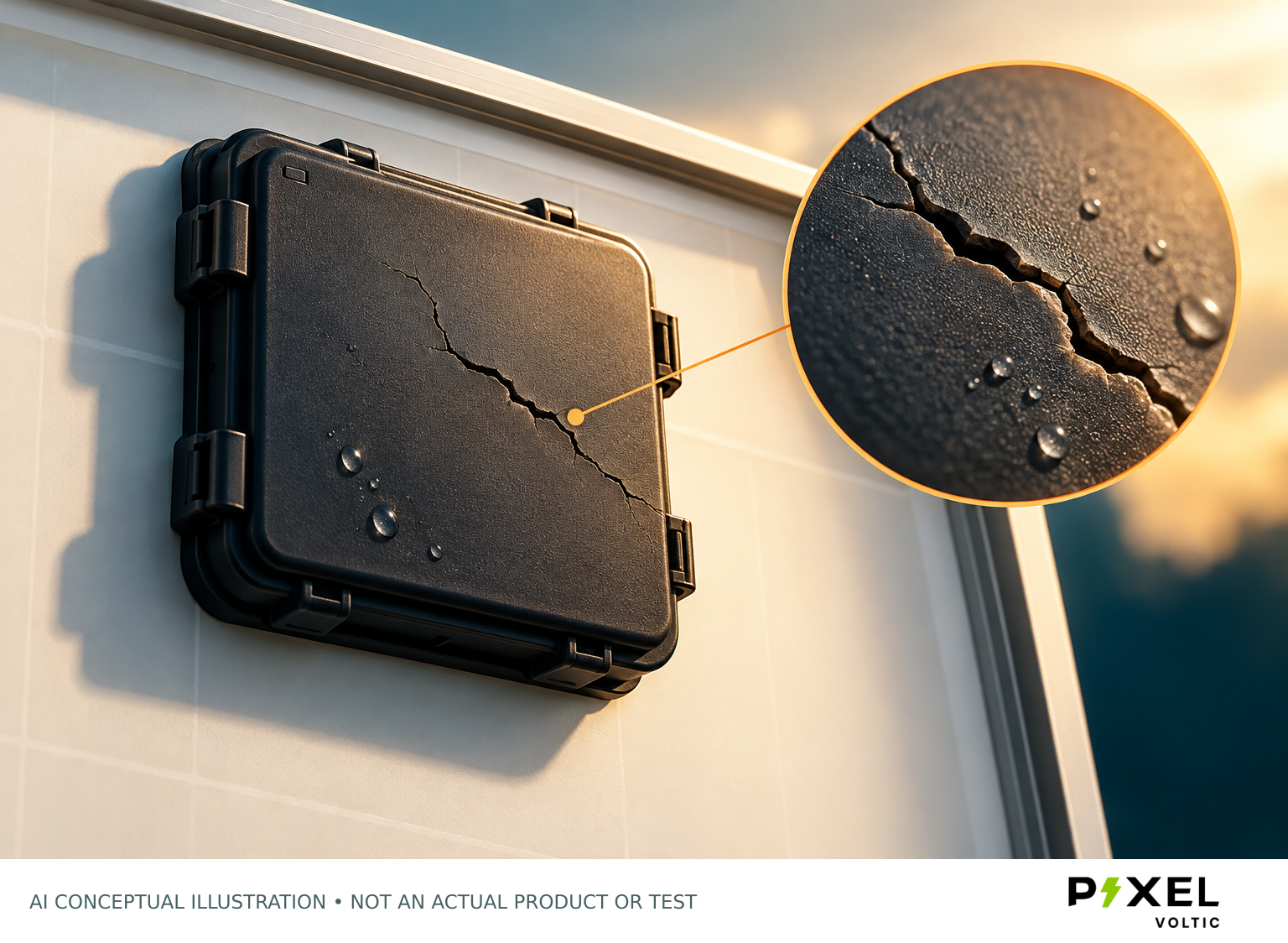
1. Inspect the rear as well as the glass
A clean front surface does not prove that a solar module arrived undamaged. The rear junction box and the places where cables leave it also deserve attention during professional receipt and installation checks. A cracked lid should not be dismissed merely because the panel still produces power.
Trina Solar's Vertex manual specifically includes broken junction boxes and missing covers among abnormalities to check before installation and again before use. It directs such findings to its service process rather than treating them as appearance issues. [1] For a Pakistan buyer, agree who performs this inspection and records exceptions before the delivery is accepted.
2. Understand the protective function
The junction box is part of the module's electrical assembly, not a decorative cover. LONGi describes its junction boxes as providing protection for cable connections and against contact with uninsulated electrical parts. Its manual also identifies bypass diodes inside the box. [2]
That explains why an outer crack requires assessment even when there is no obvious production loss. A photograph cannot establish how far damage extends or whether a particular box's protective function remains intact. Avoid declaring either “definitely dangerous internally” or “completely harmless” from appearance alone. The appropriate next step is a documented decision for the exact module and damage.
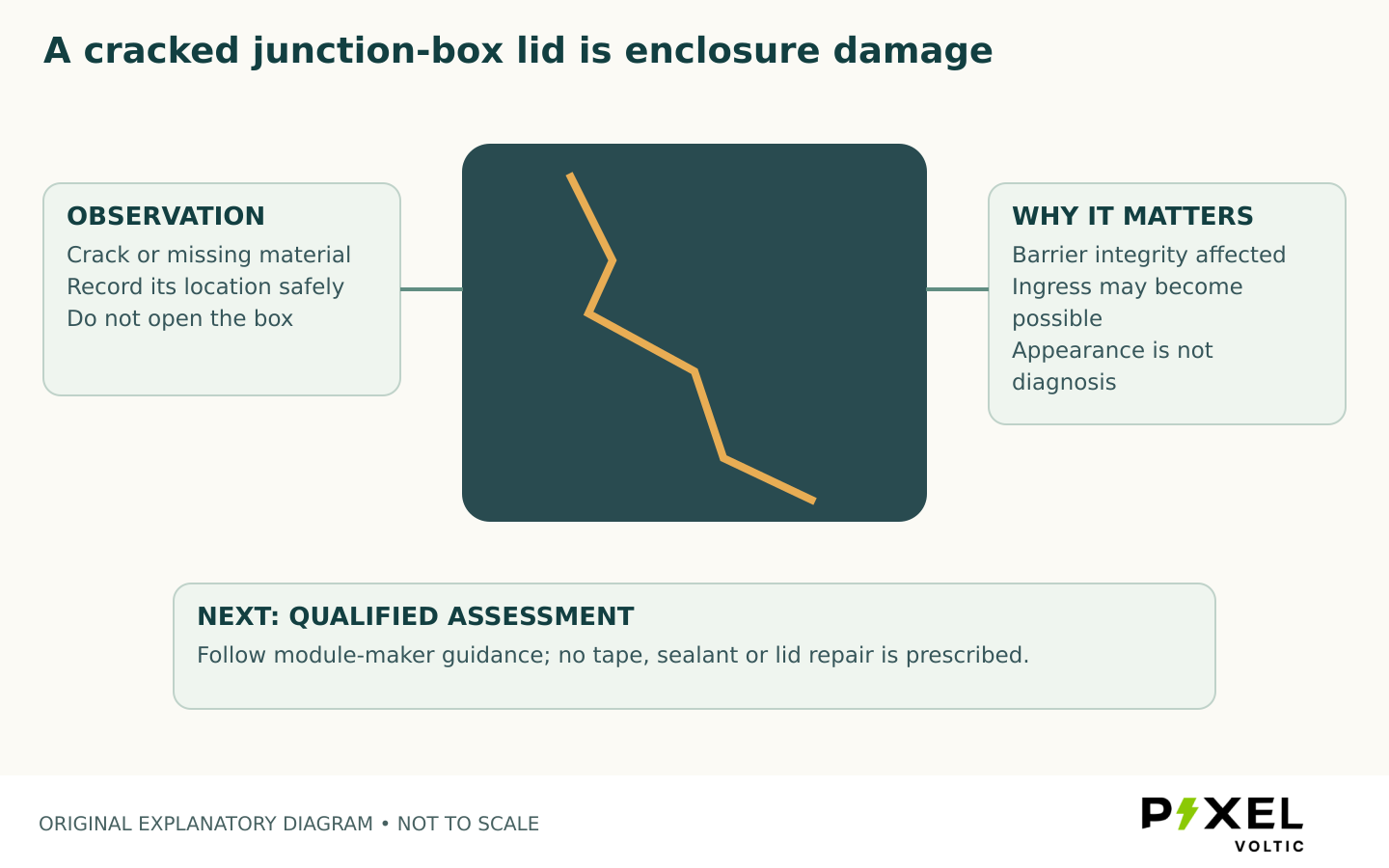
3. An IP label does not settle a damage claim
A product's original enclosure rating is not a reason to ignore a visibly damaged enclosure. JinkoSolar describes rated junction boxes while also requiring protection from prolonged direct sunlight and immersion, and calls for inspection of their sealing material. [3] LONGi likewise includes cracks or gaps around the junction-box seal in its preventive inspection guidance. [2]
Ask the service provider to consider the lid, attachment, seal and cable entries together. Do not assume that a small crack has already admitted water, but do not wait for visible moisture before reporting it. The investigation should establish the condition rather than rely on the rating alone.
4. Tape and generic sealant are not approval
A proposed patch needs more than a promise that it will keep rain out. Trina warns against unapproved substances contacting junction boxes and instructs users to keep their covers closed. [1] Canadian Solar states that its modules contain no serviceable parts and prohibits opening the junction-box cover or attempting module repairs. [4]
These are manufacturer-specific requirements, not permission to invent a universal repair method. Ask for written confirmation from the relevant service channel before accepting any proposed remedy. A local seller's verbal reassurance does not explain material compatibility, workmanship responsibility or the treatment of a future warranty claim.
5. Build a usable damage record
Request a dated overview and close-up from the installer, taken only where safe access is available. The record should show the affected module's serial number, the damage location and whether the finding occurred at delivery, during installation or after service. Keep the invoice, packaging photographs and correspondence together.
Ask for the written disposition: held from installation, assessed by an authorised service provider, or replaced. Record who made that decision and which manufacturer guidance supports it. Do not attribute damage to transport, manufacturing or installer handling without evidence. The purpose of the record is to establish what was found and how it was resolved, not to assign blame prematurely.
6. Prevent the next handling mistake
JinkoSolar warns against lifting modules by their cables or junction boxes. [3] That simple handling restriction belongs in a delivery briefing, especially when different crews unload, carry and install the panels.
For an installed array, report a suspected damaged box without climbing under panels or handling the cables. Do not open the lid, unplug a live connector or apply water to investigate a leak. Have the qualified installer determine the safe response and contact the manufacturer where required. A good close-out record identifies any replacement, preserves the old and new serial references and explains the checks completed before the affected section returns to service.
Sources and references
- [1] Vertex Series User Manual, UM-M-0002 N, safety and installation sections
Trina Solar
Manufacturer PDF inspected in full-text form: printed pages 2 and 15–16. Broken junction boxes/missing covers, closed-cover requirement and incompatible substances. Not a universal repair prohibition for all brands.
- [2] Installation Manual for LONGi Solar PV Modules, V19, §§6.2, 6.3 and 8.3
LONGi
Downloaded manufacturer PDF and inspected relevant text: junction-box protective purpose, bypass diode location and seal inspection. No IP value or wiring instructions generalised.
- [3] Global Installation Manual, 14 August 2024, §§2.1 and 6.3
JinkoSolar
Downloaded manufacturer PDF. Handling restriction, environmental caveats and sealing-gel inspection; no claim that all boxes share the same rating.
- [4] Installation Manual of Photovoltaic Module, EN-Rev IM/GN-EU/3.3, July 2026, §2
CSI Solar / Canadian Solar
Manufacturer manual on no serviceable module parts, no owner repairs and no opening junction-box covers for listed models.