SOLAR PANEL DEGRADATION GUIDE
Solar Panel LID and LeTID Why Early Degradation Is Not the Same as PID
Share on social media
A practical guide to separating light-induced degradation, LeTID and PID, reading the right test evidence, and investigating early output loss without blaming the wrong mechanism.
Start with the mechanism, not the sales label
An installer offers a panel described as PID-resistant. Does that also answer questions about its first months in sunlight? No: different degradation mechanisms need different evidence. For buyers comparing rooftop or commercial solar quotations in Pakistan, the useful question is not simply whether a panel is “degradation-free”, but which mechanism was investigated, on which product, and under what conditions.
This guide focuses on light-related early-life changes. It is not a repeat of a PID troubleshooting guide or a warranty comparison, and it does not assume that every early fall in generation is a defective panel.
LID and LeTID describe different tests and behaviour
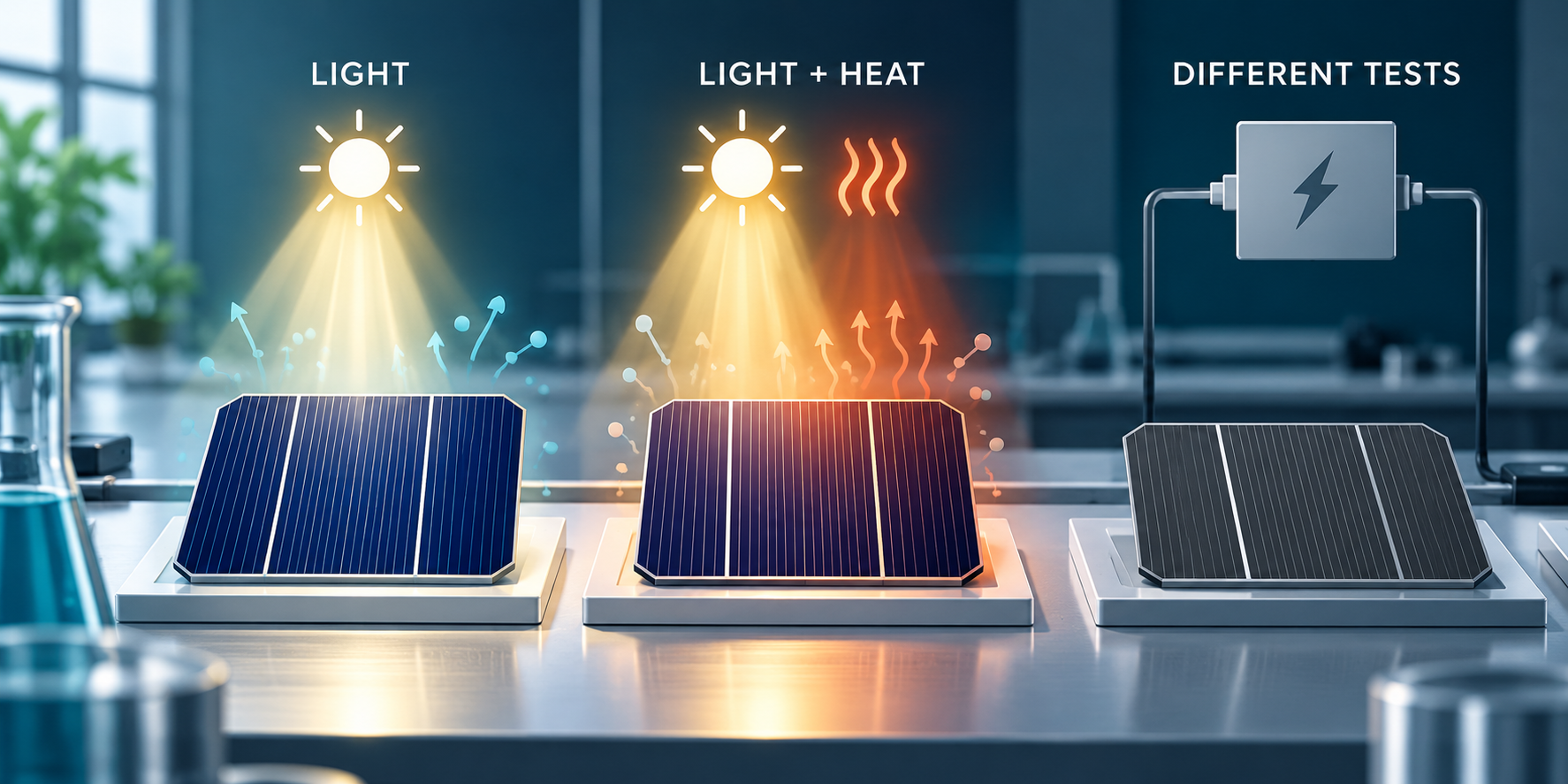
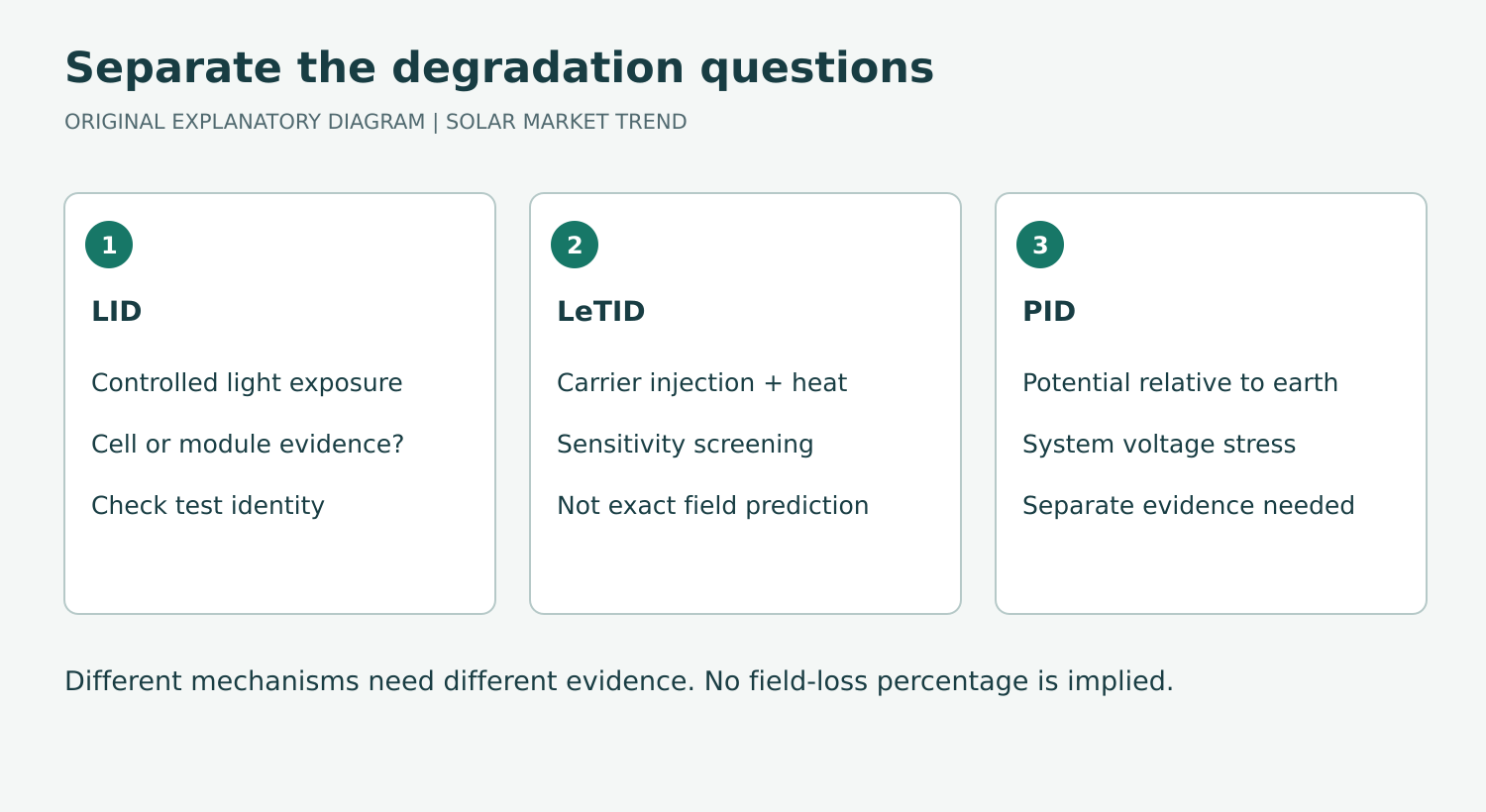
LID means light-induced degradation. In crystalline silicon, familiar examples include boron–oxygen-related changes. IEC 63202-1:2019 measures cell-level LID by comparing maximum power under standard test conditions before and after controlled exposure to simulated sunlight. A cell result is useful manufacturing evidence, but it should not be presented as a complete-module field-yield guarantee. Ask whether a quoted result concerns cells or finished panels. [1]
LeTID means light and elevated temperature-induced degradation. IEC TS 63342:2022 addresses its detection in crystalline-silicon modules through electrical current injection at elevated temperature. The specification explicitly separates this from boron–oxygen and iron–boron phenomena that can occur at room temperature under illumination on faster timescales. The names overlap, but the screening questions are not interchangeable. [2]
LeTID is not necessarily an immediate, one-off step down after installation. Fraunhofer ISE’s module experiments describe losses developing over months or years, with degradation and regeneration potentially overlapping. Their work also shows why increasing test temperature or injection level can change the observed response rather than merely compressing the same behaviour into fewer hours. These are experimental findings, not a forecast for every Pakistani roof. [3]
PID is a separate voltage-stress question
Potential-induced degradation concerns electrical potential relative to earth and associated system-voltage stress. IEC TS 62804-1:2025 evaluates crystalline-silicon module sensitivity to such stress, including different PID mechanisms. Actual exposure depends on both environmental conditions and the module’s potential relative to ground. Therefore, a favourable PID result is not evidence that LID or LeTID was tested. Equally, a LeTID report cannot establish PID resistance. [4]
For a quotation, keep three separate evidence lines: initial light-related change, elevated-temperature light/carrier-related change, and system-voltage-related change. This prevents one attractive certificate from being used to answer three different questions.
Read a LeTID report as a sensitivity test
The crucial limitation is explicit: IEC TS 63342 can reveal a sample’s sensitivity, but does not give an exact measurement of the degradation that will occur outdoors. A laboratory loss percentage should not be copied directly into a Pakistan energy-yield forecast without a justified model and relevant operating assumptions. Nor should chamber exposure hours be casually converted into years of rooftop life. [2]
Ask for the method and edition, sample identification, temperature, injection conditions, test duration, measurement uncertainty and the performance record through the test—not just its final reading. This is our purchasing recommendation based on the distinction between detection and field prediction. Fraunhofer’s comparison explains why the test conditions and the balance between degradation and recovery matter. [3]
A cell-technology label is not the whole answer
Treat claims such as “gallium-doped, therefore no degradation” carefully. Fraunhofer research comparing boron- and gallium-doped monocrystalline silicon found different LeTID responses under different carrier-injection conditions. That does not rank today’s finished commercial modules, but it demonstrates why changing one material variable is not proof of immunity to every mechanism. Ask for evidence tied to the offered module design rather than an unsupported conclusion from its technology name. [5]
Before paying, retain the exact model code, datasheet revision, serial-number records, relevant independent reports and the seller’s written explanation of any stabilization treatment. If the evidence concerns a different product family, request a clear explanation of its applicability. Avoid paying a premium for an unexplained “zero LID/LeTID” phrase.
Investigate early output loss with a baseline
A monthly inverter total alone cannot identify a microscopic degradation mechanism. The National Laboratory of the Rockies’ PV Lifetime Project uses careful, repeated indoor current–voltage measurements to distinguish early-life degradation from measurement uncertainty. That is a useful reminder to demand comparable measurements rather than diagnose a panel from two screenshots. [6]
For an installed system, preserve commissioning records and ask a qualified technician to review comparable operating conditions, shading, soiling, equipment alarms and available module measurements before assigning a cause. Do not experiment with string voltage, grounding or improvised regeneration equipment. The purchasing lesson is simple: require mechanism-specific evidence, keep a measurable baseline, and treat accelerated tests as risk-screening tools—not promises of exact lifetime output.
Sources and references
- [1] IEC 63202-1:2019 — Measurement of light-induced degradation of crystalline silicon photovoltaic cells
Checked 2026-10-23
Cell-level simulated-sunlight LID measurement; before/after maximum power at STC; controlled temperature and irradiance.
- [2] IEC TS 63342:2022 — C-Si photovoltaic modules: LETID test, detection
Checked 2026-10-23
Current-injection module LeTID detection; excludes faster B-O and Fe-B phenomena; sensitivity test does not exactly predict field degradation.
- [3] Fraunhofer ISE — LeTID: A Comparison of Test Methods on Module Level (2019)
Checked 2026-10-23
Original module experiments; effects of temperature/injection and overlapping degradation/regeneration; potential months-to-years field timescale.
- [4] IEC TS 62804-1:2025 — Test methods for detection of potential-induced degradation, crystalline silicon
Checked 2026-10-23
Short-term high-voltage stress; PID variants; actual stresses depend on climate and potential relative to earth; distinct from light-related tests.
- [5] Fraunhofer ISE — LeTID- and (extended) BO-related degradation and regeneration in B- and Ga-doped monocrystalline silicon (2020)
Checked 2026-10-23
Original controlled wafer experiments find dopant- and injection-dependent responses; does not establish commercial-module rankings.
- [6] National Laboratory of the Rockies — Photovoltaic Lifetime Project
Checked 2026-10-23
Careful repeated indoor I–V measurements distinguish early-life module degradation from measurement uncertainty; research is US field work, not Pakistani adoption evidence.