SOLAR PANEL MECHANICAL LOAD GUIDE
Solar Panel Mechanical Load Ratings Why a Test Number Is Not a Roof Design
Share on social media
A Pakistan buyer guide to reading module pressure ratings, distinguishing test loads from design loads, and asking for the separate evidence that the roof and mounting system are suitable.
The panel rating is only one part of the answer
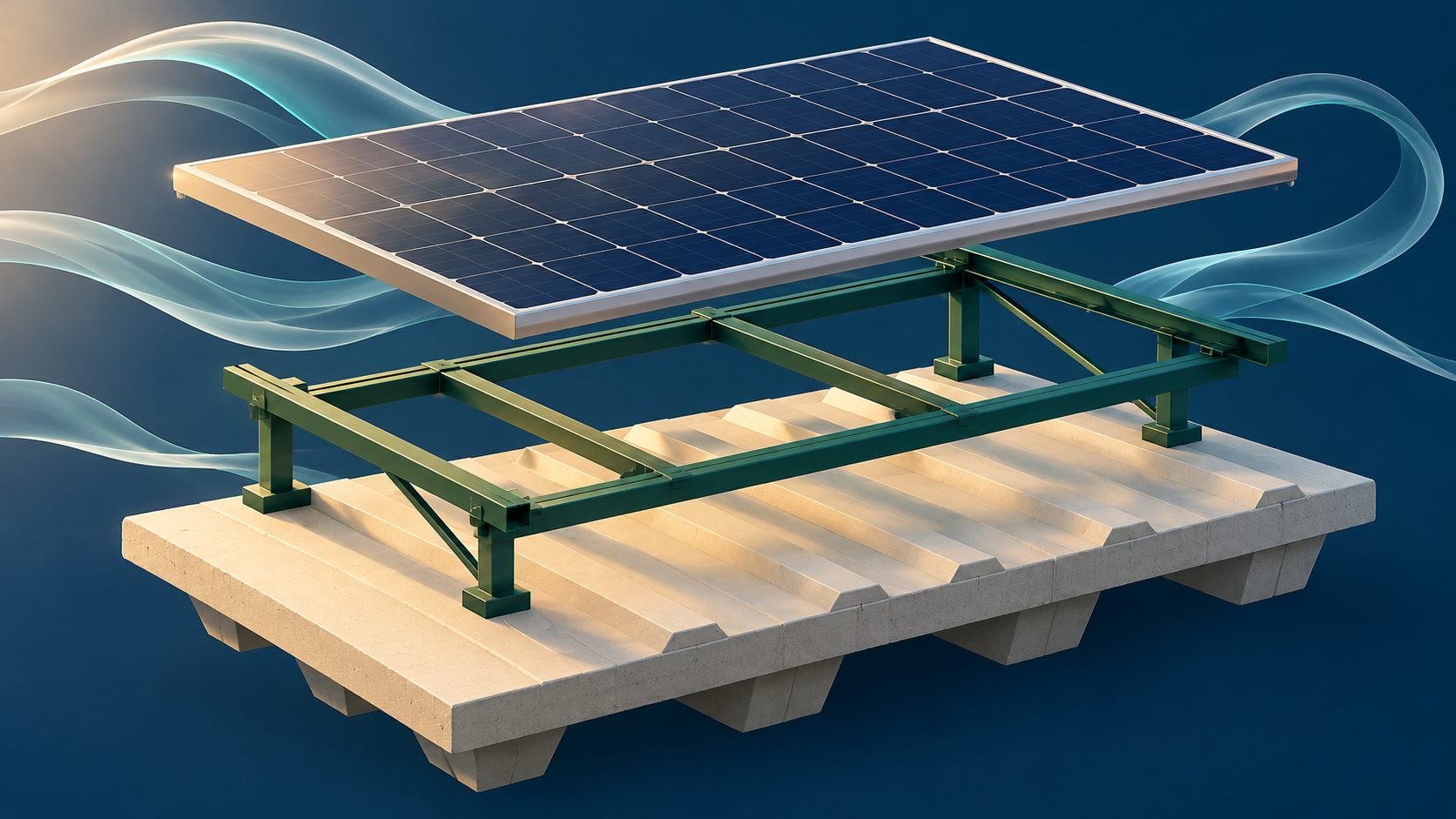
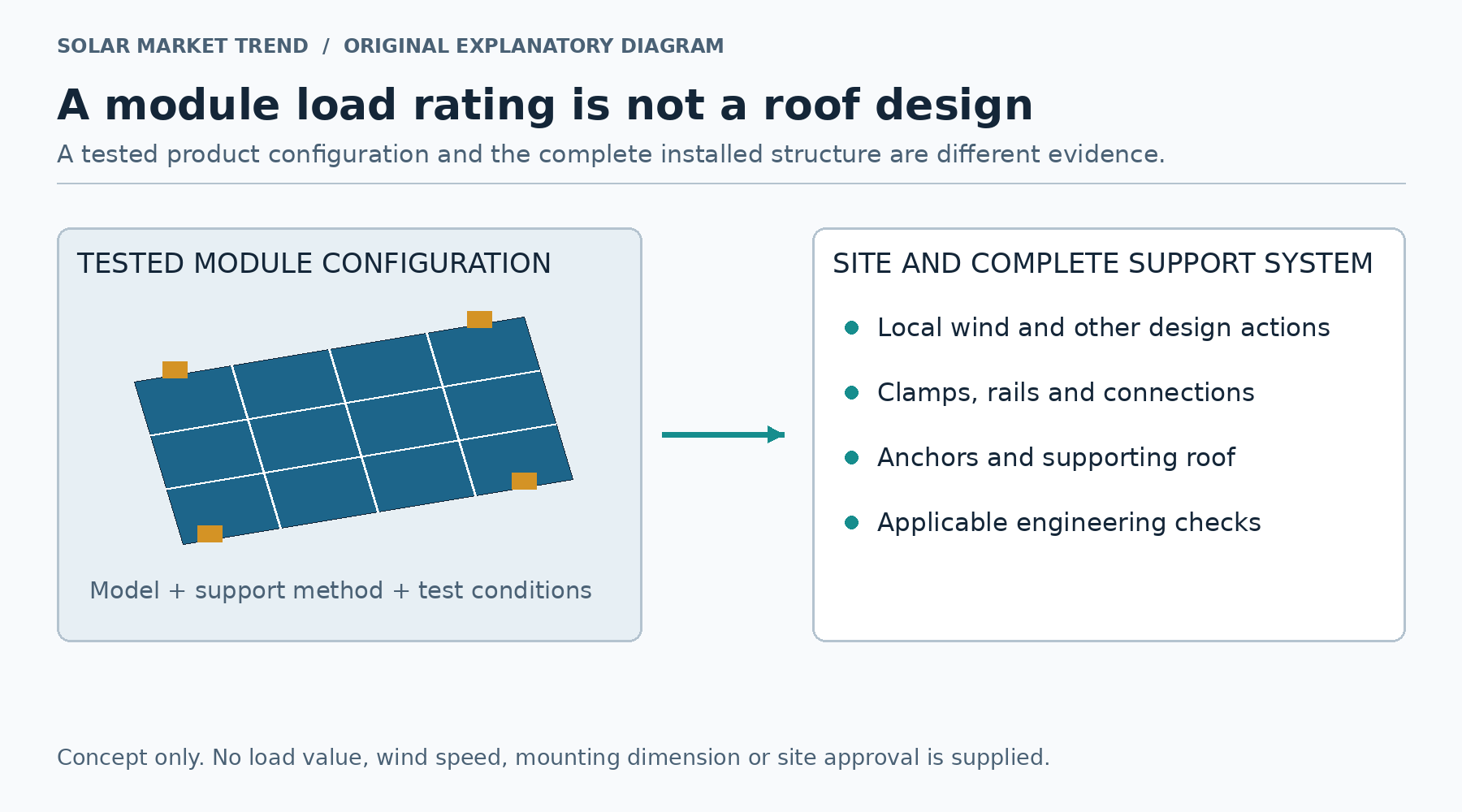
A quotation says the panels withstand thousands of pascals. That sounds reassuring, but it does not establish whether the proposed rooftop installation is structurally suitable. A module, its mounting arrangement and the building are related parts of a system; evidence about one part cannot silently stand in for evidence about the others.
For a Pakistani buyer, the useful question is not which quotation displays the biggest number. Ask what the number means, which exact module and support arrangement it covers, and how the designer has checked the actual site. This guide explains those distinctions without providing a structural design or a universal wind-speed limit.
Read pressure and direction before comparing numbers
A pascal is a unit of pressure: one newton per square metre. A stated pressure therefore is not the panel's weight, nor an amount of weight that somebody may safely place on its glass. Keep the front/downforce and rear/uplift entries separate; a higher value in one direction does not prove the same resistance in the other.
Trina Solar's August 2024 Vertex manual lists different load values for particular module and installation combinations. [2] A comparison that removes the model, direction and arrangement from those tables discards information that makes the rating meaningful. Record the complete row and its notes, not only a cropped headline.
Do not confuse the test load with the design load
Canadian Solar's November 2025 manual identifies its tabulated loads as test loads and gives the relationship test load = 1.5 × design load for the installations it describes. It separately assigns load calculation and support-structure responsibilities to the system designer, installer and mounting-system supplier. [1]
For illustration only, if an applicable instruction specifies a 5,400 Pa test load and that 1.5 relationship, the corresponding value is 5,400 ÷ 1.5 = 3,600 Pa. This arithmetic is not an approved site capacity. It assumes the stated method applies, and it does not check the roof, anchors, uneven loading or other governing conditions. Do not divide an already labelled design load again, or treat 1.5 as a complete structural design rule.
Keep the mounting conditions attached to the rating
A rating belongs to an evaluated arrangement, not to every way of supporting the same panel. Trina's manual ties installation compliance to its specified methods, requires consultation for alternatives and directs project design loads to the relevant structural assessment. [2]
Before ordering, ask the supplier to identify the manual revision, the delivered module suffix and the drawing used by the installer. If the proposed arrangement falls outside that documentation, request written manufacturer acceptance and a design review rather than assuming that a stronger-looking metal section resolves it. This is a document-control question for the buyer; detailed mounting locations and hardware selection belong to the qualified designer.
A static rating does not describe every mechanical stress
Mechanical qualification includes more than one type of test. IEC TS 62782 describes cyclic loading that alternates pressure in positive and negative directions while the module is supported at its design support points. It addresses susceptibility of module components and seals to mechanically induced damage. [3]
IEC's public description of the 2021 crystalline-silicon qualification standard also identifies the addition of a cyclic mechanical-load test and states that qualification is not a numerical prediction of lifetime. [4] The practical distinction is straightforward: a static pressure label, cyclic-test evidence and a service-life promise are not interchangeable. Ask which evidence is actually supplied instead of combining several different claims into the word durable.
Request a site check for the whole load path
The installation must transfer forces through its supports and connections to the building or ground. The US Department of Energy's severe-weather guidance treats racking, bracing and attachment to the structure as separate design concerns, including the effects of turbulent wind around roof features. [5] That is useful engineering context, not a declaration that US specifications are Pakistan's rules.
Our recommended procurement question is: who has assessed this particular roof and documented the applicable design basis? Ask the assessor to identify the existing structure, array geometry, attachment strategy, relevant environmental actions and any limitations on placement. Do not accept a module certificate as the response to a request for a building assessment.
Reject simple shortcuts that change the question
A pressure rating alone should not be advertised as a guaranteed survival wind speed for every installation. The site's geometry and structural design still matter. Nor is a uniformly distributed laboratory load a reason to stand on a panel: Canadian Solar explicitly prohibits walking on modules and warns about localised loading. [1]
If two offers appear comparable, ask each supplier to complete the same evidence list: exact module, load direction, test or design basis, qualified mounting arrangement, site assessment and responsible professional. Missing information is a clarification item, not proof that one product is inferior. A well-documented lower headline number can be more decision-useful than an unexplained higher one.
Keep the evidence available after installation
At handover, retain the selected manual, approved layout, structural assessment and a record of the installation actually supplied. Ask how future changes will be reviewed. Adding panels, raising an array or replacing a model is not merely an update to the electricity-production estimate; it may change the assumptions behind the design.
The buying decision should therefore end with two separate confirmations: the module evidence fits its specified mounting arrangement, and the installation has been assessed for its site. Neither statement should be inferred solely from a large pascal figure. Any suspected movement, damage or insecure structure warrants professional assessment, not a rooftop experiment by the owner.
Sources and references
- [1] Canadian Solar Installation Manual of Photovoltaic Module
EN Rev IM/GN-EN/3.1 November 2025 · Checked 2026-10-22
Test-to-design relationship in section 6; system support responsibility; prohibition on walking on modules.
Model- and configuration-specific manufacturer instructions. Not a structural approval of any Pakistani site.
- [2] Trina Solar Vertex Series User Manual
UM-M-0002 Version L August 2024 · Checked 2026-10-22
Separate load directions and installation tables; approved installation methods; structural-design responsibility.
Illustrates documented conditions for listed module families. Confirm the current applicable revision for delivered products.
- [3] IEC TS 62782 Cyclic Dynamic Mechanical Load Testing
IEC TS 62782:2016 published 9 March 2016 · Checked 2026-10-22
Public scope describes alternating positive and negative loading at design support points and component damage evaluation.
Public scope only; full paid standard not accessed. No test severity or acceptance criteria inferred.
- [4] IEC 61215 Special Requirements for Crystalline Silicon Modules
IEC 61215-1-1:2021 published 23 February 2021 · Checked 2026-10-22
Public scope notes cyclic test addition and says qualification is not a quantitative lifetime prediction.
Public scope only; not a complete conformity review.
- [5] US Department of Energy Severe Weather Resilience in Solar Photovoltaic System Design
Public technical guidance accessed 22 October 2026 · Checked 2026-10-22
Separates racking, bracing and building attachment design; discusses wind turbulence at roof features.
US guidance used as engineering context, not as Pakistan law or local hazard data.