SOLAR PANEL BUYER GUIDE
Solar Panel NMOT vs STC Two Ratings Not a Pakistan Output Forecast
Share on social media
Read STC and NMOT as defined comparison conditions, then request a separate site-specific energy estimate instead of treating either watt figure as guaranteed rooftop output.
Start with the question each number answers
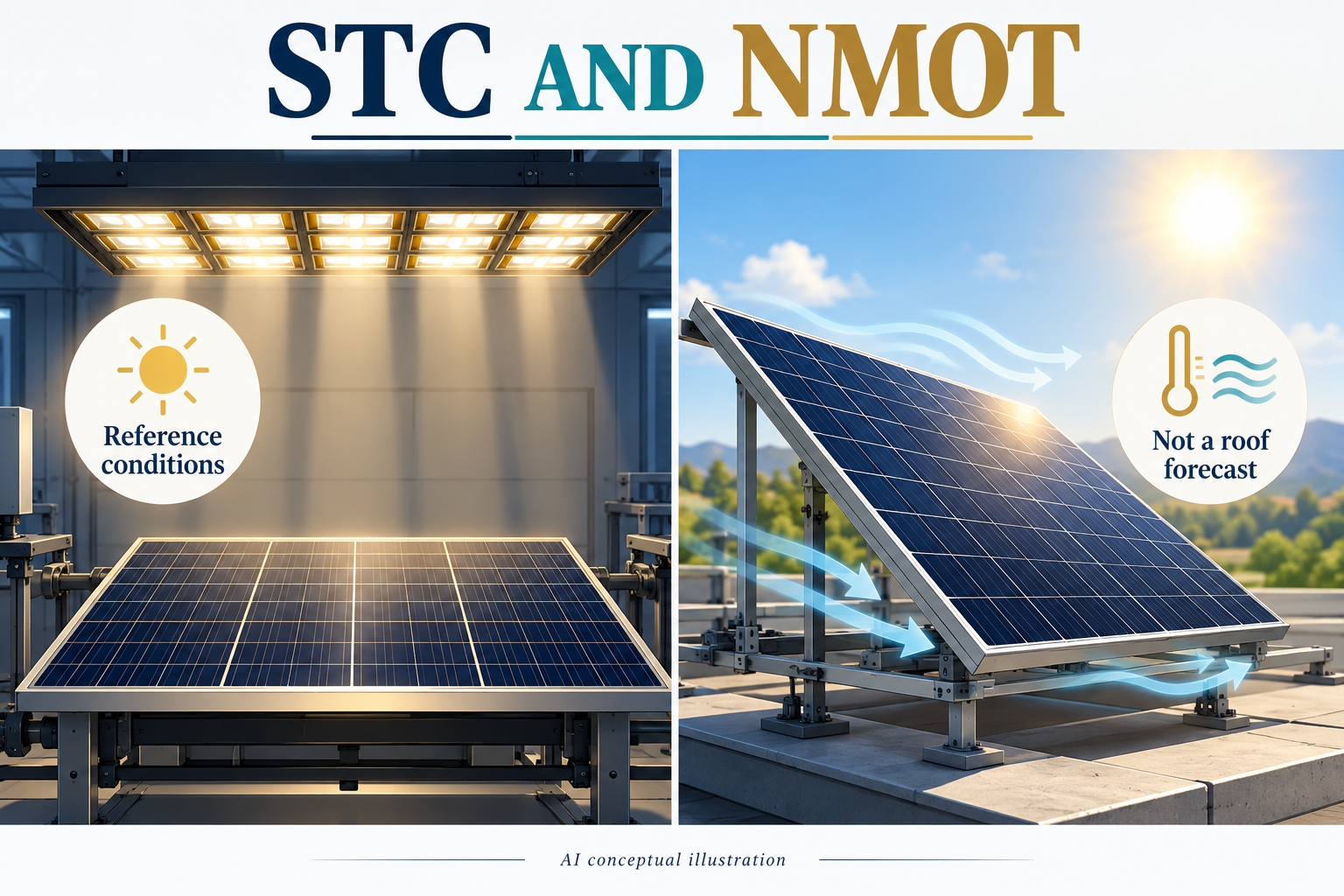
When a panel datasheet lists two power figures, the lower number is not automatically its honest output and the higher number a marketing invention. STC and NMOT describe different reference conditions. They help buyers compare documented performance, but neither is a weather forecast for a Lahore home, Karachi workshop or Islamabad office. Keep three questions separate: what the module is rated to deliver under specified conditions, what conditions exist on your roof, and how much energy the complete installation is expected to deliver over time.
STC fixes the comparison conditions
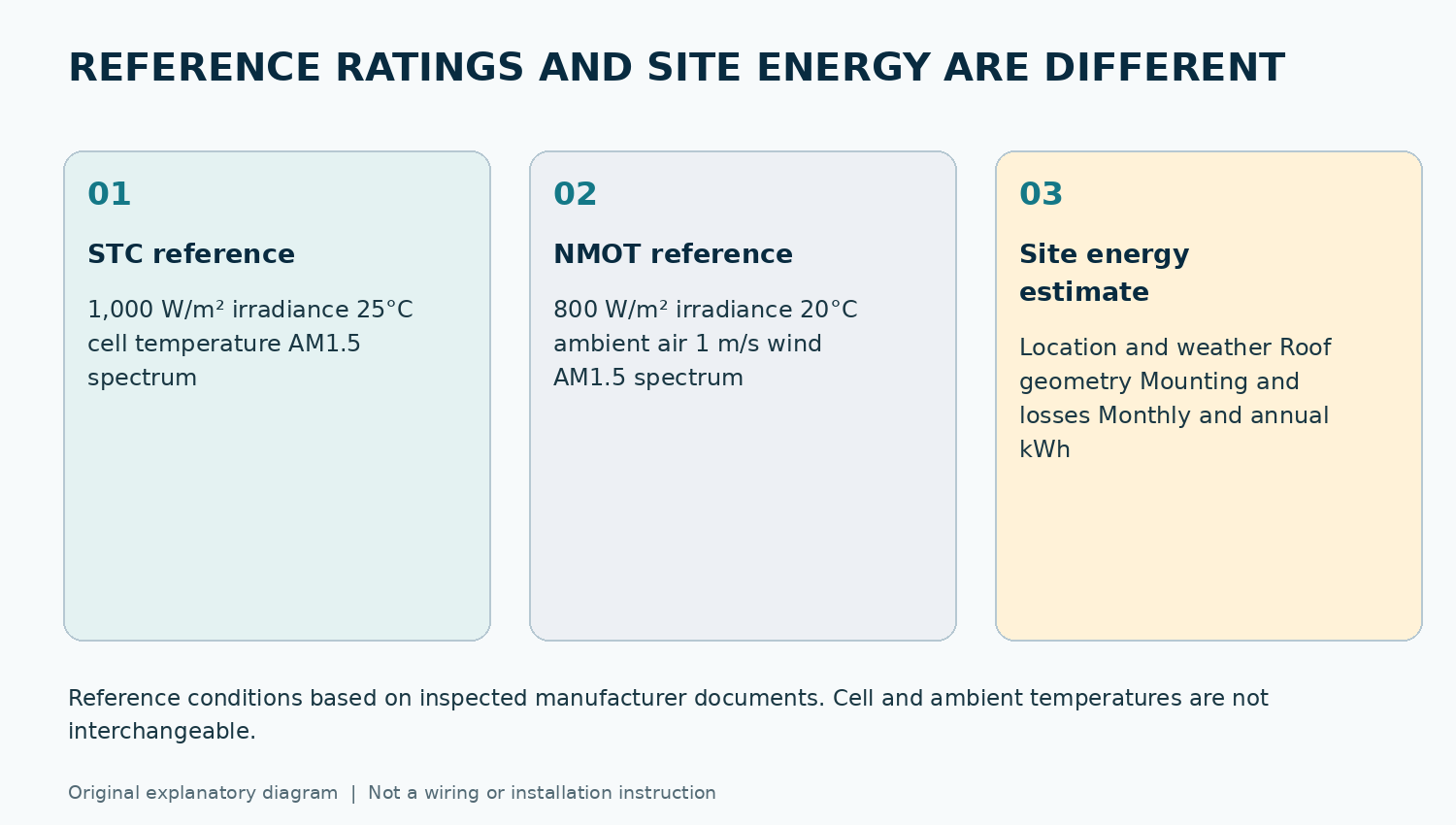
In the Thornova datasheet examined here, standard test conditions mean irradiance of 1,000 W/m², cell temperature of 25°C and an AM1.5 reference spectrum. Notice the word cell: the 25°C value is not simply the outdoor air temperature shown by a weather app. This defined basis lets different power bins be identified consistently. It does not promise that a working rooftop module remains at those conditions throughout a sunny day. Thornova manufacturer datasheet
NMOT describes a different operating reference
Dualsun describes the nominal operating reference using 800 W/m² irradiance, 20°C ambient air, 1 m/s wind and an AM1.5 spectrum. Here, ambient temperature and module temperature are deliberately different quantities. The resulting nominal module temperature is a reference characteristic, not the panel’s maximum permissible temperature or a predicted temperature for every installation. Dualsun explanation of NMOT measurements
Dualsun explains the distinction in two stages: establish the nominal working temperature under the stated outdoor conditions, then determine the electrical current-voltage characteristics at that temperature and 800 W/m². The resulting power, voltage and current entries belong to that reference case. They are not annual averages and do not include every component between the module and the customer’s appliances. Dualsun explanation of NMOT measurements
A worked reading of one real table
For the TS-SWT72(600) column, Thornova lists 600 W at STC and 447 W under NMOT conditions. Both values refer to the same model column. Dividing 447 by 600 gives 74.5%; that calculation describes this pair of listed reference powers only. It is not a universal solar-system efficiency, a Pakistan derating factor or a guaranteed fraction of daily generation. The manufacturer and model are used as a documentation example, not as an availability claim or purchase recommendation. Thornova electrical-characteristics table
A forecast needs a location and a system model
The European Commission’s PVGIS manual illustrates the extra work involved in estimating energy. Its calculations use a geographical location and solar-radiation dataset alongside installed peak power, module technology, mounting arrangement, slope, orientation and system-loss assumptions. Its outputs include monthly and annual energy estimates, plus year-to-year variability. That is a different exercise from reading one datasheet power entry. European Commission PVGIS user manual
Watts describe power at an operating point; kilowatt-hours describe accumulated energy. Multiplying a panel’s NMOT watts by an arbitrary number of daylight hours skips changing sunlight and the system’s operating conditions. For a buying decision, ask for the monthly energy estimate and the assumptions behind it rather than only a single daily-units promise. Ask whether the quoted figure refers to module DC output or usable AC energy, and compare proposals on the same basis.
Put the distinction into the quotation
Request the exact model datasheet and revision, with the chosen power-bin column clearly identified. Keep the STC nameplate total separate from the expected energy table. Ask the installer to name the weather dataset, explain the roof-specific assumptions and state what uncertainty remains. If two proposals disagree, compare their inputs before deciding which panel is better. NMOT is useful context; the missing step is a transparent, site-specific forecast, not another unsupported conversion percentage. Keep the explanation attached to the proposal, so a later equipment substitution cannot silently change the reference ratings or the assumptions used to justify the original purchase.
Sources and references
- [1] Thornova Tangra M TS-SWT72(580–600), EN_V20241226
Checked 2026-10-25
Inspected official two-page PDF on 2026-10-25, page 2 electrical-characteristics table and condition footnotes. TS-SWT72(600): STC 600 W, NMOT 447 W; NMOT 43±2°C; no Pakistan stock or comparative recommendation asserted. 447/600=74.5% is editorial arithmetic, not a performance forecast.
- [2] Dualsun — What are the NMOT values for Dualsun panels?
Checked 2026-10-25
Inspected full manufacturer explanation on 2026-10-25, updated 2024-09-23; separate nominal-temperature determination and I–V characterization under stated NMOT conditions. Used for test interpretation, not any Pakistan-specific performance claim.
- [3] European Commission Joint Research Centre — PVGIS 5 user manual
Checked 2026-10-25
Inspected sections 1.2, 2, 4.1 and 4.2 on 2026-10-25: location, weather dataset, STC installed capacity, mounting, geometry, system losses, monthly/annual output and year-to-year variability. No site yield was calculated or promised.