SOLAR PANEL BUYER GUIDE
Solar Panel Product Warranty vs Performance Warranty: What Buyers Actually Receive
Share on social media
A practical Pakistan buyer’s guide to the difference between defect coverage and power guarantees, with model, territory, remedy and claim-document checks.
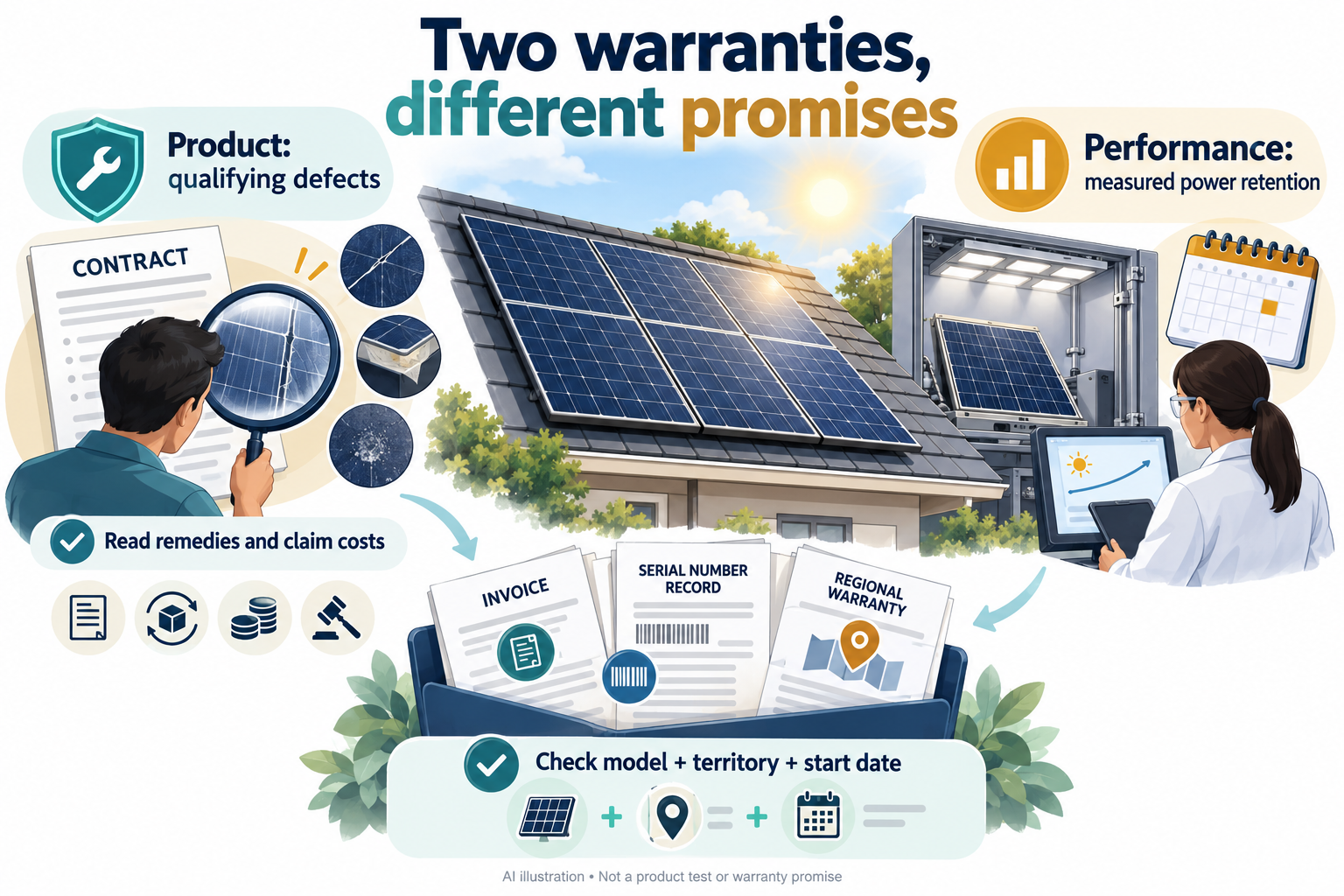
Original companion diagram
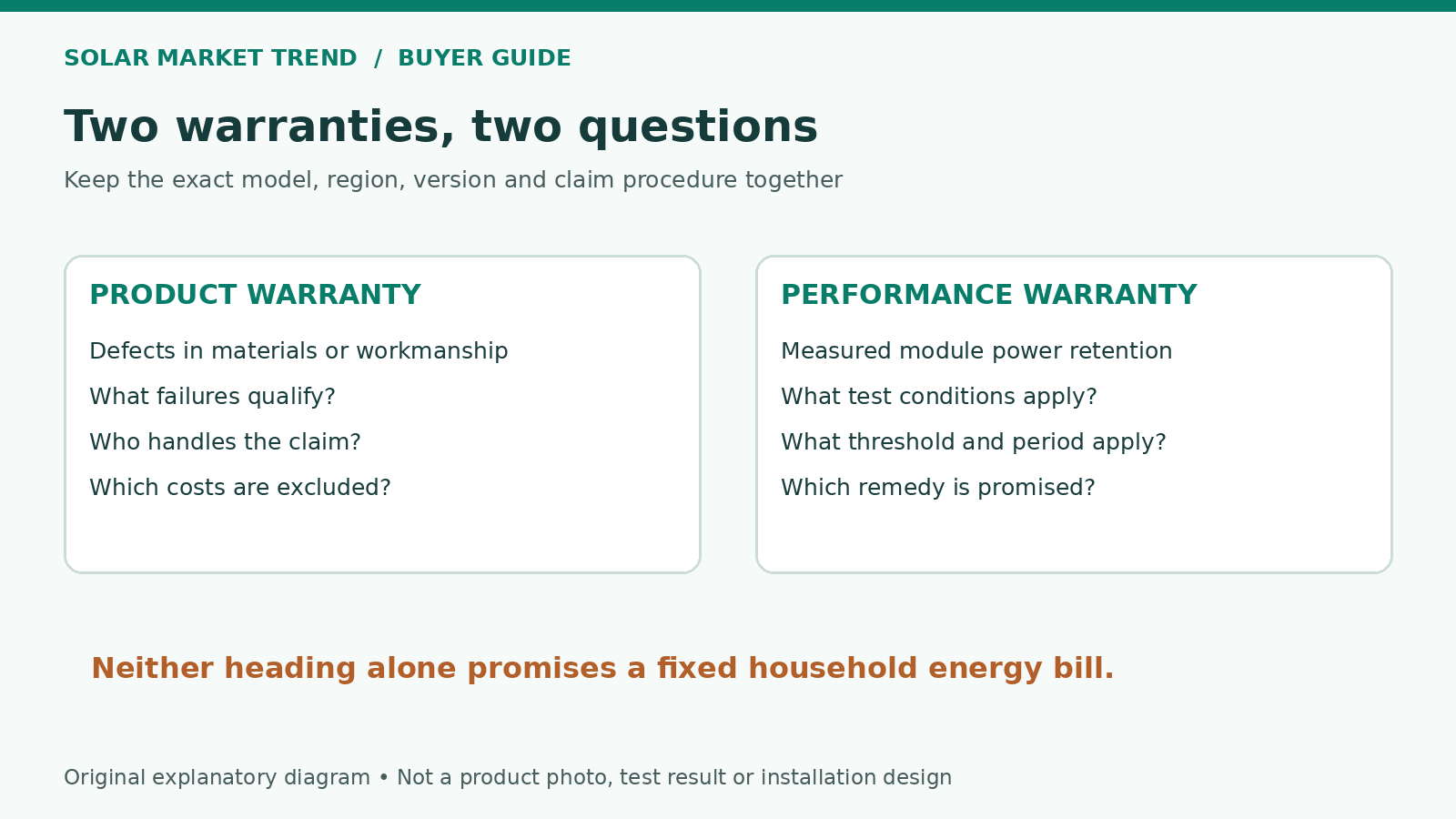
Start with the promise behind the number
A solar quotation can show a long warranty period without explaining what happens when a panel develops a problem. Before paying for a rooftop system in Pakistan, ask the seller to identify two separate promises: coverage for specified product defects and coverage for a minimum level of module power. Then ask who will handle a claim locally. Those answers are more useful than choosing the largest number printed beside a brand name.
The manufacturer documents discussed here are examples reviewed on 19 October 2026. They explain how warranties are structured, not a finding that any particular shipment in Pakistan qualifies for coverage. Your exact model, supply contract, purchase timing and territory still require verification.
Product coverage concerns a qualifying defect
A product warranty generally addresses defects in materials or workmanship, subject to its conditions. For example, Canadian Solar’s January 2026 TOPBiHiKu US statement ties coverage to defects adversely affecting functionality under specified installation, use and service conditions. It expressly separates this promise from the power-output warranty. That distinction matters: a damaged component and a measured power shortfall need not follow the same claim route. [1]
Do not assume every visible change qualifies. Read what counts as a defect, what evidence is required and which exclusions apply. Separately request the installer’s written workmanship terms for installation problems. A manufacturer’s module warranty should not be treated as a substitute for a clear agreement about the installer’s own work.
Performance coverage uses a measured power threshold
A performance warranty compares module output against a defined minimum over time. LONGi’s April 2026 Hi-MOX10 distributed-generation warranty specifies measurement under standard test conditions in an accepted independent laboratory, with equipment tolerance considered. Its stated power promise concerns the module’s front side. An inverter screenshot showing a disappointing afternoon therefore does not, by itself, establish a warranty failure. [2]
To understand the arithmetic, imagine a purely illustrative 600 W panel whose applicable warranty floor at a given age is 90%. The threshold would be 540 W under the prescribed measurement conditions. This is not a promise of 540 W throughout the day, or a particular number of electricity units each month. It also is not a prediction that the panel will produce exactly the minimum. Use the actual contract’s schedule, not this illustrative percentage.
Match the document to the shipment
Jinko’s August 2026 bifacial warranty lists different product periods, including 12, 15 and 25 years, for different model codes. Its territorial exclusions and agreement-date wording also matter. A statement about one Tiger Neo model is not automatically a statement about every Tiger Neo panel. [3]
Regional PDFs can be especially misleading when shared without context. The Canadian Solar document cited here expressly applies to products sold and installed in the United States. Its presence on an official manufacturer website does not make it Pakistan coverage. Ask the seller for the applicable document and confirmation that your serial-numbered modules fall within it. [1]
An accepted claim may still involve costs
Read the remedy section before assuming that a successful claim means a new panel delivered and fitted at no cost. LONGi’s reviewed document permits repair, replacement, additional modules or specified financial remedies at the supplier’s discretion. It places dismantling, repacking, installation and reinstallation costs on the customer and says repair or replacement does not restart the warranty period. Freight treatment is linked to the original supply terms. These are document-specific examples, not universal rules for every brand. [2]
Ask the installer to price the missing service layer: site visit, testing arrangements, safe removal, transport coordination and refitting. Have the quotation distinguish manufacturer-covered remedies from separately promised installer support. A useful comparison shows both the written coverage and the practical route to obtaining it.
Check when the clock starts and preserve evidence
Do not assume the warranty starts when you first switch on the inverter. Canadian Solar’s customer-support FAQ gives an example of the earlier of installation or 90 days after delivery by Canadian Solar to the buyer. Treat that as a reason to inspect your applicable statement, rather than a rule for every model or contract. Ask for the start date and the document establishing it before accepting older inventory. [4]
Build a claim folder containing the invoice, exact model, serial-number photographs, applicable warranty PDF, delivery and commissioning records, and installer contact details. Jinko’s reviewed statement requests purchase and warranty-start evidence, serial and model information, location and supporting photographs or reports; it also sets a 30-day notice requirement after awareness of an alleged breach. Follow the actual deadline rather than waiting for a convenient maintenance visit. [3]
Finally, obtain a written answer to one practical question: if the seller stops trading, where do you submit the claim and what records will that recipient accept? This guide explains manufacturer documents, not Pakistan-specific legal rights or a guarantee of claim acceptance.
Sources and references
- [1] Canadian Solar / CS Power Systems: TOPBiHiKu US Limited Warranty, EN-Rev 1.5, January 2026
- [2] LONGi: Limited Warranty for Hi-MOX10 Solar Modules, Distributed Generation Market, April 2026
- [3] JinkoSolar: Limited Warranty REV.EN20260801-LINEAR-BIFACIAL MODULE
- [4] Canadian Solar Global Customer Support: Module Warranty FAQ