SOLAR PANEL BUYER GUIDE
Solar Panel Serial Numbers: Why Traceability Is More Than a Sticker
Share on social media
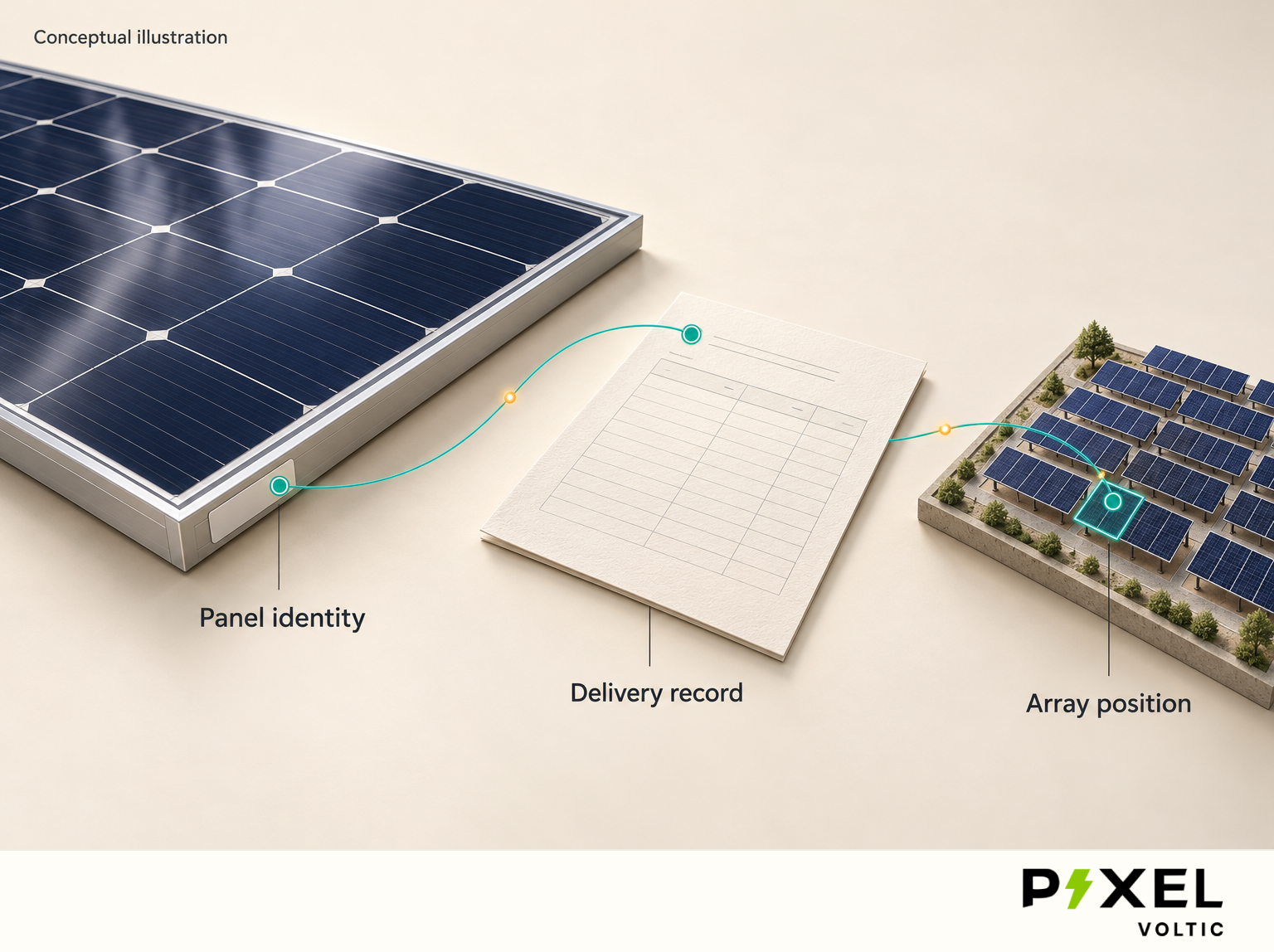
Build a panel-by-panel identity trail before delivery becomes a rooftop array. Matching labels help, but they are not a complete authenticity or quality verdict.
Buy an identity trail, not just a readable barcode
A solar-panel serial number is useful only if you can connect it to the particular panel you bought. For a buyer in Pakistan, the practical objective is a record that survives delivery, installation and later replacement: which module arrived, where it was installed, and which seller supplied it. A photograph of one attractive sticker cannot answer those questions for an entire order.
JinkoSolar’s 2024 global installation manual distinguishes the nameplate, which describes the module and its electrical specifications, from the permanently laminated serial-number barcode that identifies an individual unit. Those are different jobs: a model name describes a product family; a serial number identifies one member. [1]
Compare identifiers using the correct model documentation
Canadian Solar’s July 2026 manual describes matching identifiers under the front glass, on the frame and on the rear nameplate. It allows 14-, 16- or 18-digit serial numbers. LONGi’s V19 manual describes a laminated front identifier with the same serial beside the nameplate. These are examples for the modules covered by those documents, not a universal label layout. [2][3]
Do not apply a social-media rule that every genuine panel must have one fixed number of digits or an identical label position. Ask the supplier to identify the applicable manual revision for the exact delivered model. If the expected markings differ, seek a manufacturer explanation rather than deciding authenticity from appearance alone.
Make the delivery record panel-specific
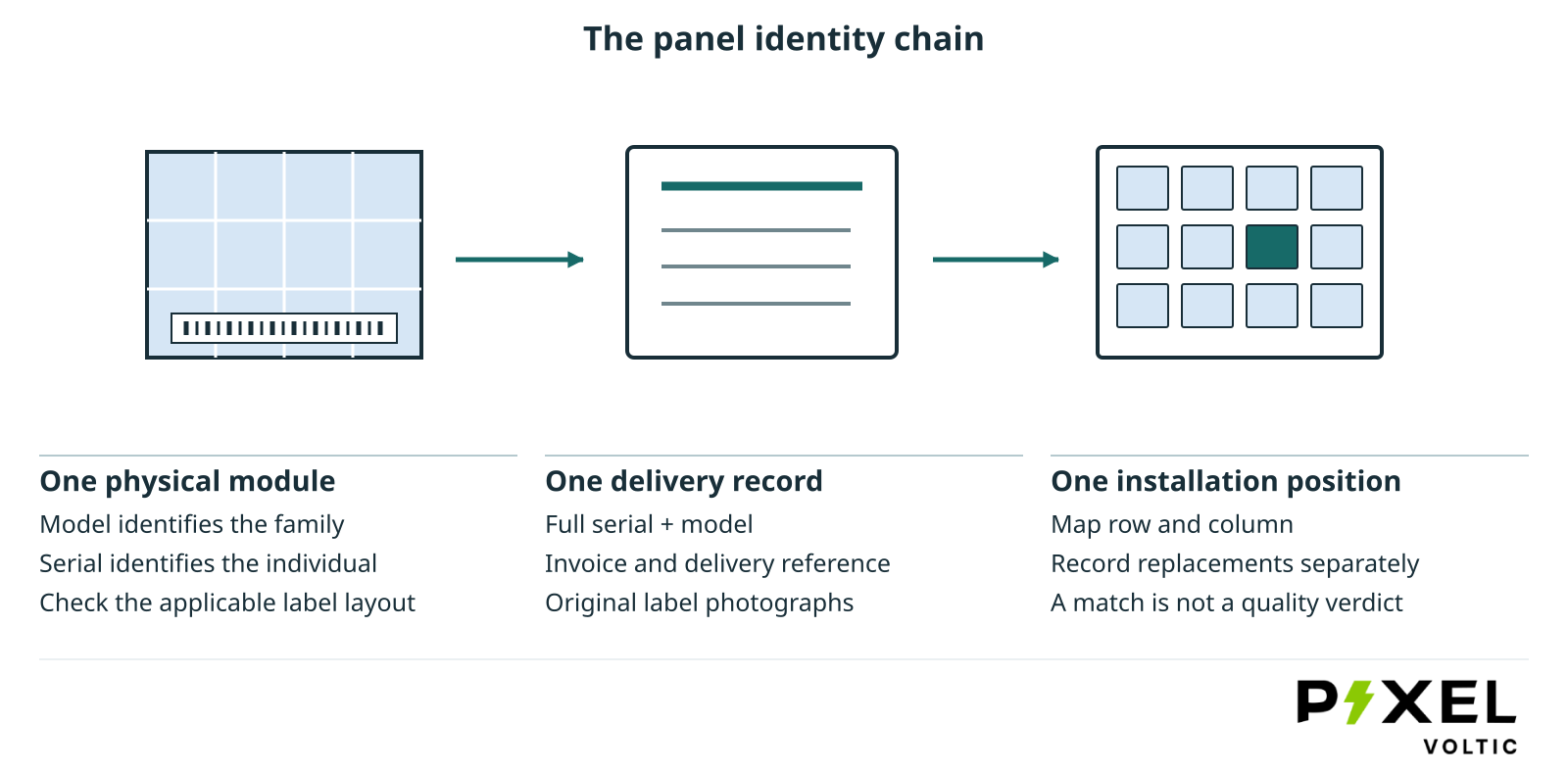
Our recommended purchasing checklist is a simple reconciliation table. Give each delivered module a row containing its full model designation, complete serial string, delivery date, seller’s invoice reference and photograph filename. Keep serials as text so that spreadsheet software does not remove leading zeroes. Ask the supplier to attach the completed serial schedule to the delivery paperwork.
Record every panel, not merely a sample, and compare the number of unique entries with the delivered quantity. Keep the original photographs as well as any typed list; transcription mistakes can then be checked without revisiting the roof. A duplicated entry may be a copying error, so investigate before alleging substitution or fraud.
Understand what a match cannot establish
A matching set of markings is an identity consistency check. It does not independently prove the seller’s relationship with the manufacturer, the module’s transport history, its present physical condition or the suitability of the proposed installation. Treat those as separate questions with separate evidence. This is a purchasing distinction, not a claim that any particular consignment is defective.
If verification is needed, approach the manufacturer through independently located official contact details and provide the model and relevant identifiers privately. Ask exactly what its response confirms. A response recognising a number should not be rewritten as confirmation of every claim in a sales quotation. Preserve the reply alongside the question that produced it.
Resolve discrepancies before the record becomes inaccessible
An unreadable identifier, inconsistent serials or paperwork for a different model deserves a written discrepancy note. Photograph the inconsistency without removing labels, scraping material or dismantling anything. Request an explanation linked to the specific unit, plus corrected documents where appropriate. A vague statement that the whole shipment is genuine does not reconcile an individual mismatch.
Agree the acceptance process before installation starts. If a discrepancy remains unresolved, keep that unit clearly identified in the delivery record and ask the supplier to resolve it before it is incorporated into the array. Heavy modules and electrical connections belong with qualified handlers; the buyer’s role here is documentary review, not rooftop inspection.
Keep the identity trail useful after handover
Ask the installer to add a simple array-position map to the serial schedule. Positions might be labelled by row and column, with the map’s viewing direction clearly stated. If a module is later replaced, retain the original entry and record the replacement serial, date and location rather than overwriting the history. This creates a practical service record instead of a folder of disconnected images.
The decision rule is straightforward: accept traceability as a chain of matching records, not as a sticker-based quality score. These manufacturer examples were checked on 27 October 2026 for the 28 October Pakistan edition. They do not verify any seller or physical panel; readers should obtain the documentation applicable to their own delivered equipment.
Sources and references
- [1] Global Installation Manual, 14 August 2024, §2
JinkoSolar
Separates nameplate information from the permanently laminated individual serial barcode; applies to the manual’s listed modules.
- [2] Installation Manual—PV Modules, v3.3, July 2026, Product Identification
CSI Solar / Canadian Solar
Describes matching module identifiers and 14-, 16- or 18-digit serials; used only for identity details, not authentication claims.
- [3] Installation Manual for LONGi Solar PV Modules, V19, §3.1
LONGi
Describes laminated front serial and matching serial beside nameplate. Direct manufacturer PDF downloaded and text inspected.