SOLAR PANEL BUYER GUIDE
Solar Panel Voc vs Vmp: Why Cold-Morning String Voltage Matters
Share on social media
Understand the two voltage figures on a solar-panel datasheet and the cold-weather check a Pakistani buyer should request before approving a string design.
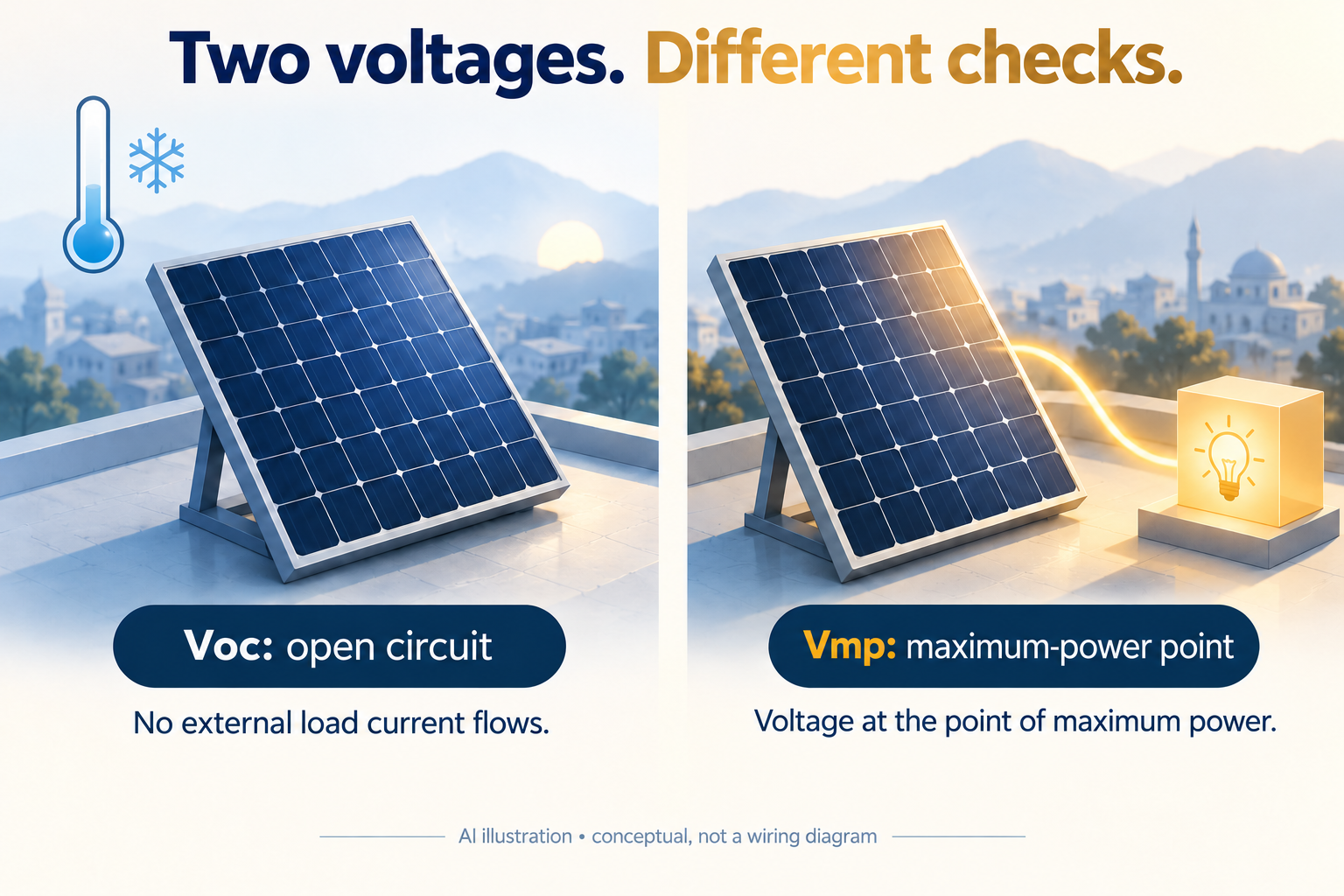
The voltage number that deserves a second look
When a solar quotation lists panel wattage and inverter capacity, it is easy to overlook voltage. Yet two arrays with similar total watts can require different string designs. Before approving a rooftop system in Pakistan, ask the installer to show the exact module and inverter datasheets, not just a combined system-size label.
The key distinction is between Voc, the panel's open-circuit voltage, and Vmp, its voltage at maximum power. They describe different operating conditions. A design that considers only the normal working voltage can miss the higher voltage the equipment may face when the array is cold. [1][2]
Voc and Vmp answer different questions
Voc is the voltage across an illuminated module when no external load current is flowing. Vmp is the voltage at the operating point where the module produces maximum power under the stated test conditions. Open circuit does not mean maximum power: with zero output current, the module delivers no electrical output power to a load.
Datasheet values are normally referenced to standard test conditions, including a cell temperature of 25°C. That is a test reference, not a promise that a rooftop panel stays at 25°C. SMA's planning guide separates these voltage quantities and explains that module voltage rises as temperature falls. [2]
The practical question is therefore not simply, “How many panels fit under the inverter's wattage rating?” It is, “Does this exact electrical arrangement remain compatible across the site's expected conditions?”
Why cold conditions change the upper-voltage check
Many crystalline-silicon module datasheets give a negative temperature coefficient for Voc. With that sign convention, a temperature below the reference temperature produces a higher calculated open-circuit voltage. Canadian Solar's installation guidance explicitly requires a low-temperature correction and identifies the lowest expected site temperature as an input. [1]
A cold, illuminated array before substantial electrical loading is an important case to consider. This is not a claim that every morning produces the maximum possible voltage, or that a weather-app reading alone is a design temperature.
Ask which location-specific minimum temperature and manufacturer method the designer used. An assumption suitable for one installation should not be copied automatically to another city, elevation or exposed site.
Original companion diagram
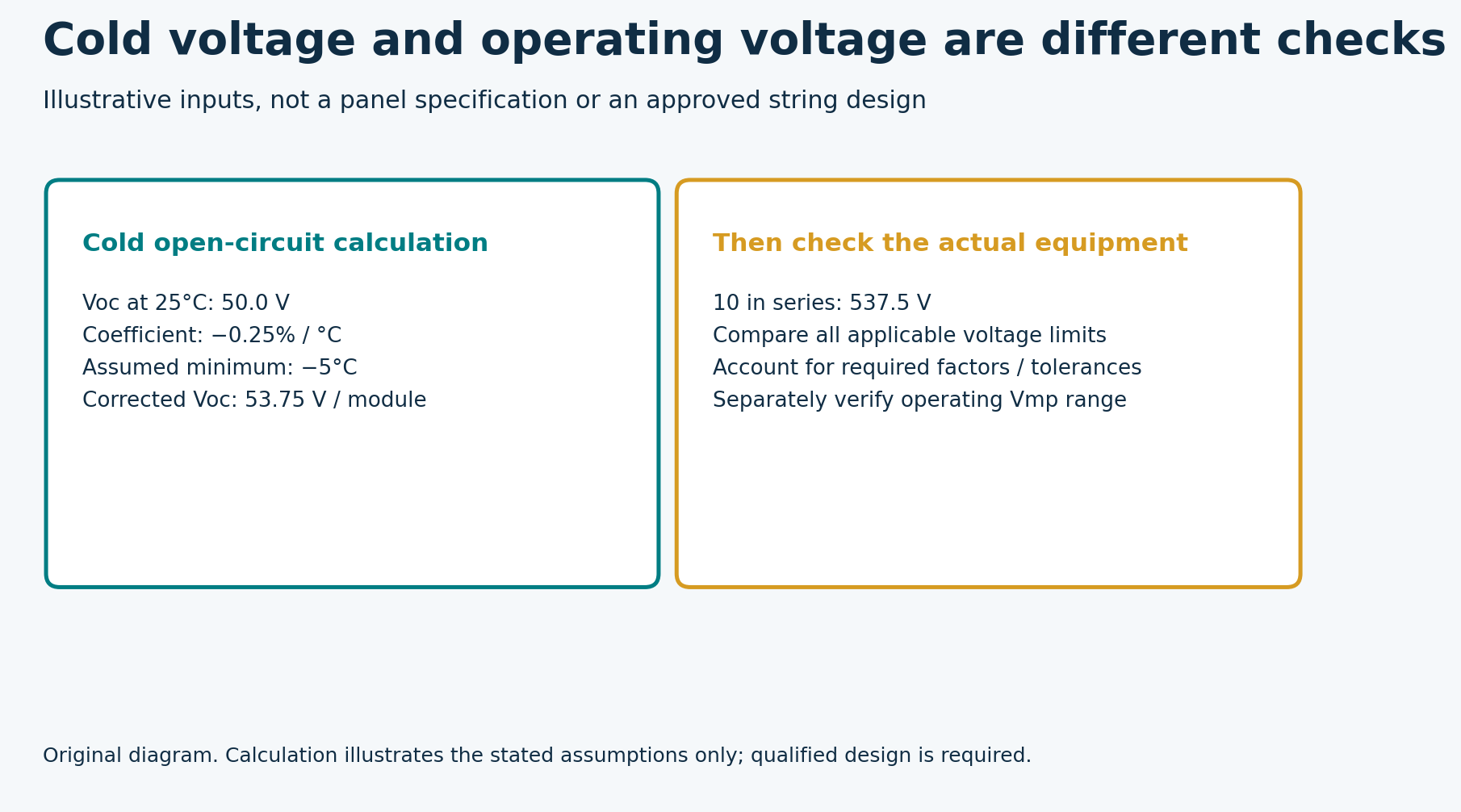
An illustrative calculation, not a string recommendation
Assume a hypothetical module has Voc of 50.0 V at 25°C and a Voc temperature coefficient of −0.25% per °C. Assume the applicable design calculation uses a minimum temperature of −5°C. These are illustrative inputs, not specifications for a named panel or recommended weather assumptions.
The temperature difference is −30°C. Applying the signed coefficient gives a 7.5% voltage increase, so the illustrative corrected Voc is 53.75 V per module. Ten identical modules in series would therefore total 537.5 V, rather than the 500 V obtained from their reference-temperature values. This demonstrates the temperature-correction principle described in manufacturer guidance. [1]
If a hypothetical inverter had a 550 V absolute input ceiling, that arithmetic alone would not approve the design. The designer must still account for the actual equipment instructions, applicable tolerances and required design factors. Do not treat a small apparent gap as universal spare capacity.
Maximum voltage and useful operating voltage are separate checks
The inverter's maximum permitted DC input voltage is a limit, not a target operating voltage. SMA warns that exceeding permissible input voltage can damage the inverter. [3]
Separately, the array must have a suitable working-voltage range. The maximum-power voltage changes with operating conditions, so passing the cold-voltage ceiling check does not by itself establish satisfactory operation in other conditions. SMA's planning guidance treats maximum string voltage and minimum operating-voltage design separately. [2]
A module's own maximum system-voltage rating also does not override a lower inverter limit. Ask for confirmation that the complete equipment combination is suitable, rather than accepting the highest number printed on any one component.
Questions to put on a Pakistani installation quotation
Request a short written design note answering these questions:
- What are the exact panel model, Voc and Voc temperature coefficient?
- How many modules are in each series string?
- What site minimum temperature and calculation method were used?
- What is the resulting maximum string voltage, and which equipment limit governs?
- Has the normal operating-voltage range also been checked?
- Would a later panel substitution or extension require the design to be recalculated?
Keep the approved model numbers with the quotation. If the supplied panel changes, ask for an updated calculation rather than relying on an assurance that its wattage is similar. This is a practical procurement safeguard, not a request for the homeowner to redesign the installation.
The buyer takeaway
Have a qualified solar designer or electrical professional verify the proposed arrangement and document the assumptions before installation. Do not open live DC connectors or attempt rooftop voltage measurements yourself. The useful buyer action is to request documented compatibility before installation, then keep that record for future changes.