SOLAR PV CABLE MARKINGS GUIDE
Solar PV Cable Markings What the Jacket Must Tell a Buyer
Share on social media
Cable size is only one purchasing check. Learn how to verify PV cable identity, insulation and sheath claims, UV exposure, water conditions and product traceability before accepting a solar installation in Pakistan.

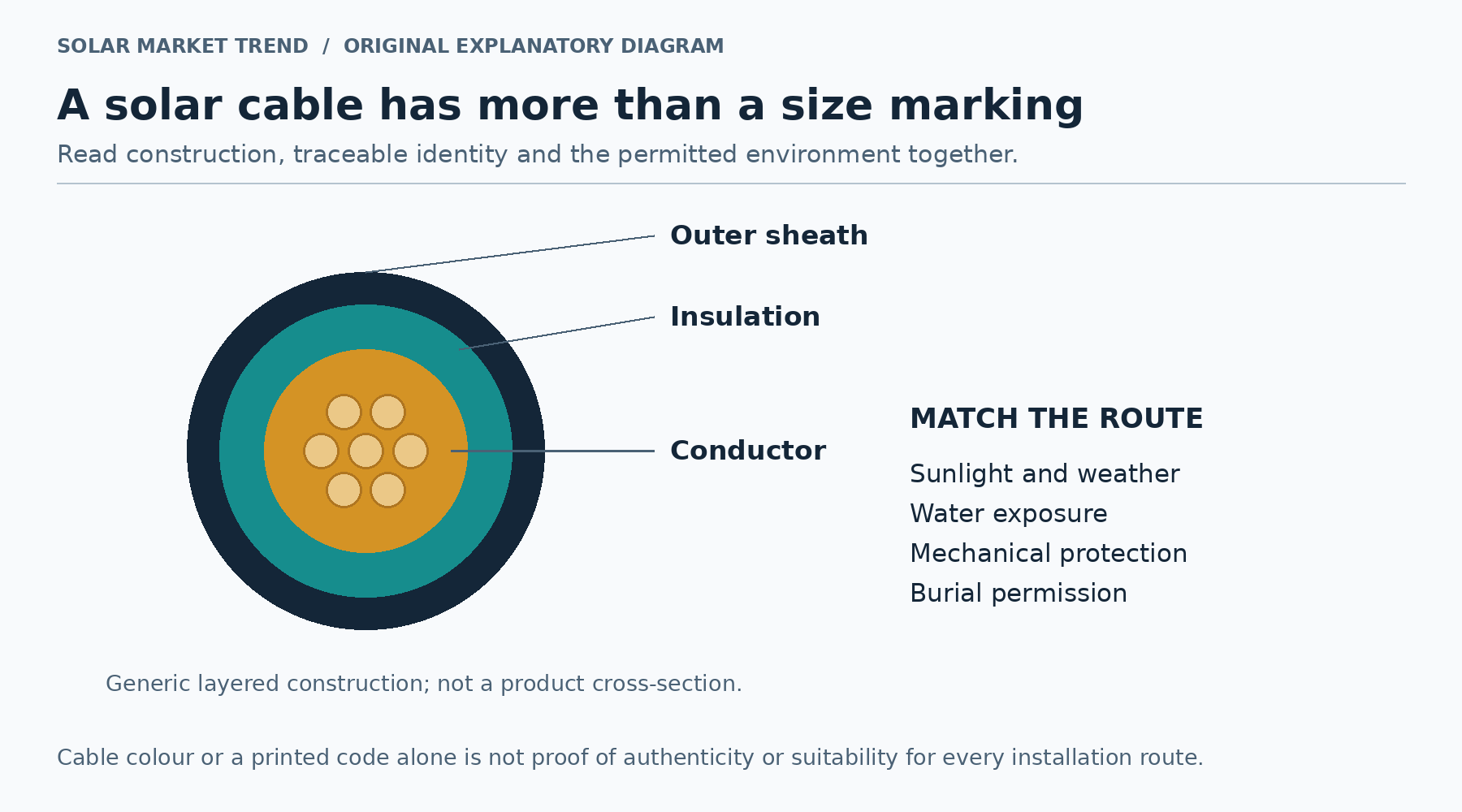
Start with the route not the colour
Two cable reels can have the same conductor size and a similar black jacket without offering the same documented service conditions. For a Pakistani rooftop, farm or commercial installation, the useful buying question is not simply whether the seller calls a cable “solar grade”. Ask whether the exact product is suitable for the places it will pass through: exposed outdoors, supported under modules, inside conduit, or in a wet or buried section.
This is a materials and traceability check, not a cable-sizing calculation. An acceptable cross-sectional area does not establish the cable's identity or environmental suitability. Equally, a strong jacket claim does not establish current capacity, voltage drop or protective-device coordination. Keep those design checks in the installer’s scope.
Treat the printed type as a starting point
IEC 62930:2017 covers single-core PV cables with cross-linked insulation and sheath for the DC side of systems within its stated voltage scope. Its public description includes both halogen-free low-smoke constructions and constructions that may contain halogens. Therefore, a reference to that standard alone is not evidence for every advertised material or fire-performance claim. [1]
NKT describes its H1Z2Z2-K product as an EN 50618 cable for PV DC interconnections and publishes a matching datasheet. That is the evidence pattern to request: an identifiable manufacturer, exact cable family, declared standard and corresponding technical document. [2] Do not interpret a type designation as independent verification that an untraceable reel is genuine.
Match the jacket to the reel and documents
Prysmian’s PRYSUN datasheet shows a marking format containing the manufacturer and product name, cable type, DC voltage, conductor size, year and metre information. It separately identifies tinned copper and the insulation and sheath materials. These are manufacturer declarations for PRYSUN, not a universal marking template for all cables. [3]
Our receiving checklist is to photograph the cable printing and reel label before installation, then reconcile them with the invoice and datasheet. Keep the product code and batch or manufacturing reference when supplied. Ask the seller to explain a mismatch rather than relying on a certificate that names only a different product family. A clear print is useful for tracing a claim; it is not a substitute for an authentic supply chain or appropriate testing.
Separate sunlight water and burial claims
UV resistance, water exposure and burial are different questions. NKT explicitly declares UV-resistant construction for the cited product. That does not, by itself, tell the buyer that every possible water or underground installation is permitted. [2]
LAPP’s ÖLFLEX SOLAR XLWP sheet separately describes weather and UV resistance, water-performance conditions and burial-related impact and crushing tests. Its underground-use statement also carries installation conditions. This example shows why the complete product sheet matters: a buyer should not reduce several conditional declarations to the single word “waterproof”. [4]
Prysmian likewise distinguishes its enhanced-water-endurance PRYSOLAR range from its TECSUN direct-burial offering in its public portfolio description. [5] The editorial conclusion is narrow: confirm the exact product and route, rather than transferring a capability from one branded range to another.
Read temperature and fire statements precisely
NKT’s cited sheet separates conductor, handling and storage temperatures and gives a time limit for its upper conductor-temperature condition. [2] Ask which condition applies to the proposed route. The highest printed temperature is not a promise about indefinite rooftop service.
PRYSUN lists fire-related tests, low-smoke properties, halogen-free materials and weather resistance separately. [3] Preserve those distinctions in the quotation. A flame-performance test reference is not a blanket claim that the cable is fireproof or will continue operating during a building fire. If fire survival or a particular building classification is required, obtain documentation that expressly addresses that requirement rather than substituting a familiar logo.
An illustrative quote comparison
Imagine two hypothetical offers for the same planned route. Offer A lists only a conductor size and “imported solar cable”. Offer B identifies the manufacturer and product code, supplies a matching datasheet and states which document supports the exposed and wet sections. No price, brand ranking or real supplier is implied.
Offer B is easier to evaluate, but it is not automatically approved. A competent installer still has to reconcile the product limits with the route and complete the electrical design. If a buried section is proposed and neither offer establishes burial suitability, the correct conclusion is “evidence missing”, not that the darker, thicker or more expensive jacket must be suitable. Ask for a documented revision before accepting the substitution.
Keep a usable acceptance record
Request a cable schedule that names each product, its intended route and the supporting document revision. Record approved substitutions explicitly. Keep photographs of reel identification and accessible completed routing, together with the installer’s inspection and test records. These recommendations make later maintenance and fault investigation less dependent on memory.
Do not cut into an installed cable to inspect the conductor or move energized PV wiring to read hidden markings. NKT expressly assigns installation to qualified electrical personnel. [2] Have the installer resolve uncertain identity, damaged jackets or unsupported environmental claims safely. The buying objective is a traceable cable matched to its actual conditions, not a reassuring word printed on an otherwise undocumented reel.
Sources and references
- [1] IEC 62930 2017 public scope summary
Edition 1.0 published 13 December 2017 · Checked 2026-10-22
Scope covers PV DC single-core cross-linked insulated and sheathed cable; includes halogen-free low-smoke and halogen-containing variants.
Official public scope summary directly retrieved and checked on 22 October 2026 after earlier timeouts. Full paid standard was not reviewed. No claim of complete standard-compliance assessment.
- [2] NKT H1Z2Z2-K English product datasheet
Undated two-page datasheet linked from current NKT product page · Checked 2026-10-22
EN50618 application and qualified installation; construction and UV declaration; distinct handling storage and operating temperature fields and 20000-hour upper-temperature caveat.
Manufacturer product declarations, not independent verification of stock offered by a Pakistani seller. Upper-temperature statement has an operating-time caveat.
- [3] Prysmian PRYSUN H1Z2Z2-K datasheet
Generated sheet footer GB00_PRYSUN_H1Z2Z2_K_1KV_20261022 · Checked 2026-10-22
Cable marking format; tinned copper and cross-linked material description; separate fire smoke halogen UV and ozone declarations.
Manufacturer product declarations. Datasheet has differing AC-voltage fields; article deliberately makes no AC-rating comparison or universal operating recommendation.
- [4] LAPP ÖLFLEX SOLAR XLWP product information
Last update 27 January 2026 · Checked 2026-10-22
Weather UV and ozone claims are separate from water and burial claims; burial impact/crushing tests and installation conditions.
Product-specific water and burial conditions. Foreign installation references are not represented as Pakistani installation law.
- [5] Prysmian solar cable portfolio
Undated current portfolio page checked 22 October 2026 · Checked 2026-10-22
PRYSOLAR enhanced water endurance and TECSUN direct-burial positioning are separately described.
Marketing range descriptions, not independent performance comparison or evidence of Pakistan availability.