SOLAR PV FUSE GUIDE
Solar PV Fuses: Why a gPV Marking and DC Rating Matter
Share on social media
A buyer-focused guide to checking PV fuse specifications, design-dependent string protection, cold-weather voltage, coordination and compatible holders before approving a solar installation.
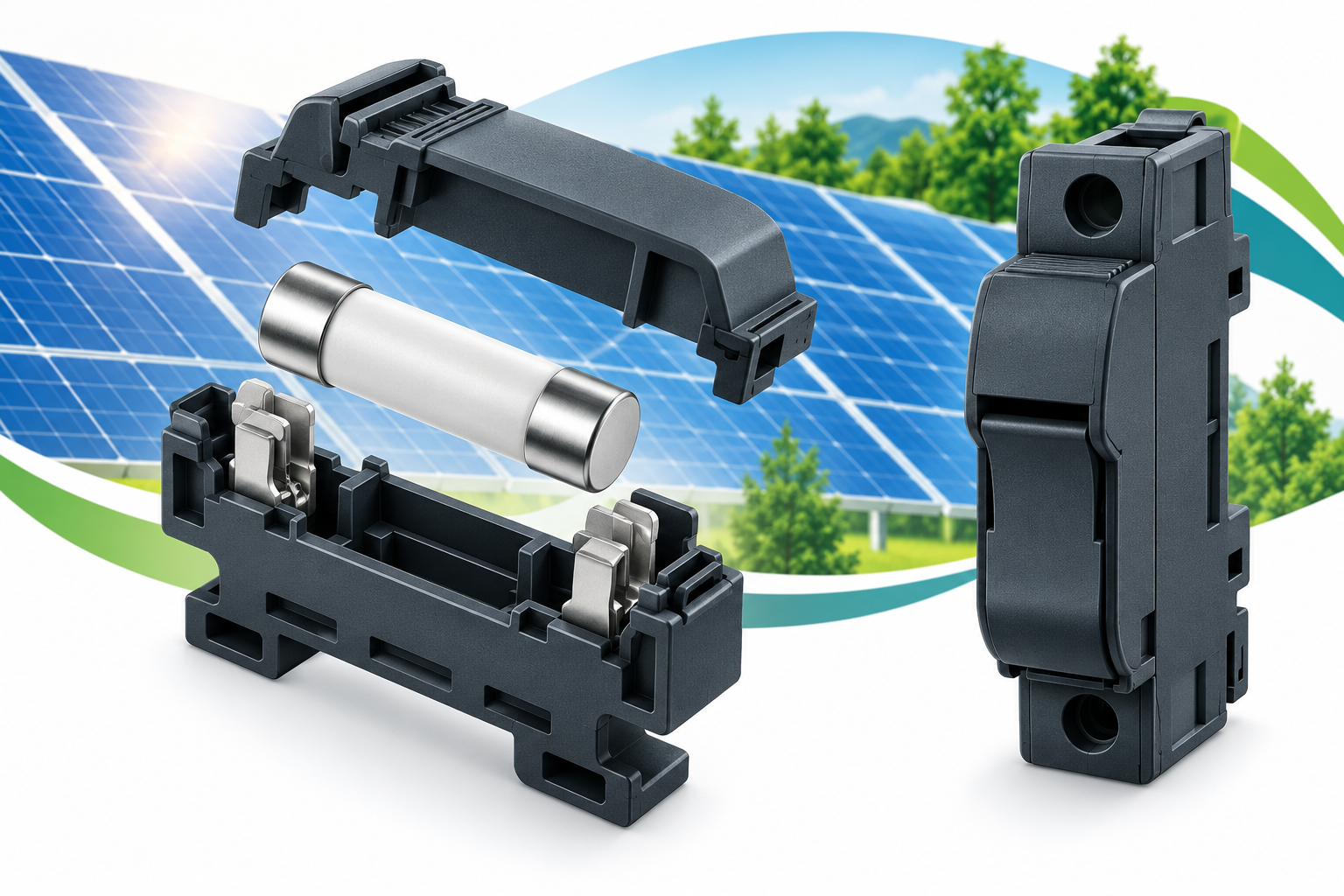
Start with a specification, not a shop description
A solar quotation may include a line that simply says 'DC fuse'. For a homeowner or business buying a system in Pakistan, that description leaves important questions unanswered: which product, which application, and which documented ratings? Request the manufacturer, complete part number and matching datasheet before accepting the item.
IEC 60269-6 addresses fuse-links for protecting photovoltaic strings and arrays in DC circuits up to 1,500 V. Its scope does not mean that every fuse mentioning the standard is rated for that maximum voltage. The actual product rating still matters. A useful purchasing record connects the proposed component to the system designer's specification rather than relying on a generic marketplace photograph. [1]
What gPV tells you about the application
The gPV designation identifies a fuse category intended for photovoltaic applications. PV protection has an awkward combination to handle: substantial DC voltage and potentially modest overcurrent. An ordinary fuse with a familiar ampere number may not have the required operating characteristics.
Mersen explains that DC fault interruption lacks the natural zero crossings found in AC and that gPV devices are specifically designed and tested for this environment. Its technical note also identifies voltage, prospective fault current and the fault circuit's time constant as relevant interruption parameters. [2]
For the buyer, the practical request is straightforward: ask for evidence of the specified PV utilization category and the manufacturer's DC ratings. A seller's 'solar suitable' label alone is not equivalent documentation.
String fuses are a design decision
Do not assume every rooftop needs the same number of string fuses, or that an installation without them is automatically defective. Parallel strings and other possible sources can feed current into a faulted circuit; whether overcurrent protection is required depends on the configuration and component limits.
Littelfuse's application paper describes exceptions where available current cannot exceed the relevant conductor capability and discusses the influence of external current sources. Its examples use the US NEC framework, so they should not be copied as a statement of Pakistani installation requirements. [3]
Ask the qualified designer to document the decision using the applicable installation requirements, module instructions, conductor ratings and inverter or other connected-source characteristics. A blanket rule based only on counting panels is inadequate.
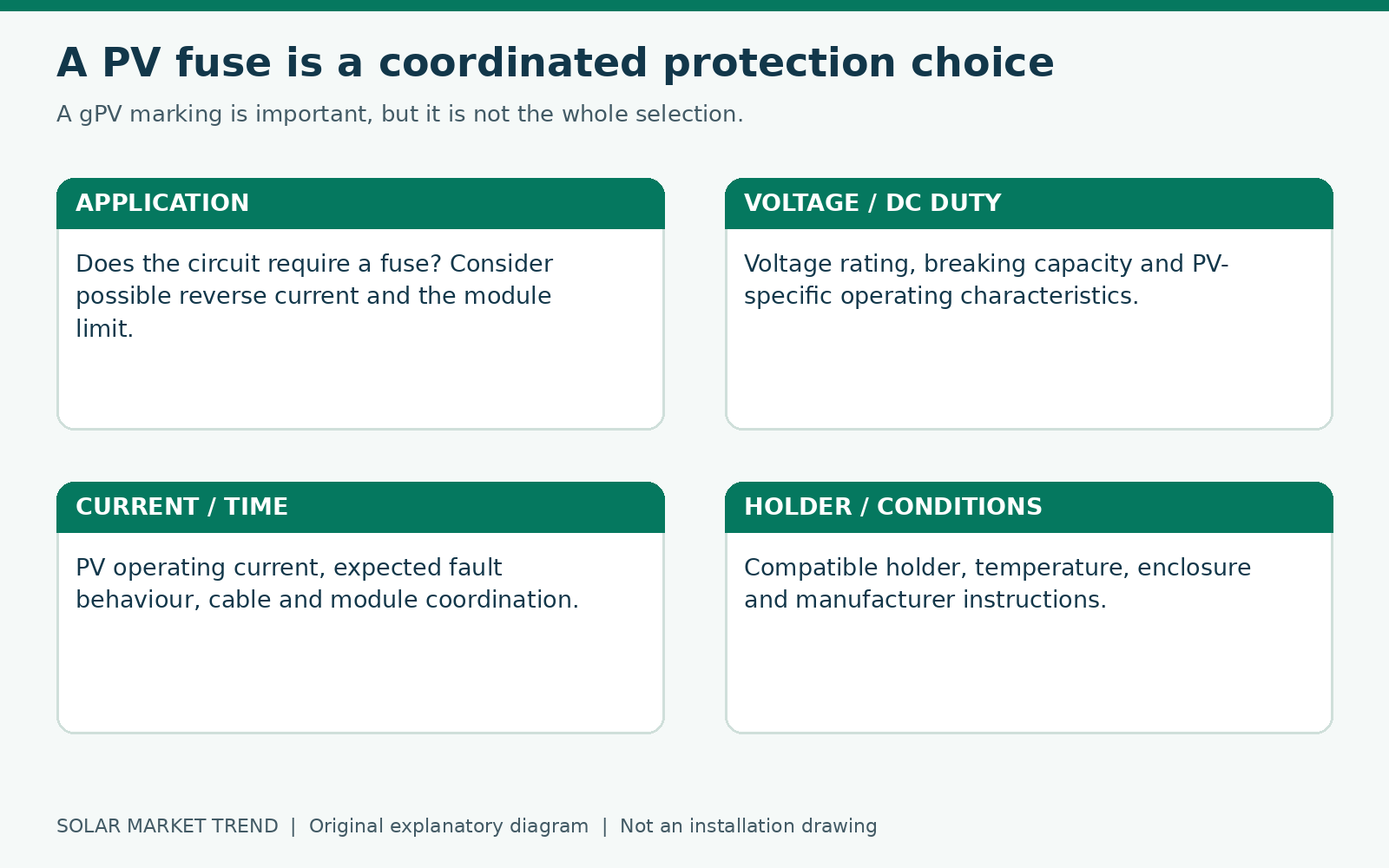
Original companion diagram
Check voltage against the cold-weather design
A string's everyday operating voltage is not the only voltage relevant to fuse selection. The design must account for open-circuit voltage and the lowest temperature used in the project's calculation. Mersen's photovoltaic guide explicitly links fuse voltage selection to string open-circuit voltage at the lowest application temperature. [4]
Request the calculated maximum string voltage alongside the selected fuse's DC voltage rating. The designer should use the actual module data and applicable method, rather than borrowing a correction factor from an unrelated example. This is especially worth revisiting when a proposal changes the module model or number of modules in series. Treat that change as a reason to recheck the specification, not as a cosmetic substitution.
Coordinate the current rating with what it protects
Choosing a higher ampere rating merely to avoid interruptions can undermine protection. The selection needs to allow legitimate operating current while remaining compatible with the module's maximum series-fuse limit, the conductor capability and the protective scheme. Temperature, installation conditions and manufacturer derating information also belong in the review.
Eaton's PV application guide addresses these constraints together, including module limits, cable protection and derating. [5] Ask the designer to identify the protected circuit and provide the selection calculation, including any upstream or downstream coordination requirements.
A fuse's interrupting rating is another separate check: it must suit the prospective fault current under the stated DC conditions. The ampere rating alone cannot establish that suitability. [2]
Review the holder and fuse as an assembly
Physical fit is only one part of compatibility. The holder must be suitable for the intended fuse, voltage, current and installation conditions. Make the holder's manufacturer and part number visible in the bill of materials instead of treating it as an anonymous accessory.
For example, Eaton's PV-15A10F product page separately lists its 15 A current rating, 1,000 V DC voltage rating, 50 kA interrupting rating, gPV class and compatible CHPV holder family. These are product-specific examples, not a recommendation for your roof. [6]
The example shows what an auditable specification looks like. If the supplied holder or fuse differs from the approved selection, request a documented compatibility review before installation acceptance rather than accepting 'same size' as the explanation.
Keep the handover useful and the inspection safe
A strong handover includes the as-built string arrangement, fuse and holder part numbers, selection rationale, applicable datasheets and the approved replacement specification. Ask who will investigate a blown fuse and how replacement parts will be verified. Repeated operation should trigger diagnosis, not a casual increase in fuse size.
This is a paperwork and professional-review checklist, not an instruction to pull fuse carriers or test live circuits. PV remains a source of electrical energy in sunlight, so switching an inverter off does not by itself establish that every DC connection is safe to touch. [2]
The buying decision should end with a traceable design and qualified installation. A clearly printed gPV marking is useful, but it becomes meaningful only when the entire selection is justified.
Sources and references
- [1] IEC: IEC 60269-6:2010+AMD1:2021 consolidated-version scope
- [2] Mersen: Photovoltaic Market, Over-current Protection, Technical Note 3
- [3] Littelfuse: How to Calculate Fuse Sizes for Photovoltaic Installations
- [4] Mersen: HelioProtection Program, Solutions for Photovoltaic
- [5] Eaton: Bussmann Series Photovoltaic Fuses Application Guide
- [6] Eaton: PV-15A10F product specifications and compatible holder