SOLAR ACCESSORY BUYER GUIDE
Solar Wiring Ferrules Why Colour and a Tight Fit Are Not Enough
Share on social media
A ferrule is one part of a conductor–terminal–tool combination. Check the exact connection data, dimensions and crimp process instead of assuming a collar colour or a forceful insertion proves suitability.
A small accessory with a specific job
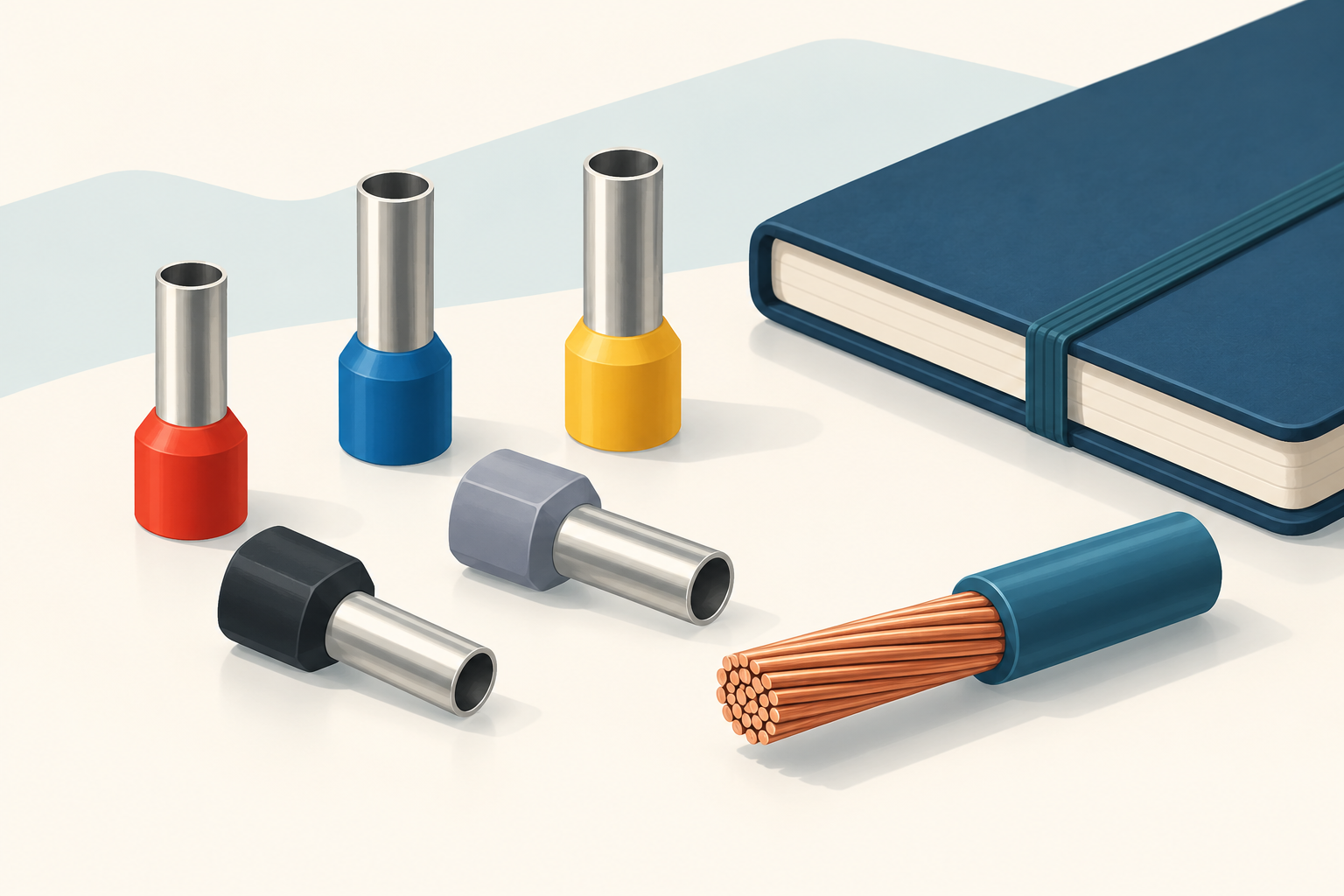
A neat-looking solar distribution box can still leave an important question unanswered: was each conductor termination selected for the actual terminal? A wire-end ferrule gathers the strands of a suitable flexible conductor into a crimped sleeve. It is not a universal adaptor that turns any cable into an approved fit for any inverter, breaker or terminal block. For buyers, the first evidence to request is the connection specification, not a close-up of colourful collars.
Phoenix Contact describes ferrules as an aid to conductor processing and insertion, with insulated, uninsulated and twin variants. That variety is useful only when the specified type matches the application. A twin ferrule designed to hold two conductors does not, by itself, prove that a particular terminal permits that conductor arrangement. [3]
Read the terminal data before choosing the sleeve
WAGO’s guidance for its splicing connectors rejects blanket ferrule approval. A ferrule changes the prepared conductor’s dimensions; its collar can affect insertion. Consult the exact terminal’s permitted ferruled configuration instead of carrying across its headline capacity for untreated copper. [1]
Our recommendation is to ask the installer to identify the allowed conductor type, size and preparation for each terminal. Keep that response with the product documentation. A forceful fit is not evidence of an approved combination.
Colour is a clue, not a specification
HELU’s dated technical explanation shows more than one ferrule colour-code system. A familiar collar colour is therefore not enough to establish conductor cross-section across mixed suppliers. Read the packaging or traceable part number and its dimensional data. The same procurement habit helps distinguish a single-conductor sleeve from a twin version without relying on how similar they look in a loose assortment. [4]
For a Pakistani installer purchasing assorted accessories, an editorial recommendation is to retain the supplier’s size/type information with the parts rather than decanting everything into an unlabelled box. A cheap mixed kit is not automatically unsuitable, but neither its colour range nor the number of pieces proves compatibility or quality. This article does not rank sellers or claim that a particular local product is counterfeit.
Length and shape matter as well as area
WAGO links ferrule length to the connector’s specified strip length and warns about inadequate engagement or excessive exposure. Area alone is insufficient: check barrel length, collar and finished geometry. This guide gives no universal stripping length. [1]
Weidmüller also emphasizes selecting a crimp shape suited to the connection point and preserving the intended conductor cross-section during preparation. A squared, trapezoidal or other crimp shape is not inherently the best choice for every terminal. The qualified installer should follow the documented combination rather than choose whichever tool happens to be closest. [2]
The collar is not a cable support system
Weidmüller warns that the plastic collar does not provide kink protection and is not mechanical insulation support. Its role should not be confused with a cable restraint. Routing, bending and support therefore remain separate installation considerations; a tidy coloured end does not excuse a conductor being pulled sideways at its terminal. [2]
Likewise, a certification claim should be read at its stated scope. Phoenix Contact describes certification of ferrules with selected crimping tools and automatic devices. That supports checking the specified tool-and-ferrule combination, not treating a mark on one component as proof for any improvised crimp. Do not assume ordinary pliers or a visually similar die reproduce the documented process. [3]
What to ask at purchase and handover
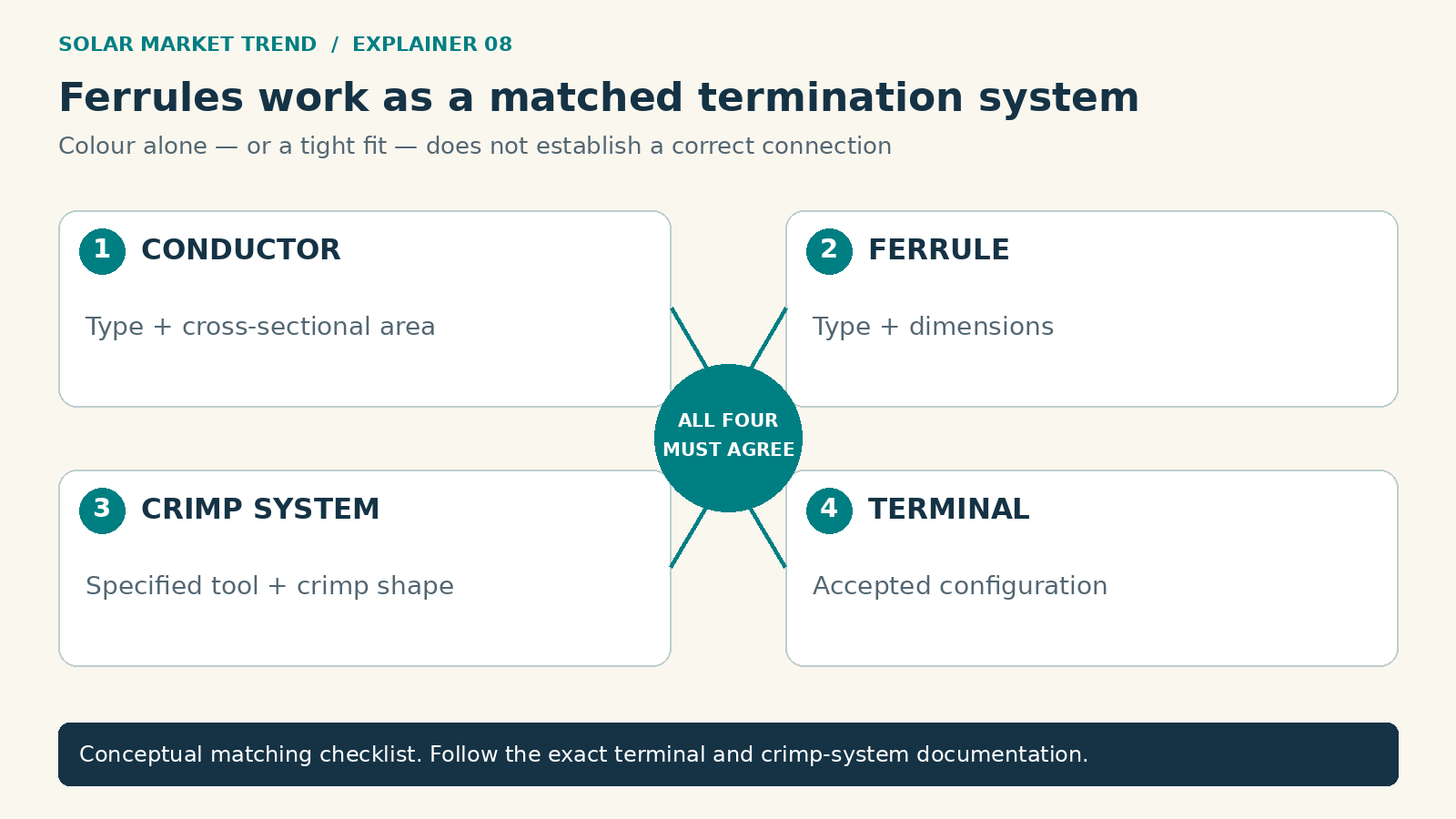
Our buying checklist is a matched set of records: terminal identification; accepted conductor type and size; ferrule dimensions; specified crimping tool; and installer inspection. Assess substitutions against these records. Do not add a ferrule for appearance without checking the terminal’s requirements. [1,3]
Do not open energized equipment to inspect ferrules or attempt a live pull test. Electrical terminations need qualified work under the equipment’s safe isolation procedure. This guide complements, rather than replaces, terminal torque and cable-sizing checks: it addresses the prepared conductor end. The strongest assurance is a documented, correctly assembled connection—not colour, shine or the claim that it feels tight.
Sources and references
- [1] WAGO — Practical tips: Using ferrules
Checked 2026-10-24
No blanket ferrule approval; length, cross-section, collar and crimp orientation matter. Undated manufacturer technical guidance.
- [2] Weidmüller — Intended use of wire-end ferrules with plastic collar
Checked 2026-10-24
Collar aids insertion but is not kink protection or mechanical insulation support; conductor preparation and suitable crimp shape matter. Undated guidance.
- [3] Phoenix Contact — Ferrules product and system information
Checked 2026-10-24
Ferrule roles, insulated/uninsulated/twin variants and certification with selected tools. Current product-family page, not local availability or universal compatibility evidence.
- [4] HELU — Q&A with HELU: Ferrules, 10 October 2022
Checked 2026-10-24
Multiple colour-code systems and cross-section identification; definition and variants. Older technical context; broader regional compliance and strain-relief claims are not adopted.